

Before the 1970s global oil crisis, city planners in Copenhagen were considering removing bike lanes. Bicycles were considered outdated now car was king, and just 10% of locals were cycling regularly.
But as economic shock waves reverberated around the world, Denmark, which almost entirely relied on imported oil, took a dramatic U-turn, with citizens staging mass protests in the middle of highways demanding better cycling infrastructure.
From 1975 until 1985, Copenhagen’s bicycle network expanded at the fastest rate in its history, and today, around 60% of Copenhageners use a bike to commute to work or study.
As another oil shock caused by war in the Middle East rattles the globe, Sydneysiders are taking inspiration from the Danes and turning to bicycles to alleviate pain at the bowser.
There were 600,000 bike-sharing trips in the City of Sydney in March, a council spokesperson says – a 25% increase on the previous month. At the same time, thousands of cars have disappeared from Sydney’s roads.
“Last month, many of our bike counters recorded slight increases and their highest numbers of trips since we installed new counters six months ago,” the spokesperson says.
‘Fuel prices went crazy’
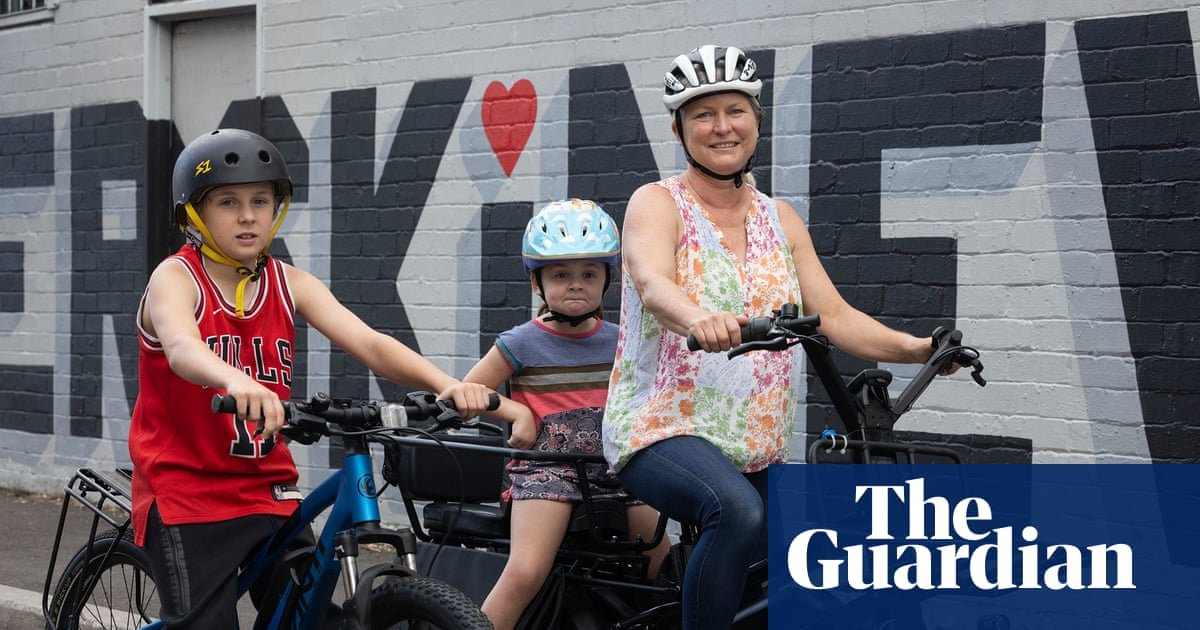
Inner-west resident Jacinta Peperkamp is among a growing cohort of people who are relying on their bike due to eye-watering fuel costs. “We haven’t used our car since fuel prices went crazy,” the single mother of two says.
With her cargo ebike and her 11-year-old son’s electric bike, they’ve been able to rely on mixed transport, taking their bikes on the train when travelling further afield.
‘I’m kicking myself for having not bought an electric car already,’ says Peperkamp. Photograph: Jessica Hromas/The Guardian
She says before the war in Iran, if it wasn’t a “direct easy bike ride, I wouldn’t have dreamed of doing it”. Now, they’ve been transiting as far as western Sydney on their bikes, and noticed others doing the same.
“The initial motivation [to get an ebike] was more environmental,” she says. “But now it’s definitely a cost-of-living thing. I’m kicking myself for having not bought an electric car already.”
New South Wales government data shows car traffic fell by around 5% in March compared with the previous year on major arterial roads in Sydney, including Pennant Hills Road and Parramatta Road.
The same month, the newly opened Oxford Street cycleway had almost 100,000 uses, according to Transport for NSW (TfNSW) figures, while the Bourke Street cycleway in Redfern had 134,254 – almost triple that of the same time last year (53,928).
Bike rides are constantly tallied by Sydney’s network of automatic counters, which were installed by councils and TfNSW.
Last Wednesday alone, more than 4,500 bike trips were recorded along Darlinghurst’s Oxford Street – the highest count since the new cycleway opened last July.
Longer term, figures provided by TfNSW show cycling rates almost doubled in the Sydney CBD last month compared with the same time last year (496,516 counts compared with 288,907) and rose in the adjacent suburbs of Paddington (26,065 compared with 17,215) and Eveleigh, where the count leapt from 15,011 to 71,151.
Other areas, including Parramatta in western Sydney, and the northern beaches, remained stable.
Table showing the most popular cycling paths in Sydney in March 2026. Illustration: Transport for NSW
‘Pulling the trigger’ and going electric
Bike retailers say much like during the start of the coronavirus pandemic, business has been booming.
At 99 Bikes, ebike sales surged by 136% year on year in the past week, indicating a “clear shift” in consumer mindsets, according to Australia and New Zealand’s general manager, David Miller-Heidke.
“We are seeing a significant sales uplift for commuter bikes, ebikes and escooters over the past few weeks, coinciding with the recent spike in fuel prices,” he says.
“Many people who were previously considering an ebike have now pulled the trigger, viewing it as a long-term cost-of-living fix.”
The owner and manager of bike shop Omafiets in Sydney, Chris Moore, says his customers have also been flocking to entry-level ebikes and cargo bikes, alongside an uptick in people dusting off their old pedal bikes to be serviced.
double quotation markHigh petrol prices are a nudge for people to reconsider how much they need to be driving, especially in the dense inner-Sydney suburbsChris Moore
He says Sydneysiders have been coming into his store who’ve “explicitly said that high petrol prices are the reason they’re purchasing a bicycle or ebike”.
According to Australian Automobile Association (AAA) data, in the last quarter of 2025, the average Australian household spent about $453 per week on car-running costs, including loan repayments ($214) and fuel ($94).
First-quarter 2026 figures haven’t been released, but since then, unleaded petrol prices have peaked from about 170c per litre last year close to 260c per litre in April – an almost 50% increase.
“There’s been a lot of interest in family ebikes and commuting bikes, which for many people can replace many of the car trips in their everyday life,” Moore says.
“We’ve seen an increase in inquiries from people who haven’t ridden their bike for a while. High petrol prices are a nudge for people to reconsider how much they need to be driving, especially in the dense inner-Sydney suburbs.”
Peperkamp rides her bike through Erskineville in Sydney’s inner west with her children. Photograph: Jessica Hromas/The Guardian
Inner-west resident Violette Kirton is among them. She’s looking to sell her car and rely entirely on her bike due to cost-of-living pains.
Kirton bought her first home last year as interest rates were climbing, and says the jump in petrol prices “really put things into perspective”.
“What once felt manageable suddenly didn’t make as much sense,” she says. “Living and working in the inner west, I’ve started riding my bike more and realised I don’t need a car day to day.”
An opportunity for a green revolution?
Peter McLean, the CEO of Bicycle NSW, says it’s “a shame” governments are continuing to rely on short-term fuel excises to ease pressures rather than capitalising on the cycling boon by investing heavily in active transport.
“It’s cheaper – even to have a really high-quality expensive ebike – than it is to maintain a car,” he says.
“It’s not just the fuel costs, it’s the insurance costs, the servicing costs, the registration costs that have all gone up and compounded.
“But of course, you do need to be in an area that has really good access to safe infrastructure, particularly if you’re a beginner.”
McLean points to the success of the Oxford Street cycleway as indication that demand is there to expand cycling “greenways” in our cities.
“Some of the commentators and politicians have all jumped to: ‘You need to cut road taxes and fuel excises’, which I agree with, but no one said you should double down on ebike subsidies,” he says.
McLean described the Albanese government’s halving of the fuel excise as a “sugar hit” that did not achieve better public health, community and social outcomes in the same way that cycling did.
“Governments need to know in times of crisis that they can pull other levers to make a long-term positive impact.”
