

If you want to build functional strength, add these bodyweight exercises to your routine.
Never underestimate the power of your own body weight when it comes to building strength. Many fitness enthusiasts believe that the only road to building significant muscle and strength is through weightlifting. While weights are a popular and successful modality, bodyweight movements are quite productive as well, and they can be done anywhere and anytime—without equipment.
Bodyweight movements involve using your own body weight to build resistance and challenge your muscles. These moves can include everything from planks to squats to pushups to lunges—and so much more. They are frequently considered even more effective than dumbbell workouts when it comes to building functional strength, because you’re supporting your own body—and not an object (in this case, the dumbbells).
We spoke with Josh York, Founder and CEO of GYMGUYZ, the world’s largest in-home and on-site personal training company, who shares five bodyweight moves that build strength faster than dumbbells after 60. With years of personal training experience under his belt, York spearheads a nationwide network that delivers personalized fitness programs to all ages, including many adults 50+ with a focus on boosting mobility, strength, and long-term function.
Why Strength Tends To Decline After 60
Shutterstock
Strength naturally declines with age due to shifts in hormones and physical activity levels. Your body doesn’t produce as many proteins in order to maintain muscle mass. This decline in strength can make performing daily tasks like carrying grocery bags, climbing stairs, or getting up from a seated position much more challenging—and sometimes, even painful, York says.
“Weakness in the core, upper back, and hips can also reduce balance and mobility, increasing risks of falls and making it harder to maintain independence,” he adds.
What Makes Bodyweight Exercises a Solid Option for Older Adults?
Shutterstock
Bodyweight workouts allow those 60 and up to move in a natural and safe way through functional exercise that channels real-life activities.
“They engage multiple muscle groups at once, improve balance, posture, and coordinate. They strengthen the hips, core and shoulders, which are all critical for daily activities,” York tells us. “Unlike dumbbells, these exercises train the body in motion, helping people develop strength that carries over to everyday tasks.”
5 Bodyweight Exercises for Building Strength After 60
Below, York breaks down five bodyweight moves that can help you build strength and functional fitness as you age.
Dead Bugs
“Dead Bugs strengthen your deep core muscles to improve posture and spinal health,” York says.
- Lie face-up on a yoga mat with your arms extended toward the sky and knees lifted and bent to 90 degrees.
- Keep your lower back pressed into the ground as you gradually lower your left arm and extend your right leg.
- Return to the center.
- Then, lower your right arm and left leg.
- Continue to alternate.
Glute Bridges
“Glute Bridges strengthen glutes and hamstrings while supporting the lower back,” York notes.
- Lie flat on your back with bent knees and feet hip-width apart, arms at your sides with palms pressing into the mattress.
- Press through your heels to lift your hips until your body forms a straight line from head to heels.
- Squeeze your buttocks, holding at the top for 2 seconds.
- Lower your hips back to the start position.
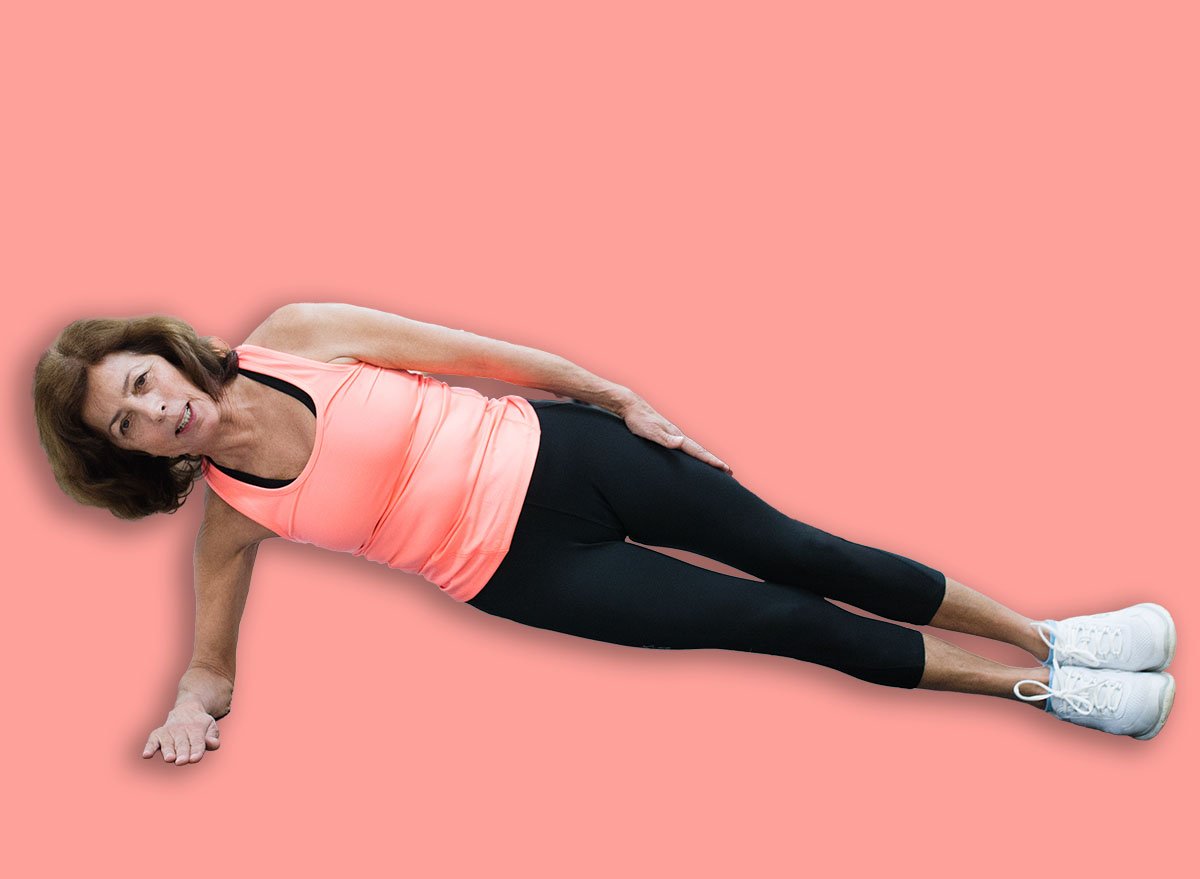
Side Plank
“Side planks engage the obliques and improve core stability,” York says.
- Begin by lying on your side and placing your elbow below your shoulder.
- Your feet should be stacked.
- Lift your hips off the floor so that your body forms a straight line from your head to your feet.
- Hold for the prescribed amount of time.
Bird Dogs
“Bird dogs improve core strength, balance, and posture,” York says.
- Start on all fours.
- Extend your left arm and right leg.
- Hold for a moment before returning to the start position.
- Switch sides and continue to alternate.
Standing Y-T-Ws
“Standing Y-T-Ws build strength in the upper back and shoulders,” York points out.
- Begin by standing tall with your feet hip-distance apart.
- Lift your arms overhead to form a “Y.”
- Lower, then lift them straight out to your sides to form a “T.”
- Lower once again, then bend your elbows to 90 degrees and lift to shoulder level to form a “W.”
- Squeeze your shoulder blades together throughout.
Alexa Mellardo
Alexa is a freelance writer, editor, and content strategist based in Greenwich, CT. She has 11+ years of experience covering wellness, fitness, food, travel, lifestyle, and home. Read more about Alexa
