

Try these tonight — your back will thank you tomorrow
It’s no secret that back pain and discomfort become more common after 60. But weakness, not age itself, is often the underlying cause. Research has found that declines in trunk muscle endurance and hip strength are associated with chronic lower back pain in older adults.
While formal physical therapy can be effective when prescribed appropriately, many people may also benefit from consistent, low-load strengthening that strengthens underused stabilizing muscles without aggravating the joints. According to one study, exercises targeting motor control and deep trunk activation can reduce pain and boost functional performance in older adults with chronic low back discomfort.
But with all the conflicting info online, where do you start? Fortunately, ETNT is here to help. We chatted with James Brady, personal trainer at OriGym, who shares his five best bed exercise designed specifically to restore back strength better than physical therapy after 60.
“When performing in a controlled environment like a bed, exercises reduce compressive load on the spine while reinforcing coordination between the hips and core,” Brady explains. “This approach prioritizes endurance and control over intensity.”
Read on for the exercises and detailed step-by-step instructions. Then, when you’re done, be sure to check out these 5 Exercises That Restore Walking Endurance After 65, According to a Trainer.
Pelvic Tilts
Pelvic tilts retrain awareness and control of your lumbar spine, which often weakens with age or after prolonged sitting. By gently rocking the pelvis, you activate the deep core and spinal stabilizers without strain.
How to do it:
- Lie on your back with your knees bent and your feet flat on the bed.
- Place your arms comfortably at your sides.
- Relax your upper body and shoulders.
- Gently tighten your abdominal muscles.
- Flatten your lower back into the bed by tilting your pelvis backward.
- Hold for two to three seconds.
- Slowly release and return to the starting position.
- Perform two to three sets of 10 to 15 reps, resting for 30 to 45 seconds between sets.
Glute Bridges
Glute bridges build strength through your hips, which directly support your lower back. Strong glutes reduce strain on the lumbar spine during walking and standing.
How to do it:
- Lie on your back with your knees bent and your feet hip-width apart.
- Position your heels directly under your knees.
- Brace your core to stabilize your spine.
- Press through your heels and lift your hips toward the ceiling.
- Keep your ribs down and avoid arching your back.
- Squeeze your glutes at the top for one to two seconds.
- Lower slowly with control.
- Complete two to three sets of 10 to 15 reps. Rest for 45 to 60 seconds between sets.
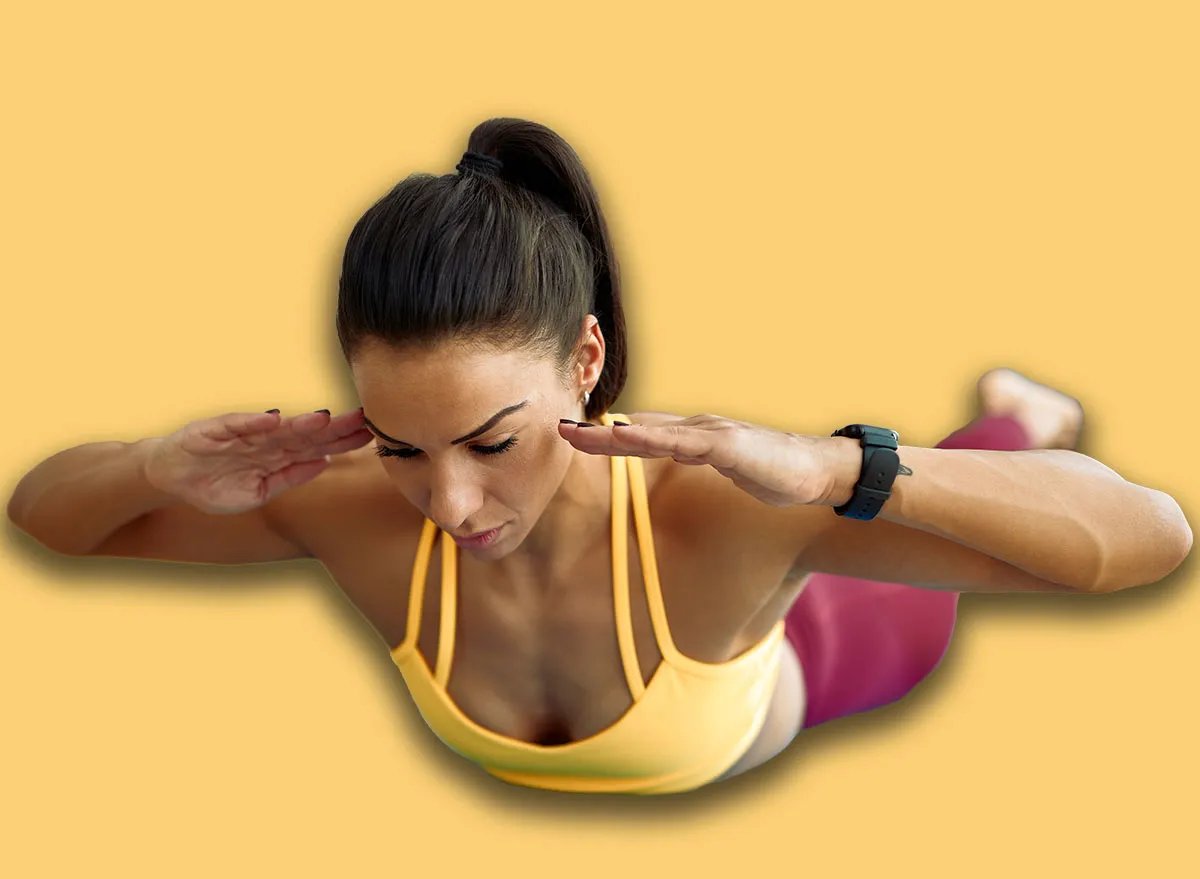
Prone Back Extension Hold
The prone back extension hold activates your spinal extensor muscles that help improve posture. The lift should be small and controlled, focusing on length rather than height.
How to do it:
- Lie face down on the bed.
- Place your arms by your sides.
- Keep your neck in a neutral position.
- Engage your glutes.
- Lift your chest slightly off the bed.
- Focus on lengthening through the spine.
- Hold for five to ten seconds.
- Lower back down slowly with control.
- Perform two to three sets of 5 to 8 holds, resting for 30 to 45 seconds between sets.
Dead Bug
This classic ab exercise builds coordination between your core and back muscles. Alternating opposite arm and leg movements while maintaining spinal stability trains the body to resist unwanted movement. Plus, the anti-extension control aspect help protect your spine during everyday tasks like lifting objects or carrying groceries.
How to do it:
- Lie on your back with your arms extended toward the ceiling.
- Bend your hips and knees to 90 degrees.
- Press your lower back into the bed.
- Slowly extend your right arm overhead.
- At the same time, extend your left leg toward the bed.
- Keep your lower back stable and your ribs down.
- Return to the starting position.
- Complete two to three sets of 8 to 12 reps per side. Rest for 30 to 45 seconds between sets.
Side-Lying Hip Abduction Hold
Side-lying hip abduction strengthens your lateral hip muscles, which are essential for spinal stability. Weak hip stabilizers also increase strain on your lower back during walking and standing.
How to do it:
- Lie on your side with your legs stacked.
- Keep your hips aligned and your core tight.
- Rest your head comfortably on your arm.
- Lift your top leg slightly upward.
- Keep your toes facing forward.
- Avoid rolling your pelvis backward.
- Hold the position for five to ten seconds.
- Lower slowly and repeat before switching sides.
- Perform two to three sets of 8 to 10 holds per side. Rest for 30 to 45 seconds between sets.
Adam Meyer, RHN
Adam is a health writer, certified holistic nutritionist, and 100% plant-based athlete. Read more about Adam
