

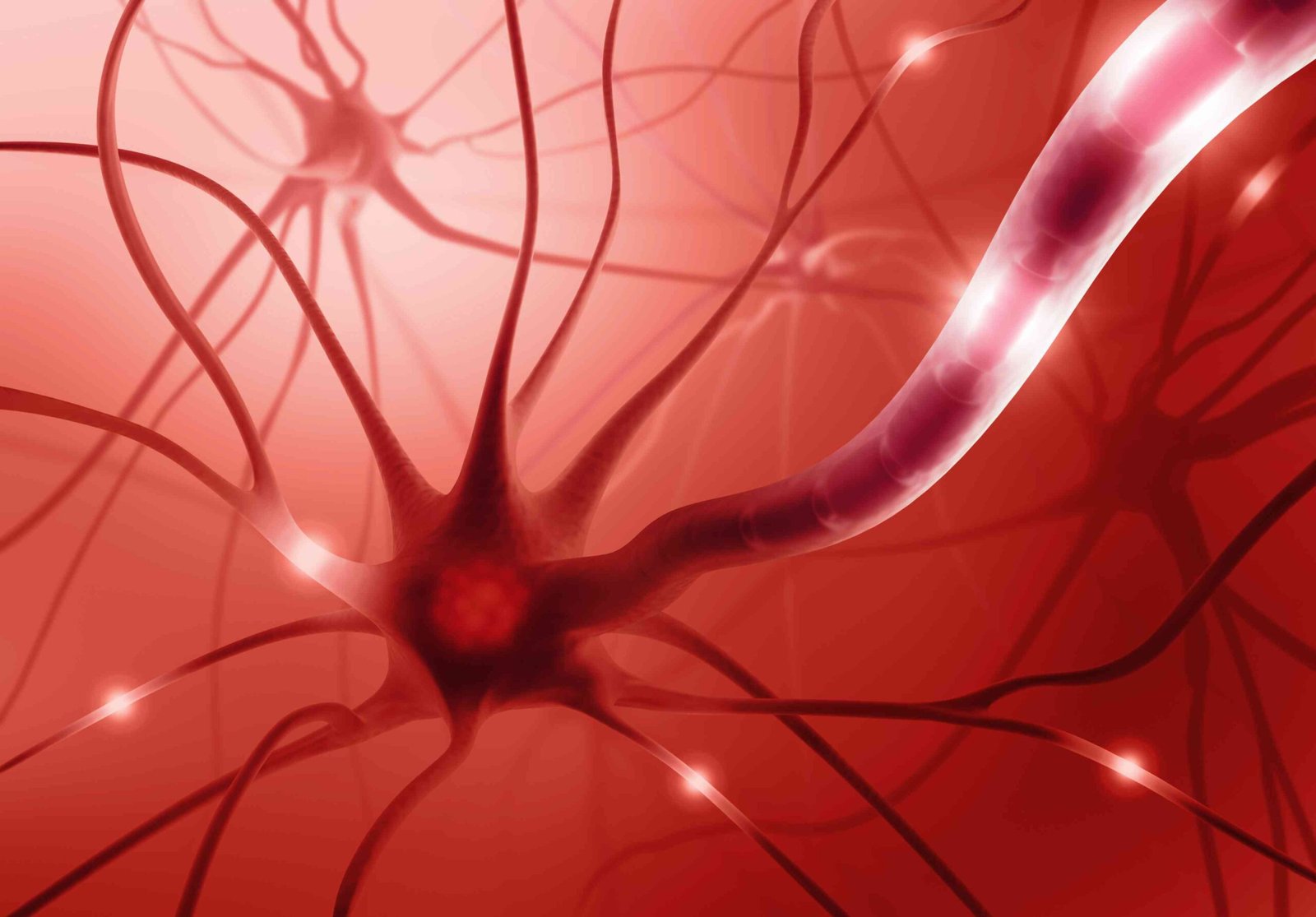
Neurons (aka nerve cells) are responsible for communication in the brain and body. They receive stimuli, communicate it to the brain, and transmit signals from the brain to the rest of the body. When a neuron “fires,” it transmits a signal down the length of the axon to trigger the release of chemicals at the end of the neuron that then trigger a reaction in the connecting cell. Whether this process happens (or not) hinges on the all-or-none law.
The all-or-none law states that the strength of a nerve cell or muscle fiber’s response is not dependent upon the strength of the stimulus. A nerve or muscle fiber will fire if a stimulus is above a certain threshold.
According to the all-or-none law, an individual neuron or muscle fiber will either respond fully or not at all.
How Does the All-or-None Law Work?
If a stimulus is strong enough, an action potential occurs and a neuron sends information down an axon away from the cell body and toward the synapse. Changes in cell polarization result in the signal being propagated down the length of the axon.
The action potential is always a full response. There is no such thing as a “strong” or “weak” action potential. Instead, it is an all-or-nothing process. Why? By always triggering a full response, it minimizes the possibility of information being lost along the way.
This process is similar to the action of pressing the trigger of a gun. A very slight pressure on the trigger will not be sufficient and the gun will not fire. When adequate pressure is applied to the trigger, however, it will fire.
The speed and force of the bullet are not affected by how hard you pull the trigger. The gun either fires or it does not. In this analogy, the stimulus represents the force applied to the trigger while the firing of the gun represents the action potential.
How the Signal Triggers an Action Potential
In its normal resting state, the inside of a neuron is around -70 millivolts. When activated by the stimulus, the membrane depolarizes, causing ion channels to open. As a result, sodium ions enter the action and change the polarization of the axon.
Once the cell depolarizes to the required threshold, the action potential will fire. As the all-or-nothing law states, this action is not graded—it either happens, or it doesn’t.
A stimulus might cause sodium to enter the cell, but too few ions might enter the cell. This means that the cell won’t reach the required threshold and it will not fire.
Determining Stimulus Strength
The body still needs to determine the strength or intensity of a stimulus. For example, it’s important to know how hot a cup of coffee is as you take an initial sip or how firmly someone is shaking your hand.
To gauge stimulus intensity, the nervous system relies on two sources of information:
- The rate at which a neuron fires: A neuron firing at a faster rate indicates a stronger intensity stimulus.
- How many neurons fire at any given time: Numerous neurons firing simultaneously or in rapid succession would also indicate a stronger stimulus.
If you take a sip of your coffee and it is very hot, the sensory neurons in your mouth will respond rapidly. A very firm handshake from a co-worker might result in both rapid neural firing and a response from many sensory neurons in your hand. In both cases, the rate and number of neurons firing provide valuable information about the intensity of the original stimulus.
According to the rate law, the more intense a stimulus is, the faster the neuron will fire. In other words, a strong stimulus will cause the neuron to fire much faster than a weak one.
The rate at which a neuron can fire is determined by its absolute refractory period, which is the period of time after a cell fires, during which it cannot generate another action potential regardless of the stimulus’s intensity.
Examples of the All-or-None Response
Some examples of the all-or-none response can be seen in different sensory and perceptual situations. For example:
- Touching a hot pan
- Smelling a delicious scent
- Feeling the coldness of a glass of water
- Detecting the sweetness piece of candy
In each case, sensory information is transmitted via the action potentials that carry the signal to the brain. Once the threshold has been reached to trigger an electrical impulse, the nerve fires and transmits the sensory information. That is an example of the all-or-nothing law in action.
It is the speed and frequency that the nerve fires that provide information to the brain about the intensity of the stimulus.
So touching a hot pan, for example, would result in the rapid firing of a nerve impulse that would result in an immediate response.
Discovery of the All-or-None Law
The all-or-none law was first described in 1871 by physiologist Henry Pickering Bowditch. In his descriptions of the contraction of the heart muscle, he explained, “An induction shock produces a contraction or fails to do so according to its strength; if it does so at all, it produces the greatest contraction that can be produced by any strength of stimulus in the condition of the muscle at the time.”
While the all-or-none law was initially applied to the muscles of the heart, it was later found that neurons and other muscles also respond to stimuli according to this principle.
Takeaways
The all-or-nothing law is an important principle that describes how nerve cells either fire at full strength or do not. Because of this, important information does not lose strength as it is carried to the brain, ensuring that people are able to respond to environmental stimuli.
Verywell Mind uses only high-quality sources, including peer-reviewed studies, to support the facts within our articles. Read our editorial process to learn more about how we fact-check and keep our content accurate, reliable, and trustworthy.
American Psychological Association. All-or-none law.
Prieto N, Wrobleski J. Action potentials. In: Vonk J, Shackelford T, eds. Encyclopedia of Animal Cognition and Behavior. Springer International Publishing; 2017:1-5. doi:10.1007/978-3-319-47829-6_1268-1
Shao S, Meister M, Gjorgjieva J. Efficient population coding of sensory stimuli. Phys Rev Research. 2023;5(4):043205. doi:10.1103/PhysRevResearch.5.043205
American Psychological Association. Refractory period.
Leivaditis V, Mulita F, Dahm M, et al. History of the development of isolated heart perfusion experimental model and its pioneering role in understanding heart physiology. Arch Med Sci Atheroscler Dis. 2024;9:e109-e121. doi:10.5114/amsad/188270
Chakravarthy VS. Demystifying the Brain: A Computational Approach. 1st ed. 2019. Springer Singapore : Imprint: Springer; 2019.
Thanks for your feedback!
What is your feedback?
Helpful
Report an Error
Other
