

Feel unsteady after 60? These 5 moves help you build balance and control
Balance takes more than steady feet. Your ankles, hips, core, shoulders, and eyes all help keep you upright and in control. After 60, balance can start to feel less reliable when strength dips or your body gets fewer chances to practice shifting weight in different positions.
Resistance bands can help build strength, but balance needs practice under your own bodyweight. You need standing positions, single-leg support, full-body bracing, and smooth transitions between positions. That’s why lunges, step-ups, planks, and side planks work so well. They challenge balance from the ground up while forcing your body to stay organized as you move.
I’ve seen this play out often with clients. The people who improve balance faster usually train more than one piece at a time. They build lower-body strength, practice single-leg control, and learn to maintain steady posture when their arms or legs move. Real-life balance rarely happens in one clean, perfect position, so your training shouldn’t stay there either.
The five exercises below cover different types of stability. Walking lunges and step-ups build balance while you move. Single-leg holds strengthen your foot, ankle, and hip control. Plank shoulder taps challenge your core as your upper body moves. Side plank holds strengthen the side-body muscles that help keep you steady when your weight shifts.
Walking Lunges
Walking lunges train your quads, glutes, hamstrings, and core while your body works to stay balanced through each step. Every rep asks your front leg to control the landing and your midsection to keep your torso tall. This builds dynamic balance, which matters every time you walk, climb stairs, or recover your position after a misstep. Compared with band exercises, walking lunges give you a more realistic challenge because your body has to move and reset with every stride.
Muscles Trained: Glutes, quadriceps, hamstrings, calves, core
How to Do It:
- Stand tall with your feet together.
- Step forward with one leg into a lunge.
- Lower your back knee toward the floor with control.
- Push through your front foot to step forward.
- Repeat on the opposite leg.
- Continue alternating sides with steady control.
Recommended Sets and Reps: Perform 3 sets of 8 to 10 reps per leg. Rest for 45 seconds between each set.
Best Variations: Short-step walking lunges, reverse lunges, assisted walking lunges
Form Tip: Keep your torso tall and place each foot with control before lowering.
Single-Leg Balance
Single-leg balance trains your feet, ankles, calves, hips, and core to work together while you hold position. Standing on one leg forces your body to make constant small adjustments, which is exactly what keeps you steady during everyday movement. This exercise builds the foundation for better balance because your stance leg has to support you without relying on momentum or outside help. It carries over to walking, stepping off curbs, turning, and catching yourself when your weight shifts.
Muscles Trained: Foot stabilizers, calves, glutes, hip stabilizers, core
How to Do It:
- Stand tall with your feet hip-width apart.
- Shift your weight onto one foot.
- Lift your opposite foot a few inches off the floor.
- Brace your core and keep your hips level.
- Hold the position without leaning.
- Switch sides after each hold.
Recommended Sets and Reps: Perform 3 rounds of 20 to 30 seconds per leg. Rest for 30 seconds between rounds.
Best Variations: Eyes-closed holds, knee-lift holds, light fingertip support
Form Tip: Keep your weight centered over your standing foot.
Plank With Shoulder Taps
Plank shoulder taps train your core and shoulders while your body fights rotation. Each tap forces your midsection to brace harder so your hips don’t rock side to side. This builds trunk control, which matters for full-body balance because your core connects your upper and lower body. The payoff carries into bracing during daily tasks, catching yourself with your hands, and staying steady when one side of your body moves.
Muscles Trained: Core, shoulders, chest, triceps, glutes
How to Do It:
- Start in a high plank position with your hands under your shoulders.
- Set your feet slightly wider than hip-width.
- Brace your core and squeeze your glutes.
- Tap one hand to your opposite shoulder.
- Place your hand back on the floor with control.
- Alternate sides while keeping your hips steady.
Recommended Sets and Reps: Perform 3 sets of 8 to 12 taps per side. Rest for 45 seconds between each set.
Best Variations: Incline shoulder taps, slower shoulder taps, wider-stance shoulder taps
Form Tip: Move your hand slowly and keep your hips quiet.
Alternating Step-Ups
Alternating step-ups train your legs while building the control needed to move from one level to another. Each rep asks your lead leg to produce force while your hips and core keep your body aligned. This builds balance in a way bands can’t fully match because you’re stepping, loading one leg, and controlling your bodyweight at the same time. It carries over directly to stairs, curbs, trail walks, and any moment where you need to step up with confidence.
Muscles Trained: Quadriceps, glutes, hamstrings, calves, core
How to Do It:
- Stand facing a sturdy step or low box.
- Place one foot fully on the step.
- Press through your lead foot to stand tall.
- Step back down with control.
- Repeat with your opposite leg.
- Continue alternating sides.
Recommended Sets and Reps: Perform 3 sets of 8 to 10 reps per leg. Rest for 45 seconds between each set.
Best Variations: Lower step-ups, assisted step-ups, slow-lowering step-ups
Form Tip: Drive through your whole foot and avoid pushing off too much from the back leg.
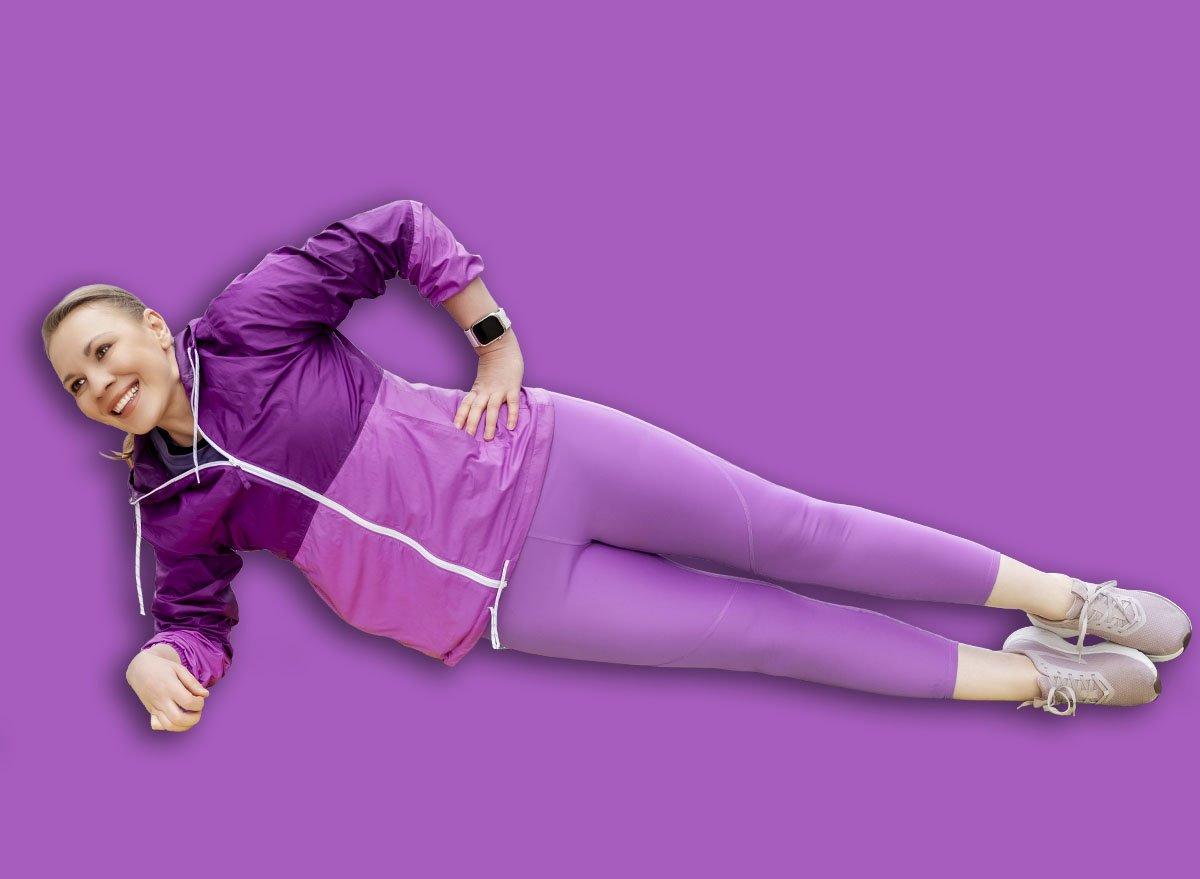
Side Plank Holds
Side plank holds train your obliques, hips, shoulders, and glutes while your body resists dropping or twisting. The muscles along your side help you stay steady when your weight shifts, making them a major part of full-body balance. This exercise strengthens lateral stability, an area many routines miss because most exercises move forward and back. Stronger side-body control helps with turning, carrying items on one side, walking on uneven ground, and staying upright when balance gets challenged.
Muscles Trained: Obliques, core, shoulders, glutes, outer hips
How to Do It:
- Lie on your side with your forearm under your shoulder.
- Stack your feet or stagger them for support.
- Brace your core and lift your hips off the floor.
- Keep your body in a straight line from head to heels.
- Hold the position while breathing steadily.
- Lower with control, then switch sides.
Recommended Sets and Reps: Perform 3 sets of 20 to 30 seconds per side. Rest for 30 seconds between each set.
Best Variations: Bent-knee side plank, staggered-feet side plank, side plank with top-leg lift
Form Tip: Press your forearm into the floor and keep your hips lifted.
How to Build Better Full-Body Balance After 60
Shutterstock
Better balance comes from repeated practice in positions that ask your body to stabilize. These exercises work because they train more than one muscle group at a time without making the routine complicated. Your legs build strength, your hips help control your position, and your core keeps everything connected. That gives you a stronger balance foundation than band work alone.
- Train balance while standing: Walking lunges, single-leg holds, and step-ups teach your body to control weight shifts while you’re on your feet. That’s where balance matters most during daily life.
- Strengthen your hips and core together: Your hips help control your legs while your core keeps your trunk steady. When those areas work well together, your body adjusts faster when balance gets challenged.
- Move slowly enough to stay in control: Speed can hide weak spots. Slower reps give your body time to organize each position and make cleaner corrections.
- Use support when needed: A wall, chair, or railing can help you build confidence without removing the challenge. Light support works best because your body still has to stabilize.
- Practice a few minutes daily: Balance improves through frequent exposure. Short daily sessions build confidence without wearing you down.
Stay consistent and keep your reps clean. You’ll feel the difference when walking, stepping, turning, and moving through your day with more confidence.
References
- Wang, Jixian et al. “Age-Related Dysfunction in Balance: A Comprehensive Review of Causes, Consequences, and Interventions.” Aging and disease vol. 16,2 714-737. 24 Jan. 2024, doi:10.14336/AD.2024.0124-1
- Zhong, Yuanji et al. “Effects of core training on balance performance in older adults: a systematic review and meta-analysis.” Frontiers in public health vol. 13 1661460. 9 Oct. 2025, doi:10.3389/fpubh.2025.1661460
