

A trainer with 40 years of experience says these 4 moves rebuild everything.
I’m a personal trainer and fitness educator at TRAINFITNESS and I’ve spent close to 40 years working with adults over 60 who want their strength back. The good news is that the body responds to training at any age. The bad news is that most people wait far too long before they do anything about it, and by the time they decide to act, simple things like getting off the sofa or carrying shopping have become genuinely hard. None of this needs to be permanent.
From around age 30, we lose roughly 1% of our muscle mass each year if we’re not actively training to keep it. By 60, that’s potentially 30% of the muscle a person had in their prime, and the loss in power (how quickly we can produce force) is closer to double that. People don’t notice it because the loss is gradual. They just start avoiding things. Stairs become something to take slowly. Heavy bags get split into two trips. Getting up from low chairs requires a hand on the armrest. These four exercises can help you rebuild that strength and start reversing the decline.
Why Strength Fades After 60
Shutterstock
The muscle loss I described above is just the starting point. Fear is the second challenge I see constantly. Many of the people I work with are nervous about hurting themselves. They’ve heard stories about friends putting their backs out or hurting a knee, and they assume that any kind of resistance training is going to be risky. The reality is the opposite. Not training is what makes the body fragile. Sensible, progressive loading is what makes it durable.
Then there’s joint stiffness and reduced range of motion. Hips, shoulders and ankles are usually the worst affected. People can’t squat to a normal depth, can’t reach overhead properly, and can’t get low without their heels lifting. This means that when they do try to exercise, half the movements feel awkward or painful, and they give up before they’ve given themselves a chance.
Coordination and balance decline together. The brain gets slower at firing the right muscles in the right order, and reactions to a wobble or stumble aren’t as quick as they used to be. This makes some people scared of training standing up, so they default to seated machines, which are useful but don’t address the real issue.
The last challenge, and probably the biggest, is consistency. Most people over 60 know they should be doing something. They start, they feel sore, life gets in the way, and three weeks later they’ve stopped. Strength is built over months and years, not days, and the people who get great results are the ones who simply keep showing up.
Why Functional Training Works Best
Shutterstock
Resistance training is the single most effective thing an older adult can do for their body. It’s the only type of exercise that directly reverses the muscle loss that’s been happening since your 30s. Walking is great for cardiovascular health, stretching helps with flexibility, but neither of these will rebuild the muscle you’ve lost. Only loading the muscles with resistance does that.
What makes functional training particularly useful for people over 60 is that it trains movement patterns rather than isolated muscles. When you do a squat, you’re not just working your legs. You’re training your body to stand up from a chair. When you do a hinge, you’re training your body to pick something up safely. These patterns translate directly into daily life, which means the strength you build actually shows up where you need it.
There’s also the bone density side, which becomes increasingly important after 60. When you load a bone with weight or resistance, the bone responds by becoming denser. This is hugely protective against osteoporosis and fractures, and it’s something that no amount of walking will achieve to the same degree.
The nervous system response is just as important as the muscle response. Within the first few weeks of training, the brain gets much better at activating the muscles you already have. This is why people often see noticeable strength gains very quickly, before any visible muscle change has happened. Your body is essentially relearning how to use itself properly.
Functional resistance training also addresses balance and coordination at the same time as strength, because most of the exercises require you to stabilise yourself rather than rely on a machine to hold you in place. This is a much better preparation for real life, where nothing holds you steady when you bend, lift, twist or carry.
Sit-to-Stand (Bodyweight Squat)
This is the single most useful exercise for people over 60. It builds quad, glute and core strength, it directly mirrors getting in and out of a chair, the toilet, the car and the bath, and it’s accessible to almost anyone. Loss of the ability to stand up unassisted is one of the strongest predictors of loss of independence, and this exercise prevents that decline.
Muscles Trained: Quads, glutes, core
How to Do It:
- Sit on a sturdy chair with your feet flat on the floor, roughly hip width apart, and toes pointing slightly outwards.
- Lean your chest forward slightly so your weight shifts over your feet.
- Push through your whole foot (not just your toes) and stand all the way up, squeezing your glutes at the top.
- Lower yourself back down slowly, taking around three seconds, controlling the descent rather than dropping into the chair.
Common Mistakes to Avoid:
- Pushing up with the toes and letting the knees collapse inwards. The power needs to come from the heels and mid-foot, with the knees tracking out over the second and third toes.
- Dropping back into the chair instead of lowering with control. The lowering phase is where most of the strength is built, so don’t rush it.
Recommended Sets and Reps: 2 to 3 sets of 8 to 12 repetitions.
Form Tip: The lowering phase is where most of the strength is built. Take a full three seconds on the way down.
Wall or Counter Push-Up
Upper body pushing strength is what gets you off the floor if you fall, helps you push a heavy door open, and supports you when you stand up from the bath. Most people over 60 have very little chest, shoulder and tricep strength because they’ve not loaded these muscles in decades. Wall or counter push-ups build this safely without any risk of falling onto the floor, and they can be progressed simply by using a lower surface.
Muscles Trained: Chest, shoulders, triceps, core
How to Do It:
- Stand facing a sturdy wall or kitchen counter, around an arm’s length away.
- Place your hands flat on the surface, slightly wider than your shoulders, at chest height.
- Keep your body in one straight line from your head to your heels, with your core tight and glutes squeezed.
- Bend your elbows and lower your chest towards the surface, keeping your elbows at roughly a 45 degree angle from your body.
- Push back to the start position with control.
Common Mistakes to Avoid:
- Letting the hips sag or stick up in the air. The body needs to stay in one straight line throughout.
- Flaring the elbows out to 90 degrees, which puts a lot of stress on the shoulders. Keep the elbows tucked in closer to the body.
Recommended Sets and Reps: 2 to 3 sets of 8 to 12 repetitions. Once 12 reps feels easy, progress to a lower surface like a kitchen counter, then a sturdy table.
Form Tip: Keep the elbows at roughly 45 degrees from your body to protect the shoulders.
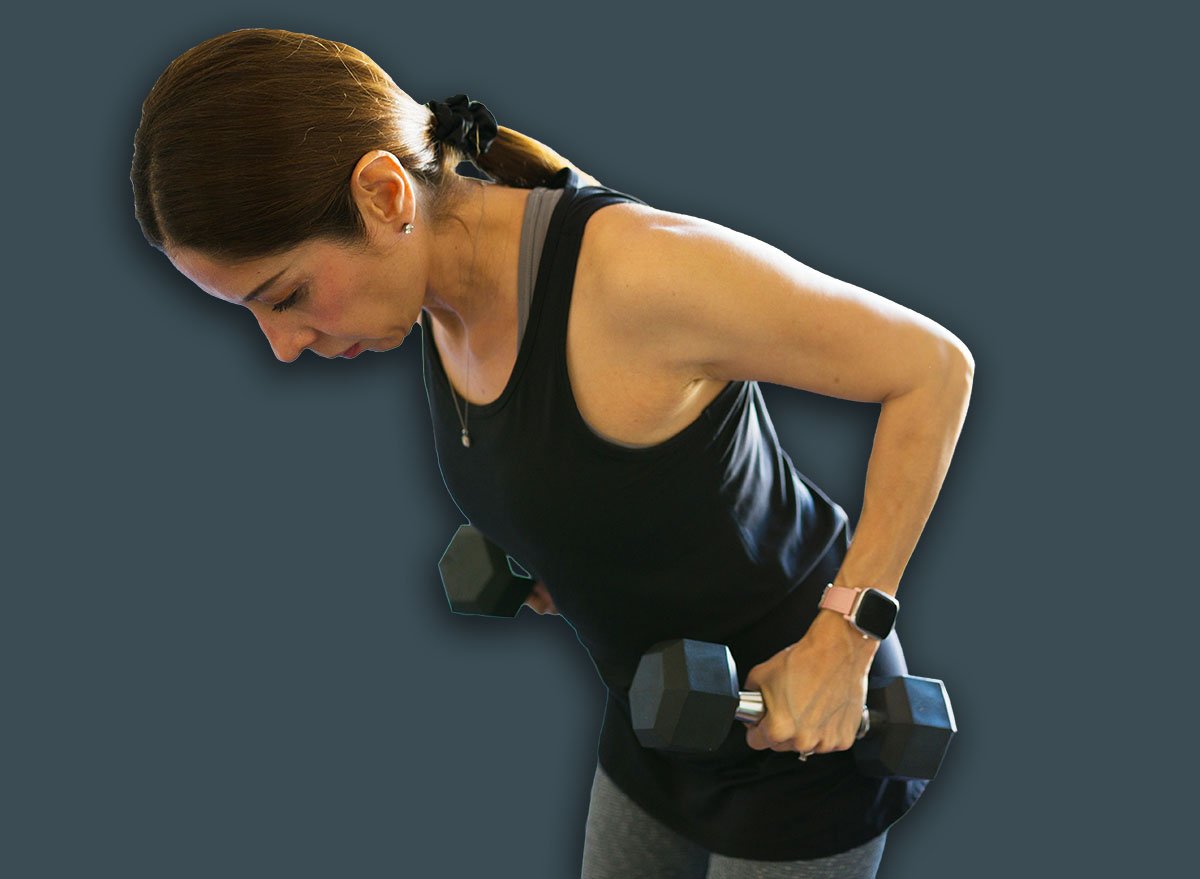
Hip Hinge to Bent-Over Row
This works two of the most neglected areas at once. The hip hinge trains the glutes, hamstrings and lower back, which are the muscles you use every time you bend down to pick something up. The row trains the upper back muscles, which counter the rounded posture most people develop from years of sitting and looking at phones and screens. Strong upper back muscles also reduce neck and shoulder pain and make it much easier to stand tall.
Muscles Trained: Glutes, hamstrings, lower back, upper back (rhomboids, lats, rear delts)
How to Do It:
- Hold a light weight in each hand. A pair of small dumbbells works well, but two filled water bottles or shopping bags are perfectly fine to start with.
- Stand with your feet hip width apart, knees softly bent (not locked, not deeply bent).
- Push your hips backwards as if you were closing a car door with your bottom, allowing your chest to lower towards the floor while keeping your back flat.
- Lower until your chest is somewhere between parallel to the floor and a 45 degree angle, depending on your flexibility.
- From this position, pull the weights up towards your ribcage, squeezing your shoulder blades together.
- Lower the weights back down with control, then push your hips forward to return to standing.
Common Mistakes to Avoid:
- Rounding the lower back. The hinge has to come from the hips, not the spine. If you can’t hinge with a flat back, you’ve gone too low.
- Shrugging the shoulders up to the ears during the row instead of squeezing the shoulder blades down and back. Keep the shoulders away from the ears throughout.
Recommended Sets and Reps: 2 to 3 sets of 8 to 10 repetitions.
Form Tip: Think about closing a car door with your bottom. That image keeps the hinge in the hips where it belongs.
Step-Up
Step-ups build single-leg strength, which is what you actually use when walking, climbing stairs and getting in and out of the bath. Both legs work independently, so any imbalance between sides gets corrected (most older adults have one leg noticeably stronger than the other). Step-ups also challenge balance in a controlled way, which helps reduce fall risk.
Muscles Trained: Quads, glutes, hamstrings, calves, core (plus balance and coordination)
How to Do It:
- Stand in front of a sturdy step or low bench. Start with something around 15 to 20 centimetres high. The bottom step of a staircase works well.
- Place your whole right foot flat on the step.
- Push through your right heel to stand all the way up onto the step, bringing your left foot up to meet it.
- Step back down with the left foot first, then the right, controlling the descent.
- Repeat for the prescribed reps, then switch the leading leg.
- Hold a wall or banister for support if needed.
Common Mistakes to Avoid:
- Pushing off with the back foot. The leg on the step is meant to do all the work. If you’re using your trailing foot to bounce yourself up, you’re missing the entire point of the exercise. Concentrate on driving through the heel of the leading leg.
- Choosing too high a step too soon, which forces the body to compensate. Build up the height gradually.
Recommended Sets and Reps: 2 to 3 sets of 8 to 10 repetitions per leg.
Form Tip: Make the leg on the step do all the work. If you feel your back foot pushing off, the step is too high.
Your Weekly Routine
Shutterstock
For most people new to training (or coming back to it after a long break), three sessions per week works really well. This gives the body enough stimulus to build strength while allowing a full day of recovery between sessions. Recovery is when the muscle actually adapts and grows stronger, so this rest is doing real work.
A typical week might look like this:
- Monday: All four exercises, 2 sets of each.
- Wednesday: All four exercises, 2 sets of each.
- Friday: All four exercises, 2 sets of each.
- Tuesday, Thursday, Saturday, Sunday: Walking, gentle mobility, or complete rest.
Each session should take around 25 to 35 minutes, including a few minutes of gentle warm-up at the start (marching on the spot, arm circles, a few practice reps with no weight). After the first 2 to 3 weeks, when 2 sets of each exercise feels manageable, add a third set. After 4 to 6 weeks, start to look at progressing the exercises themselves: a lower chair for the sit-to-stand, a lower surface for the push-up, slightly heavier weights for the row, a slightly higher step for the step-up.
The single most important rule is consistency. Three sessions a week, every week, will produce far better results than five sessions one week followed by nothing for a fortnight. Pick days that fit into your life and protect them.
What Results to Expect in 4 to 6 Weeks
Shutterstock
The first changes happen very quickly, but they’re not the ones most people are watching for. Within the first 1 to 2 weeks, you’ll notice that the exercises themselves feel easier. The reps you struggled with on day one will start to feel manageable. This is your nervous system getting better at activating the muscles you already have, before any real muscle change has happened. It’s a good sign that the body is responding.
By the end of week two, daily movements start to feel different. Standing up from a chair takes less effort. The first few stairs in the morning don’t feel as stiff. Carrying a bag of shopping doesn’t leave your arm aching. These are small changes but they build confidence quickly.
By weeks three and four, you’ll notice that you can do more reps with less effort, or move on to harder versions of the exercises. Your balance will feel more solid when you’re standing on one leg. Reaching for things on high shelves will feel less precarious. Bending down to tie a shoe or pick something off the floor won’t fill you with the same sense of dread.
By week five or six, you’ll begin to notice some of the visible changes. Your legs are feeling firmer to the touch. You stand up straighter, without even having to focus on it. Your clothes probably fit a little bit better through the shoulders, the legs, and even the chest. Your friends and family might even comment on how well you look, even if they can’t quite put their finger on the exact reason why.
Something you can’t expect in 4 to 6 weeks is a big change in body shape and/or significant fat loss. That’s driven much more by nutrition than by your exercise and visible changes in body composition typically take much longer to achieve. Instead, what you will see is a stronger, more capable body that can handle the daily tasks you actually have to do better than it did before, which is the most important goal to achieve after age 60.
