

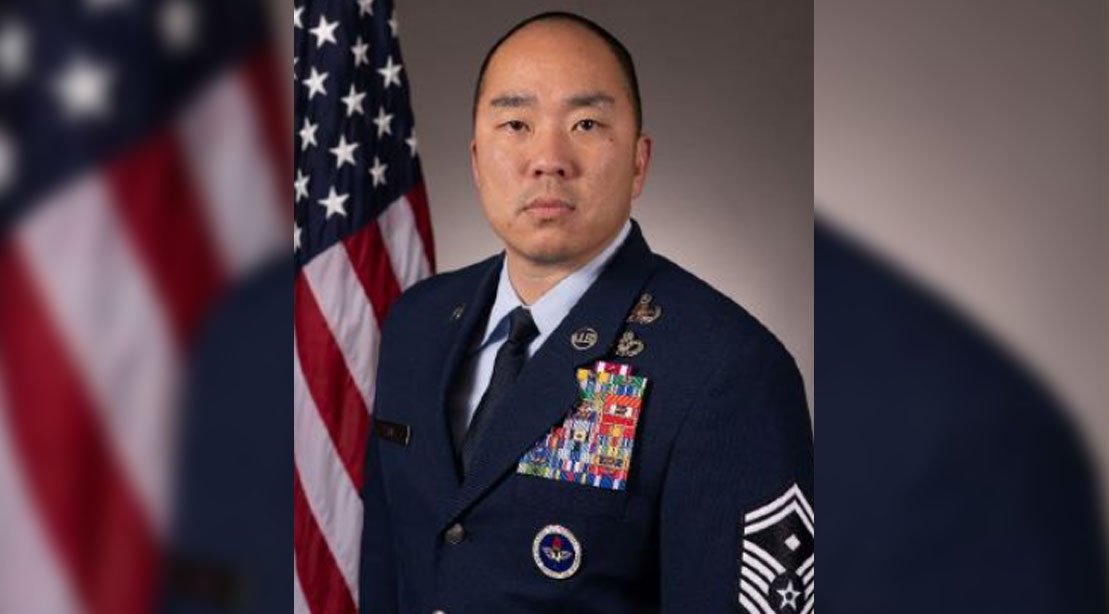
The American public has seen videos of those that have worn the nation’s uniform executing missions on the battlefield with surgical precision. These heroes make the impossible look routine, but what they won’t tell you is that the most intense battles they have been in are those that aren’t captured on camera or seen by the naked eye.
Air Force Senior Master Sergeant Aaron Lin has navigated both versions of the battlefield, and he acknowledges that the mental struggles are unique and could longer than the physical conflicts but confirms that coming out of the other side fortified him for his service, those he serves with, and himself.
“I have learned that I am not a quitter. I will not quit or let my team down.”
Who Is Air Force Veteran Aaron Lin?
Like many servicemembers of his generation, Lin was compelled to serve following the events of September 11, 2001. He went to a Marines Corps recruiting office originally, but after finding out the Air Force also had an Explosive Ordnance Disposal (EOD) program, he joined that branch instead.
“I really wanted to be in the mix. I wanted to be an entity that was a force multiplier on the battlefield. So, I was looking at medic or EOD.”
His first deployment was in Iraq, where he was part of a unit that helped clean out a neighborhood from explosives. To this day, he vividly recalls a moment that made him proud of wearing the uniform and doing the work he did.
“An Iraqi grandfather shook my hand and said, ’thanks for making my neighborhood safe for my grandchildren.’ I thought to myself, ‘I could do this job for the rest of my life.’”
From the Battlefield to Personal Battle: Aaron Lin’s PTSD Journey
A later deployment to Afghanistan in March 2010 would be the one that changed his life and career forever. While his team was disarming improvised explosive devices (IEDs) on foot, a powerful explosion occurred within their patrol. He survived, but two of his closest friends and fellow service members did not.
The combination of them being killed and his own survivor’s guilt altered Lin’s mental state. Combat-related Post-Traumatic Stress Disorder was just the beginning. Heroes in service are seen as noble and independent. They are the ones to provide help, not ask for it. This was especially true in Lin’s role. If he is called, that means he is a part of the last line of defense. So, while he was never directly told that he couldn’t get help, he internally believed there was no one he could turn to.
“That was when I lost a lot of my confidence. I lost my ability to even make simple decisions, and I felt like I was a liability,” Lin admitted. “I was really close to ending it.”
Nonetheless, Lin carried on and even returned to Afghanistan on another deployment. Following that, he became an EOD instructor and tried to seek mental help. Strategies that were tried didn’t work for him, which led him to diving even deeper into more work, pushing himself to stay focused on things outside of himself.
The Air Force Wounded Warrior Program That Changed His Life
After a friend talked him into entering a six-week outpatient program, he also found out about the Air Force Wounded Warrior (AFW2) program, which is a congressionally mandated, federally funded program designed to provide personalized care and advocacy for Airmen dealing with injuries or issues during service. They provide many forms of support to the members they serve, including checking on medical boards, signing them up for services and courses, and even sports. Lin had continued to train throughout his struggles, but he credits AFW2 because it provided a new purpose.
“It gave me a place and a reason to start competing and getting that camaraderie with people that had been through the same things I had.”
Lin competed in multiple sports such as wheelchair rugby, wheelchair basketball, and sitting volleyball. He was a part of teams that went on to compete in the Warrior Games, highlighted by winning a gold medal in wheelchair basketball in 2024. He also took part in powerlifting, archery, shooting, and indoor rowing. Lin shared that being able to channel his anxiety into competiition was a literal and figurative game changer.
“Sports and fitness elevated my recovery to a place where I never thought possible. When you’re on a team trying to win gold, it’s a really great feeling.”
Aaron Lin
How Fitness Became a Lifeline for Mental Health Recovery
Lin kept improving, training, and devoting himself to getting better and being available to his teammates. This new outlet played a positive impact on his physical and mental health, and he even saw changes and recognition that he didn’t even count on. Lin was awarded the title of 2024 Air Force Male Athlete of the Year, an honor he wasn’t aware of before he was nominated for it.
“I was completely blown away,” Lin said humbly. “I didn’t think something like this could ever happen to me.”
Lin now has fingers crossed that he will be a part of the Invictus Games in the future. He also serves as an ambassador for AFW2, sharing the services they offer and how the program has
helped him. He gives the program significant credit for helping him “get back in the fight” as he returned to his career. He also credits training and working out for not only helping him come out of the “hole” he was in but staying above ground today.
“I need to be able to work out every day in order to function correctly,” he stated. “It really is a part of my recovery.”
Adaptive Sports Helped a Veteran Rebuild Strength and Confidence
Fitness is a non-negotiable for service, but it is also paramount for mental health, especially when faced with the levels of adversity Lin has. By leaning in on improving his body and skills, he has been able to heal himself and turn tragedy he had no control over into a personal triumph that he could.
Lin found options and resources that helped him get back to where he needed to be, which he credits the people that provided those services for. What he has done for others is larger than he may realize. For the Airmen, Guardians, Coast Guardsmen, Sailors, Marines, and soldiers that are navigating their own darkness, Lin’s successful return to service is a guiding light, a North Star that validates that there are more missions ahead, and they are capable of performing them.
“Before I was in the Air Force Wounded Warrior program, I was really stuck. I didn’t think I was going to be able to get out of the hole I was in mentally and emotionally. For me to have the kind of turnaround because of AFW2 and adaptive sports and all the things that came with it, it completely changed my life.”
He concluded, “Do whatever you can to get back up, dust yourself up, and keep going.”
Aaron Lin
Aaron Lin’s Fitness Advice for Athletes and Veterans
1. Take Rest Days
Lin loved training but didn’t like to stop. Unfortunately, his lack of recovery time affected his performance when it counted. He now says recovery is non-negotiable.
“The gym is my church, but you got to take rest days.”
2. Positive Self-Talk
Lin found it easy to talk down to himself when it counted, and his coaches noticed. After being told he needed to “fix himself,” Lin now advises others to be their own cheerleaders when those big moments arrive.
“You have to say ‘I’m a champ. This weight is easy,’ those kinds of things.”
3. Live in Your Gold Medal Moments
Just because you don’t have a trophy or a medal to wear, special moments are worth celebrating. If you new PR on the bench or reached a long goal, Lin says to be present for it and don’t take it for granted.
“Cherish those moments and recognize them.”
For more information on the AFW2 program, visit their website.
M&F Senior Military Editor Rob Wilkins contributed to this installment of Fit to Serve.
