

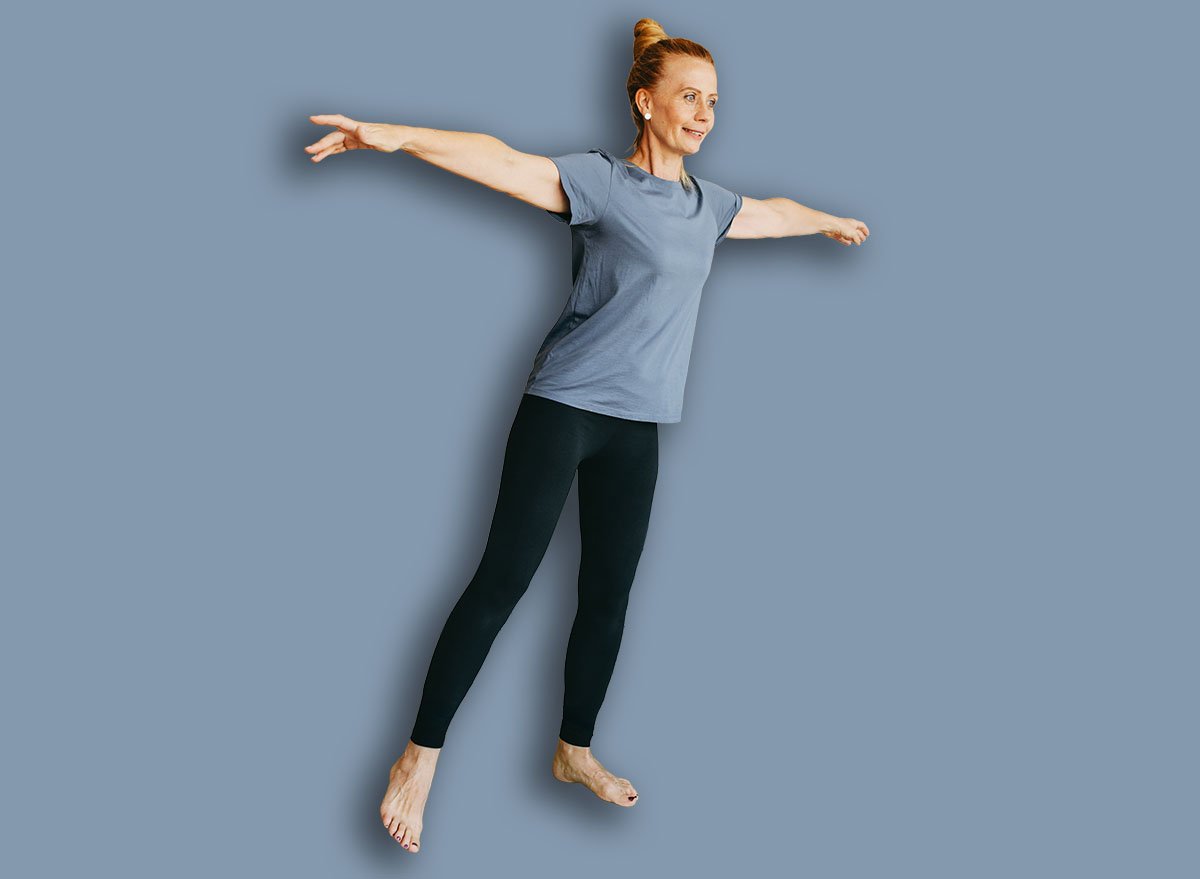
Feel steadier in 15 minutes a day. Try these doctor-approved balance moves today.
We don’t really think about our balance until something happens, a close call on the stairs or that split second where you feel unsteady reaching for something on a high shelf in the kitchen. Those moments can be scary, but here’s what I tell my clients and patients: we don’t have to wait for a wake-up call. We can get ahead of this. As a physician who works with women in this age group every single day, both in my practice and in the hospital, I’ve seen how a few simple, targeted exercises can make the difference between feeling unsteady and feeling confident on your feet again. The five exercises below can help you build that stability back, and they take less than 15 minutes a day.
Why Falls Are the Biggest Risk
Shutterstock
The single greatest risk for women over 60, without a doubt, is falls. A fall after the age of 60 is not just a minor mishap; it can be a truly life-altering event, leading to a hip fracture, loss of independence, and a deep-seated fear of falling again, which then causes a person to become even less active, leading to a very vicious cycle.
So what exactly is happening in our bodies that makes this risk so much higher? It’s really a double whammy of losing strength and losing our sense of balance at the same time.
First, there’s a natural process called sarcopenia, which is just a fancy term for age-related muscle loss. After the age of 30, we can lose 3-8% of our muscle mass per decade, and this process really speeds up for women after menopause. The muscles in our legs and our core are our foundation. They’re what hold us up, allow us to get out of a chair, and most importantly, catch ourselves when we trip so that we don’t fall. When that strength declines, our foundation becomes shaky.
Then there’s the balance system itself, which gets less reliable as we age. I like to explain it this way: your balance is like a three-legged stool. One leg is your vision, which helps you stay oriented. The second leg is your inner ear, which works kind of like a built-in gyroscope. And the third leg, which people don’t think about as much, is something called proprioception: basically, the feedback your feet and legs send to your brain about where you are in space. As we get older, all three of these can start to falter. Maybe your vision isn’t quite as sharp, or you’ve got some inner ear changes, or those nerve signals from your feet aren’t firing as quickly. The result? When you trip or lose your footing, your body’s reaction time to catch yourself just isn’t what it used to be.
I actually had a patient, a wonderful woman named Carol, who came to me after she tripped on her own rug. She didn’t break anything, thank goodness, but she was terrified. She told me she used to be so steady on her feet, and now she felt like she couldn’t trust her own body. We worked on some very simple, targeted exercises, and the biggest change wasn’t just her physical stability but the return of her confidence. That’s the real goal here: to feel confident and safe in your own body again.
Why These Exercises Work for Daily Practice
Shutterstock
If an exercise isn’t safe, you won’t do it. And if you don’t do it consistently, it won’t be effective. The beauty of these exercises is that they were designed with the 60+ body in mind. They are gentle, low-impact, and can be done every single day.
What makes them safe? A couple of things. First, everything is done slowly and with control. No jumping around, no sudden movements. Your joints, those knees, hips, and ankles that have been working hard for you all these years, will appreciate that. Second, you always start with something to hold onto, whether that’s a chair or a wall. Think of it as your safety net. It lets you work on your balance without that fear of toppling over. And you only let go of that support when you feel ready, not a moment before.
Their effectiveness really lies in their consistency and specificity. Doing these movements daily re-trains the connection between your brain, your muscles, and your nerves. It’s like practicing a musical instrument; the more you do it, the more natural it becomes. You’re waking up those neural pathways that may have become a little sleepy over the years. Daily practice helps make balance an automatic reflex again, not something you have to consciously think about.
These exercises target the exact muscles that matter most for stability: the glutes (your powerhouse hip muscles), the leg muscles (quads, hamstrings, and calves), and the deep core muscles. By strengthening these specific areas in a coordinated way, you’re not just building strength, you’re building functional strength, the kind you need to walk on uneven ground, carry groceries, or get up from the floor.
Sit-to-Stand
This is arguably the most important functional exercise for maintaining independence. It strengthens the major muscles in your legs, which you need to get up from a chair, out of a car, and off of the toilet. It’s a direct counterattack against muscle loss.
Muscles Trained: Quads, glutes, hamstrings
How to Do It:
- Sit on the front half of a sturdy chair (one that won’t roll away!) with your feet flat on the floor, about hip-width distance apart.
- Cross your arms over your chest or hold them out in front of you.
- Lean forward slightly, keeping your back straight and chest up.
- Push through your heels and stand up completely. Think about squeezing your glutes at the top.
- Slowly and with control, reverse the motion and sit back down. Try not to just “plop” down.
Easier Modification: If standing up without using your hands is too difficult, that’s perfectly okay. Start by placing your hands on the chair’s armrests or on your thighs and use them to help you push up. Over time, try to use less and less arm assistance.
Avoid These Mistakes:
- Don’t rock back and forth to get yourself up. The work should come from your legs, not momentum.
- Don’t let your knees cave inward. Keep your knees in line with your feet as you stand up and sit down.
- Don’t hold your breath. Exhale as you stand up, and inhale as you sit down.
Form Tip: Think about driving through your heels, not your toes, as you stand. This keeps the effort in your glutes and hamstrings where it belongs.
Tandem Stance
This exercise directly challenges your balance by narrowing your base of support, forcing your body to make small adjustments to stay upright. It is fantastic for retraining the communication between your feet, your brain, and your muscles.
Muscles Trained: Core, ankles, calves, hip stabilizers
How to Do It:
- Stand next to a wall or a sturdy countertop, with your hand lightly touching it for support.
- Place the heel of one foot directly in front of the toes of the other foot, as if you were walking on a tightrope.
- Stand tall, look straight ahead, and try to hold this position for 10-15 seconds.
- Switch feet and repeat.
Easier Modification: If the full tandem stance is too wobbly, start with a “semi-tandem” stance. Instead of placing your feet in a perfect line, offset them slightly so the heel of your front foot is touching the big toe of your back foot. This gives you a slightly wider base of support.
Avoid These Mistakes:
- Don’t look down at your feet. This will throw your balance off. Keep your gaze fixed on a point in front of you.
- Don’t lean heavily on your support. The wall or chair is for safety, not for bearing your weight. Try to just hover your hand over it, or touch it with only one or two fingers.
- Don’t hold your body stiff. Allow for small, natural sways. Your body is supposed to make tiny adjustments.
Form Tip: Think of the wall or countertop as a safety net, not a crutch. The less you rely on it, the harder your balance system has to work.
Single-Leg Stance
This is a classic balance-builder. It strengthens the muscles in your standing leg, hip, and core, all while improving your stability. This is the skill you need when you have to step up onto a curb or quickly shift your weight from one foot to the other.
Muscles Trained: Glutes, quads, core, hip stabilizers
How to Do It:
- Stand behind a sturdy chair or next to a countertop, holding on with both hands.
- Plant your feet firmly on the ground, hip-width apart.
- Slowly lift one foot off the ground, bending your knee. Don’t worry about how high you lift it.
- Focus on keeping your standing leg strong and your posture tall. Try to hold for 10 seconds.
- Lower your foot back down with control and switch to the other side.
Easier Modification: Don’t lift your foot all the way off the floor. Simply rest the toes of your lifted foot on the ground for a little extra support, like a kickstand on a bicycle. This is called a “staggered stance” and it’s a great starting point.
Avoid These Mistakes:
- Don’t slouch or lean to one side. Try to keep your body as upright as possible. Imagine a string pulling the crown of your head up to the ceiling.
- Don’t lock the knee of your standing leg. Keep a tiny, micro-bend in your standing knee to protect the joint and engage the muscles properly.
- Don’t look around the room. Find a spot on the wall in front of you and fix your gaze there to help you stay steady.
Form Tip: The kickstand modification is a smart way to build up to the full version. There’s no rush.
Heel-to-Toe Walk
This exercise simulates walking on a narrow path and is a fantastic way to improve dynamic balance, which is balance while you are moving. It improves coordination and forces you to slow down and be very deliberate with your foot placement.
Muscles Trained: Calves, ankles, core, hip stabilizers
How to Do It:
- Find a clear path in your home, perhaps alongside a wall or a long countertop that you can lightly touch for support.
- Stand tall and take a step forward, placing the heel of your front foot directly in front of the toes of your back foot. It should feel like you’re on a tightrope.
- Pause for a moment, then take the next step with your other foot in the same heel-to-toe fashion.
- Aim to take 10-15 steps forward.
Easier Modification: Instead of walking heel-to-toe, just try to walk in a straight line, placing one foot directly in front of the other without them touching. You can also take shorter steps.
Avoid These Mistakes:
- Don’t rush. This exercise is all about slow, controlled movement. Speed is your enemy here.
- Don’t stare down at your feet the whole time. Try to look ahead, only glancing down when you need to check your foot placement.
- Do use your arms. Allow your arms to be out to the side to help you balance, just like a tightrope walker would.
Form Tip: Slow is the name of the game here. If you feel like you’re going too fast, you are.
Side Leg Raise
This move strengthens your hip abductor muscles, which are on the outside of your hips. These muscles are incredibly important for stabilizing your pelvis when you walk and for preventing you from falling over sideways. Many people neglect these muscles, but they are a key to stability.
Muscles Trained: Hip abductors (gluteus medius), core
How to Do It:
- Stand behind a sturdy chair or next to a countertop, holding on for support.
- Stand tall with your feet together.
- Slowly lift one leg straight out to the side, keeping your leg straight and your toes pointing forward. Don’t worry about lifting it high; just a few inches is effective.
- Hold for a second at the top, then slowly lower the leg back down with control.
- Complete 10-12 repetitions on one side before switching to the other.
Recommended Sets and Reps: 10-12 reps per side.
Easier Modification: If lifting your leg is too challenging, you can do a simple side step instead. Just step one foot out to the side, tap your toe, and bring it back to the center. This still engages those important hip muscles.
Avoid These Mistakes:
- Don’t lean your torso to the opposite side. The movement should come from your hip. Keep your torso upright.
- Don’t swing the leg. Use your muscles to lift and lower your leg with control. Avoid using momentum.
- Don’t point your toes up to the ceiling. This turns the exercise into a quad exercise. Keep your foot parallel to the floor to target the hip muscles correctly.
Form Tip: Think “lift from the hip,” not “lean and kick.” If your upper body is swaying, lower the height of your leg lift and focus on control.
Equipment and Time
Shutterstock
This is the best part, honestly. You need next to nothing! The only piece of equipment I insist on is a sturdy, stable chair that won’t slide or roll. A solid kitchen chair or a heavy dining room chair is perfect. Please don’t use an office chair with wheels! You can also use a kitchen countertop or a wall for support.
That’s it. No expensive gym memberships or fancy gadgets. The most important thing is consistency, and these exercises are designed to be done anywhere, anytime.
As for how long it takes, you can get through this entire routine in 10 to 15 minutes. That’s it! It’s less time than it takes to drink a cup of coffee and read the morning headlines. The goal is to make this a small, manageable part of your daily routine, like brushing your teeth. When a habit is this easy to fit in, you’re so much more likely to stick with it, and that’s where the real magic happens.
How to Progress These Exercises
Shutterstock
Progression is a sign that you are getting stronger and more stable. The key is to challenge yourself a little bit, but not so much that you feel unsafe. Think of it as turning up the dial on your balance, not flipping a switch.
For the Sit-to-Stand, the first step is to use your hands less and less. Maybe you start by pushing off with both hands, then progress to just one hand, then just your fingertips, and finally to crossing your arms over your chest. Another great way to make it harder is to slow down the “sitting” part of the movement. Try to take a full five seconds to lower yourself back into the chair. This will build tremendous control.
For the Tandem Stance and Single-Leg Stance, the progression is all about reducing your reliance on support. Start by holding on with your whole hand, then just a few fingers, then just one finger. The next step is to just hover your hand over your support without touching it. Once you can hold the stance for 30 seconds without support, you can add a challenge: try turning your head slowly from side to side or closing your eyes for just a second or two. Make sure you are in a safe spot!
For the Heel-to-Toe Walk, the first progression is to let go of the wall or countertop. Once you can do that confidently, try taking a few steps backward in the same heel-to-toe manner. This is much harder than it sounds! You can also try carrying a light object, like a book or a small can of soup, to add a little bit of dynamic challenge.
For the Side Leg Raise, you can add a one or two second pause at the top of the movement. You can also add a light ankle weight (just 1-2 lbs is plenty) or a small resistance band loop around your ankles to increase the resistance and build more strength in those hip muscles.
The most important rule of progression is to listen to your body. If you feel wobbly or unsafe, take a step back to the previous level. The goal is to build confidence, not to create fear.
What to Expect in 30 Days
Shutterstock
You can absolutely feel a difference in 30 days if you are consistent. The key is to know what to look for.
The first thing you’ll likely notice, probably within the first week or two, isn’t a dramatic physical change, but a change in your confidence. You’ll feel more “connected” to the ground. When you stand up from a chair, it will feel more solid. When you walk, you’ll feel a little less tentative or hesitant. These are the first, wonderful signs that your brain and muscles are starting to work better together.
By the end of 30 days, you should notice more tangible results. You might be able to stand on one leg for a few seconds longer than you could at the start. You might be able to do the sit-to-stand exercise without using your hands at all. Maybe you can walk heel-to-toe without holding onto the wall. These are huge victories!
I had a client who, at the start, couldn’t let go of her kitchen counter while trying to stand on one leg. After a month of doing these exercises almost every morning, she called me, excited, to say that she had stood on one leg long enough to put her sock on without holding onto anything. For her, that was more meaningful than any number on a chart. It was a piece of her independence back.
So, in 30 days, expect to feel more stable, more confident, and more in control of your body. The visible strength gains take a bit longer, but the foundation for them, and for a safer, more active life, will be firmly in place.
