

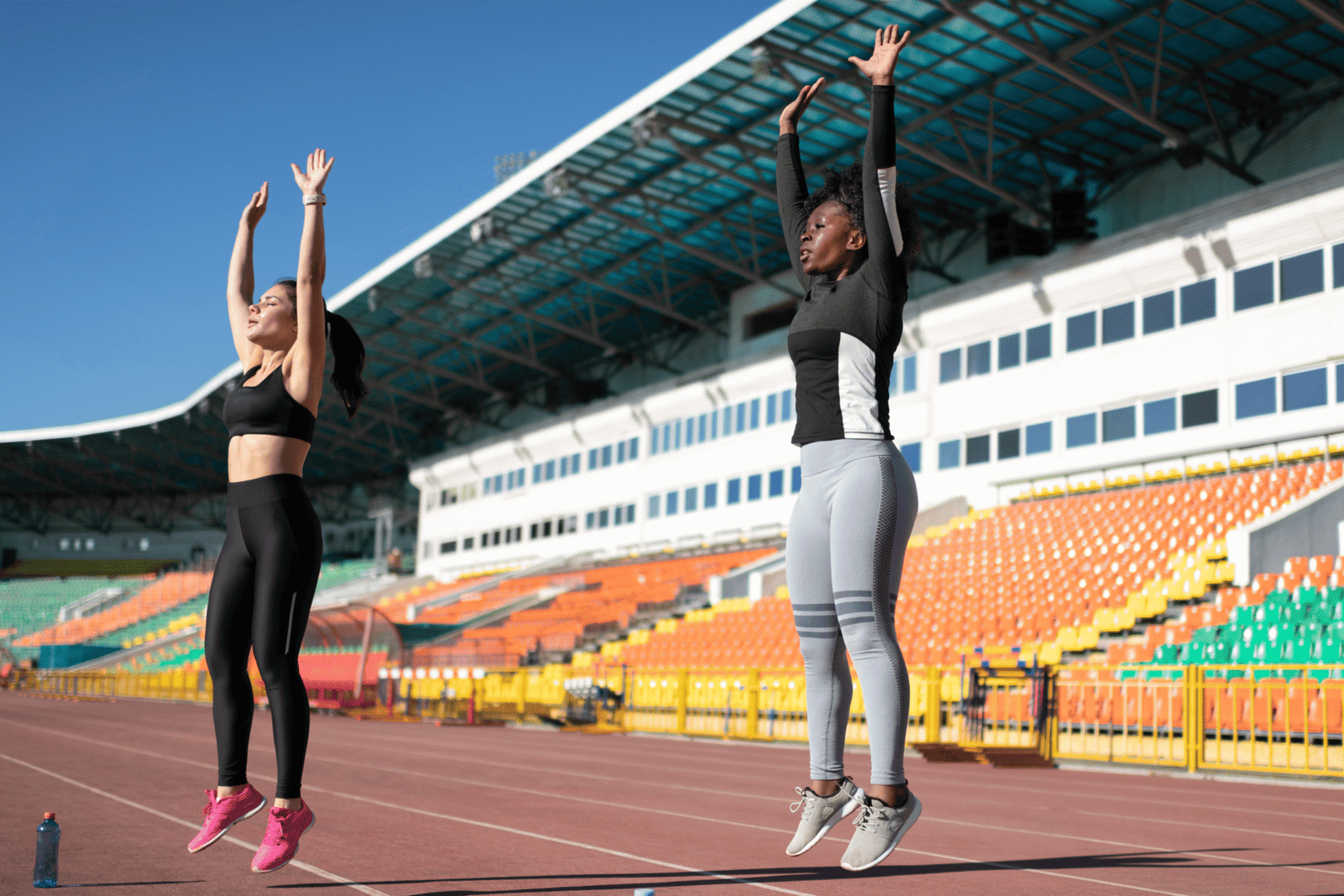
Burpees are often regarded as the best full-body, bodyweight exercise. However, this high-impact exercise puts a lot of stress on your joints and is often performed with incorrect form. Rather than relying solely on burpees, there are plenty of alternative exercises that can also help you build strength and cardiorespiratory fitness just as effectively.
Jumping jacks are a moderate-intensity alternative to burpees. They elevate your heart rate quickly, delivering a full-body cardio boost. However, jumping jacks also allow you to maintain a smoother, more consistent movement (unlike burpees’ up-and-down jumping transitions).
In addition to their cardio benefits, jumping jacks are also a good exercise if you’re looking to improve bone health.
Here’s how to do the movement:
- Stand with your feet together and arms at your sides.
- Jump your feet apart while lifting your arms overhead.
- Jump your feet back together while bringing your arms back down.
- Repeat at a steady pace for 30 repetitions.
Like burpees, jump squats improve lower body power and get your heart rate up—however, they’re much simpler, allowing you to focus on strength and form. Over time, jump squats can also help you improve your vertical jump height.
Here’s how to do the movement:
- Stand with your feet shoulder-width apart and your hands in front of you.
- Bend your knees into a squat as if you were sitting in a chair.
- Push through your feet to jump straight up.
- Land softly with your knees bent and go right into your next jump squat.
- Perform 3 sets of 10 repetitions.
Kettlebell swings are explosive movements that build full-body strength, putting far less strain on your shoulders and wrists than burpees. They also elevate your heart rate quickly, without requiring repeated transitions to the floor.
Here’s how to do a kettlebell swing:
- Stand with your feet apart, holding the kettlebell with both hands.
- Bend your knees slightly and swing the kettlebell back between your legs.
- Push your hips forward to swing the kettlebell forward up toward your chest.
- Let the weight swing back down smoothly, maintaining control.
- Perform 3 sets of 10 repetitions.
Medicine ball slams are a high-intensity, low-impact exercise that works your upper body and core. They are easier on your joints and help improve power, strength, and coordination.
- Stand with your feet apart, holding the medicine ball above your head.
- Keep your core muscles tight and lift the ball overhead as high as you can.
- Throw the ball straight down.
- Pick it up and repeat 3 sets of 10 slams.
Dumbbell thrusters deliver a full-body burn, working the muscles of your trunk, lower body, and upper body. The movement is much more controlled than burpees, and builds strength and power with a reduced impact.
Here’s how to do a dumbbell thruster (or, a weighted squat and press):
- Hold a dumbbell in each hand at the same level as your shoulders.
- Squat down as if you are sitting in a chair.
- As you stand up, press the dumbbells overhead.
- Bring the dumbbells back to your shoulders and repeat for 3 sets of 10 repetitions.
Mountain climbers are considered a high-intensity interval training (HIIT) exercise, just like burpees, so they can improve strength and increase your heart rate. However, mountain climbers don’t require you to leave the ground, making them gentler on your joints.
Here’s how to do the movement:
- Start in a plank position with your wrists under your shoulders.
- Bring one knee up towards your chest.
- Quickly switch legs, almost as if you’re running in place.
- Keep switching for 3 sets of 10 repetitions.
Plank jacks add a jump to a traditional plank, working your core muscles while also improving endurance. They’re an intense exercise, but have far less impact than burpees.
Here’s how to do plank jacks:
- Start in a plank position with your wrists under your shoulders.
- Keep your core muscles engaged as you jump your feet out wide, like you would in a jumping jack.
- Jump your feet back together and continue for 3 sets of 10 repetitions.
Ski jumps build side-to-side, or lateral, strength and agility. They also provide a challenge to your cardiovascular system while remaining low-impact.
Here’s how to do ski jumps:
- Start standing with your feet together and your knees slightly bent.
- Hop sideways to the right, landing on both feet.
- Then hop sideways to the left, landing on both feet (as if you’re skiing).
- Keep your jumps smooth and controlled, and repeat 3 sets of 10 jumps for both sides.
The sprawl—also called a no-jump burpee—works many of the same muscles as a traditional burpee. But with less jumping and no overhead movement, the sprawl has a lower impact on your body.
Here’s how to do it:
- Start standing with your feet apart and knees slightly bent.
- Drop into a plank position with your hands on the ground and your feet back.
- Jump your feet forward toward your hands, and stand up.
- Repeat 3 sets of 10 movements.
Bear crawls are similar to a plank, strengthening your upper body, lower body, and core muscles. They also offer a coordination and balance challenge, and are low-impact as compared to burpees.
Here’s how to do the movement:
- Start on all fours, then engage your core as you lift your knees off the ground.
- Move your right hand and left foot forward at the same time.
- Then move your left hand and right foot forward.
- Stay low and keep crawling forward for 3 sets of 10 repetitions.
Inchworm push-ups—sometimes called walkouts—work strength and mobility in a lower-impact way than burpees. They activate and engage a number of muscle groups, including the arms, back, chest, shoulders, and abs.
Here’s how to do an inchworm push-up:
- Start standing, then reach down towards your toes, placing your hands on the floor.
- Walk your hands out in front of you until you’re in a plank position.
- Perform a push-up, then walk your hands back toward your feet and stand up.
- Repeat 3 sets of 10 inchworm push-ups.
If you want to add more bodyweight exercises to your routine, choose three to five to start with—modify as you see fit by decreasing repetitions or increasing weight, for example.
Anytime you’re starting a new exercise routine, remember to:
- Check in with a healthcare provider first
- Listen to your body to avoid overtraining
- Ensure you’re hydrating properly as you exercise
