

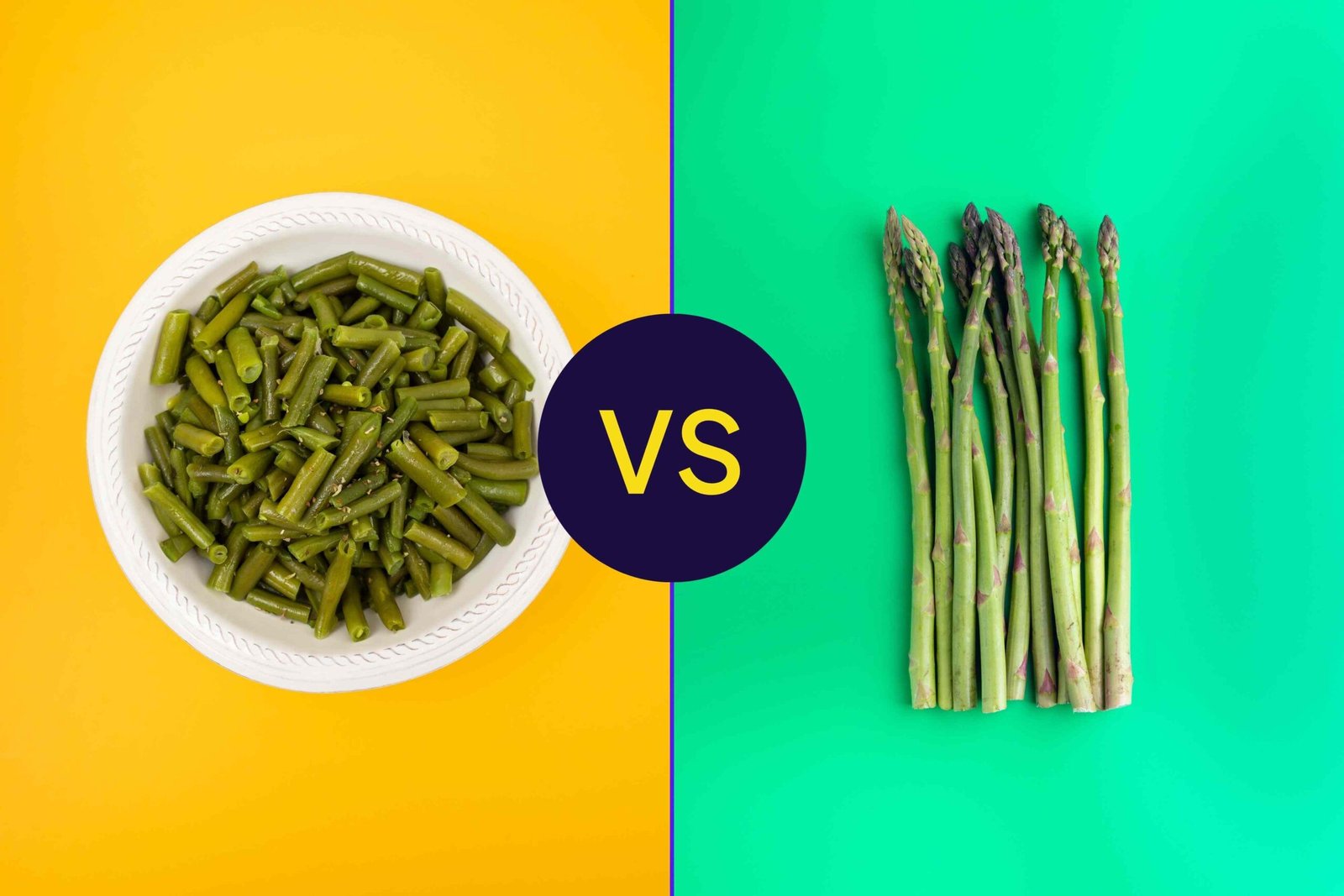
Green beans and asparagus have similar shapes and nutritional profiles. While both are high in vitamin K, they differ somewhat in vitamin content and their health benefits.
While green beans and asparagus differ in taste and texture, they have strikingly similar nutritional profiles. Both are low in calories, protein, and carbohydrates. Their fiber content is nearly equal.
Vitamin comparisons include:
- Both are high in vitamin K, providing a large percentage of the recommended daily value (DV), but asparagus provides more.
- Green beans have slightly more vitamin C.
- Asparagus has significantly higher levels of folate and beta-carotene (which is converted to vitamin A).
Characteristic
Green Beans (1 cup)
Asparagus (1 cup)
Calories
31 calories
26.8 calories
Protein
1.83 grams (g)
2.95 g
Carbs
6.97 g
5.2 g
Fiber
2.7 g
2.81 g
Vitamin K
43 micrograms (mcg), 36% DV
55.7 mcg, 46% DV
Vitamin C
12.2 milligrams (mg), 13% DV
7.5 mg, 8% DV
Folate
33 mcg, 8% DV
69.7 mcg, 17% DV
Beta carotene
379 mcg
449 mcg
Availability
Summer and Fall
Spring
Green beans are a solid vegetable choice for a balanced diet. They are low in calories and provide fiber and vitamins. Benefits of eating green beans include:
- May aid digestion for those with digestive disorders: If you have irritable bowel syndrome (IBS), you may tolerate green beans because they are a low-FODMAP food. Fermentable oligo-saccharides, disaccharides, mono-saccharides, and polyols (FODMAPs) are types of carbohydrates that are difficult for some people to digest.
- May boost heart health: Eating a diet rich in beta-carotene, vitamin C, and folate (all found in green beans) can help you lower cholesterol and blood pressure.
- May support eye health: Healthy vision can be influenced by your intake of vitamin K and folate. Adding green beans to a well-balanced meal plan can help ensure you are getting these important nutrients.
- May promote bone health: Getting adequate amounts of vitamin K, which is found in green beans, may support bone formation and help prevent osteoporosis.
- May benefit weight management: Eating green beans, which are low in calories and rich in fiber, can support weight-loss efforts.
Asparagus is a popular vegetable, especially during the spring when it’s in season. It’s low in calories and offers a host of nutrients. Benefits include:
- May help prevent urinary tract infections (UTIs): As a natural diuretic, asparagus helps flush excess fluid and salt from your body. This characteristic could also help prevent urinary tract infections. Some evidence suggests that eating asparagus regularly may help prevent UTIs.
- May protect against cancer: Research indicates that some compounds in asparagus may help protect against some types of cancer.
- May benefit gut health: Asparagus has inulin, a prebiotic that helps improve gut health, promote good gut bacteria, and help you digest food more easily.
- May lower cholesterol: Research shows that asparagus may help lower cholesterol. It improves the ability of bile acids to bind together during digestion, which can improve cholesterol levels.
- May boost immunity: Eating asparagus may improve your body’s ability to produce antibodies (proteins that help fight invaders).
For most people, eating asparagus and green beans is safe and recommended due to their high nutritional value. Caution may be needed in these instances:
- Food allergy: If you have an allergy or sensitivity to either vegetable, replace them with a different option.
- Blood thinners: Some blood thinners (anticoagulants) work by inhibiting vitamin K, which is required for blood clotting. Eating too much of vegetables high in vitamin K could make your medication less effective. Talk to a healthcare provider about whether you need to limit these vegetables.
- Diuretics: Asparagus is a natural diuretic. If you are already taking a diuretic, you may want to limit your consumption of asparagus, since it can cause you to urinate more frequently. Talk to a healthcare provider for a recommendation.
- Kidney stones: If you are prone to uric acid kidney stones, you may need to limit asparagus. Talk to a healthcare provider for specific advice.
Because asparagus and green beans have similar shapes and density, it is easy to make dishes that include both:
- For a salad or grain bowl addition, roast them together or blanch them.
- Sauté them in a large skillet with garlic and olive oil until tender but still crisp, then stir them into your pasta.
- Sauté them in lemon butter and serve alongside your favorite fish.
- Roast in the oven with onions, garlic, and diced potatoes to accompany a heartier meal.
Health.com uses only high-quality sources, including peer-reviewed studies, to support the facts within our articles. Read our editorial process to learn more about how we fact-check and keep our content accurate, reliable, and trustworthy.
U.S. Department of Agriculture: FoodData Central. Beans, snap, green, raw.
U.S. Department of Agriculture: FoodData Central. Asparagus, raw.
U.S. Department of Agriculture: SNAP-Ed Connection. Green beans.
U.S. Department of Agriculture: SNAP-Ed Connection. Asparagus.
Association of Accredited Naturopathic Medical Colleges. Naturopathic kitchen: green beans.
American Heart Association. Green beans can be one of the healthiest dishes at the holiday table.
Merle BM, Silver RE, Rosner B, Seddon JM. Dietary folate, B vitamins, genetic susceptibility and progression to advanced nonexudative age-related macular degeneration with geographic atrophy: A prospective cohort study. Am J Clin Nutr. 2016 Apr;103(4):1135-44. doi:10.3945/ajcn.115.117606
National Institutes of Health, Office of Dietary Supplements. Vitamin K.
Fusaro M, Mereu MC, Aghi A, Iervasi G, Gallieni M. Vitamin K and bone. Clin Cases Miner Bone Metab. 2017;14(2):200-206. doi:10.11138/ccmbm/2017.14.1.200
Das S. Natural therapeutics for urinary tract infections-a review. Futur J Pharm Sci. 2020;6(1):64. doi:10.1186/s43094-020-00086-2
Olas B. A review of the pro-health activity of Asparagus officinalis L. and its components. Foods. 2024;13(2):288. doi:10.3390/foods13020288
Romani A, Casciano F, Stevanin C, et al. Anticancer activity of aqueous extracts from Asparagus officinalis L. byproduct on breast cancer cells. Molecules. 2021;26(21):6369. doi:10.3390/molecules26216369
Xiao H, Deng Z, Hough JT, et al. The effect of asparagus extract on pancreatic cancer: an intriguing surprise. Anticancer Res. 2022;42(5):2425-2432. doi:10.21873/anticanres.15721
Carlson JL, Erickson JM, Lloyd BB, et al. Health effects and sources of prebiotic dietary fiber. Curr Dev Nutr. 2018;2(3):nzy005. doi:10.1093/cdn/nzy005
Guo Q, Wang N, Liu H, Li Z, Lu L, Wang C. The bioactive compounds and biological functions of Asparagus officinalis L. – A review. Journal of Functional Foods. 2020;65:103727. doi:10.1016/j.jff.2019.103727
MedlinePlus. Kidney stones – self-care.
