

Key Takeaways
- Altruism means helping others without expecting anything in return.
- Small acts of kindness, like holding doors or sharing, are examples of altruism.
- People might help others because it makes them feel good and happy.
Altruism is defined as the unselfish concern for other people—doing things simply out of a desire to help, not because you feel obligated to do so out of duty, loyalty, or religious reasons. Instead, it involves acting purely out of concern for the well-being of other people.
It plays a vital role in human connection, improving the lives of both recipients and givers.
In some cases, these acts of altruism lead people to jeopardize themselves to help others. Such behaviors are often performed unselfishly and without any expectations of reward. Other instances, known as reciprocal altruism, involve taking actions to help others with the expectation that they will offer help in return.
Real-Life Examples of Altruism
Everyday life is filled with small acts of altruism, from holding the door for strangers to giving money to people in need. News stories often focus on grander cases of altruism, such as someone who dives into an icy river to rescue a drowning stranger or a donor who gives thousands of dollars to a local charity.
But altruism isn’t just dramatic, sweeping acts of heroism. It can also be much smaller acts that people do every day to help others.
Some examples of altruism include:
- Doing something to help another person with no expectation of reward
- Forgoing things that may bring personal benefits if they create costs for others
- Helping someone despite personal costs or risks
- Sharing resources even in the face of scarcity
- Showing concern for someone else’s well-being
Altruism isn’t just defined as life-saving heroism. Even small acts of kindness and care are altruistic.
Types of Altruism
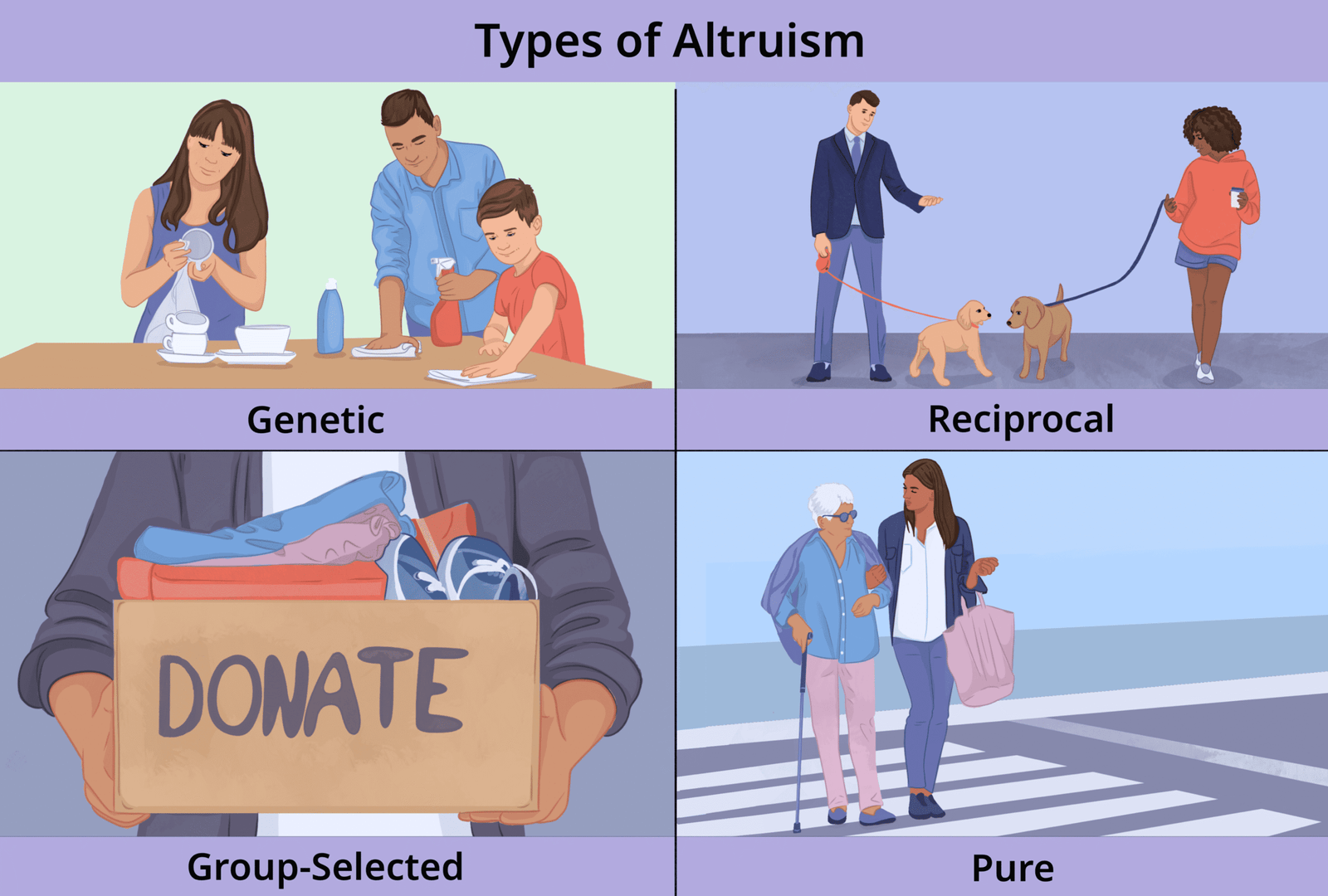
Psychologists have identified several different types of altruistic behavior. These include:
- Genetic altruism: As the name suggests, this type of altruism involves engaging in altruistic acts that benefit close family members. For example, parents and other family members often engage in acts of sacrifice to provide for the needs of family members.
- Reciprocal altruism: This type is based on a mutual give-and-take relationship. It involves helping another person now because they may one day be able to return the favor.
- Group-selected altruism: This involves engaging in altruistic acts for people based on their group affiliation. People might direct their efforts toward helping people who are part of their social group or supporting social causes that benefit a specific group.
- Pure altruism: Also known as moral altruism, this form involves helping someone else, even when risky, without any reward. It is motivated by internalized values and morals.
What Causes Altruism?
While we may be familiar with altruism, social psychologists are interested in understanding why it occurs. What inspires these acts of kindness? What motivates people to risk their own lives to save a complete stranger?
Altruism is one aspect of what is known as prosocial behavior. Prosocial behavior refers to any action that benefits other people, no matter what the motive or how the giver benefits from the action.
While all altruistic acts are prosocial, not all prosocial behaviors are completely altruistic. We might help others for a variety of reasons such as guilt, obligation, duty, or even for rewards.
We’re not sure why altruism exists, but psychologists have suggested a number of different explanations.
Evolution
Psychologists have long debated whether some people are just born with a natural tendency to help others, a theory that suggests that altruism may be influenced by genetics.
Kin selection is an evolutionary theory that proposes that people are more likely to help those who are blood relatives because it will increase the odds of gene transmission to future generations, thus ensuring the continuation of shared genes. The more closely the individuals are related, the more likely people are to help.
Prosocial behaviors such as altruism, cooperativeness, and empathy may also have a genetic basis.
Brain-Based Rewards
Altruism activates reward centers in the brain. Neurobiologists have found that when a person behaves altruistically, the pleasure centers of their brain become more active.
Engaging in compassionate actions activates the areas of the brain associated with the reward system. The positive feelings created by compassionate actions then reinforce altruistic behaviors.
Environment
Interactions and relationships with others can also significantly influence altruistic behavior. Socialization may have a significant impact on altruistic actions in young children.
In one study, kids as young as three expected others to reciprocate prosocial actions. Before that age, kids tend to share indiscriminately without any specific expectations that their actions will be reciprocated. It also showed that kids utilize reciprocal interactions strategically by age five.
Modeling altruistic actions can be an important way to foster prosocial and compassionate actions in children.
Observing prosocial behavior seems to lead to helping behavior among adults as well (though the extent to which this occurs varies based on factors like gender, culture, and individual context).
Social Norms
Society’s rules, norms, and expectations can also influence whether or not people engage in altruistic behavior. The norm of reciprocity, for example, is a social expectation in which we feel pressured to help others if they have already done something for us.
For example, if your friend loaned you money for lunch a few weeks ago, you’ll probably feel compelled to reciprocate when they ask you if they can borrow $100. They did something for you, now you feel obligated to do something in return.
Incentives
While the definition of altruism involves doing for others without reward, there may still be cognitive incentives that are not obvious. For example, we might help others to relieve our own distress or because being kind to others upholds our view of ourselves as kind people.
Other cognitive explanations include:
- Empathy: People are more likely to engage in altruistic behavior when they feel empathy for the person in distress, a suggestion known as the empathy-altruism hypothesis. Children also tend to become more altruistic as their sense of empathy develops.
- Helping relieve negative feelings: Altruistic acts may help alleviate the negative feelings associated with seeing someone else in distress, an idea referred to as the negative-state relief model. Essentially, seeing another person in trouble causes us to feel upset, distressed, or uncomfortable, but helping them reduces these negative feelings.
The Benefits of Altruism
While altruism can have some drawbacks when taken to extremes, it is a positive force that can benefit both you and others. Altruism has a wide range of benefits, like:
- Better health: Behaving altruistically can improve physical health in a variety of ways. People who volunteer have better overall health, and regularly engaging in helping behaviors is linked to significantly lower mortality.
- Better mental well-being: Doing good things for other people can make you feel good about yourself and the world. Research shows that people experience increased happiness after doing good things for other people.
- Better romantic relationships: Being kind and compassionate can also lead to a better relationship with your partner, as kindness is one of the most essential qualities that people across all cultures seek in a romantic partner.
In addition to these benefits, engaging in altruism can also help improve social connections and relationships, which can ultimately play a part in improving health and wellness.
Fostering Altruism
Some people come by altruistic tendencies naturally, but there are things you can do to help foster helpful behaviors in yourself and others. These include:
- Find inspiration: Look to inspirational people who engage in altruistic acts. Seeing others work to actively improve the lives of individuals and communities can inspire you to act altruistically in your own life.
- Practice empathy: Rather than distancing yourself from others, practice empathy by building connections and putting a human face on the problems you see. Consider how you would feel in that situation, and think about things that you can do to help make a difference.
- Set a goal: Find ways that you can regularly perform random acts of kindness for others. Look around you for people who may need help, or look for ways that you can volunteer in your community. Fix a meal for someone in need, help a friend with a chore, donate during a blood drive, or volunteer for a local organization.
- Make it a habit: Try to keep kindness in the forefront of your thoughts. For example, think about the altruistic acts you’ve performed, how they might have helped someone, and how you might repeat them going forward. Or, consider performing at least one act of kindness a day, and take some time to reflect on it.
Potential Pitfalls of Altruism
There can be some possible drawbacks and difficulties to altruism, like:
- It can sometimes create risk. People may engage in altruistic acts that can place them in danger.
- It may sometimes lead people to neglect their own health, social, or financial needs in order to care for others.
- While acts of altruism may be done with good intentions, they don’t always lead to positive outcomes.
- It may lead people to focus their efforts on one cause while neglecting others.
People who work in helping professions may find themselves emotionally overwhelmed by caring for and helping others, a phenomenon known as compassion fatigue. In a more severe example, a person who altruistically adopts animals may shift into animal hoarding, reaching a point where they can no longer house or care for the animals they have taken in.
Despite these potential problems, altruism is generally a positive force in the world, and it’s a skill worth developing.
Verywell Mind uses only high-quality sources, including peer-reviewed studies, to support the facts within our articles. Read our editorial process to learn more about how we fact-check and keep our content accurate, reliable, and trustworthy.
Oda R, Hayashi N. Deciding who is worthy of help: Effect of the probability of reciprocity on individuals’ willingness to help others. Evol Psychol. 2024;22(2):14747049241254725. doi:10.1177/14747049241254725
Ando J, Kawamoto T. Genetic and environmental structure of altruism characterized by recipients in relation to personality. Medicina (Kaunas). 2021;57(6):593. doi:10.3390/medicina57060593
Weiss-Sidi M, Riemer H. Help others-be happy? The effect of altruistic behavior on happiness across cultures. Front Psychol. 2023;14:1156661. doi:10.3389/fpsyg.2023.1156661
Sisco MR, Weber EU. Examining charitable giving in real-world online donations. Nat Commun. 2019;10(1):3968. doi:10.1038/s41467-019-11852-z
Filkowski MM, Cochran RN, Haas BW. Altruistic behavior: mapping responses in the brain. Neurosci Neuroecon. 2016;5:65-75. doi:10.2147/NAN.S87718
Leimgruber KL. The developmental emergence of direct reciprocity and its influence on prosocial behavior. Curr Opin Psychol. 2018;20:122-126. doi:10.1016/j.copsyc.2018.01.006
Jung H, Seo E, Han E, Henderson MD, Patall EA. Prosocial modeling: A meta-analytic review and synthesis. Psychol Bull. 2020;146(8):635-663. doi:10.1037/bul0000235
Mahmoodi A, Bahrami B, Mehring C. Reciprocity of social influence. Nat Commun. 2018;9(1):2474. doi:10.1038/s41467-018-04925-y
Miyazono K, Inarimori K. Empathy, altruism, and group identification. Front Psychol. 2021;12:749315. doi:10.3389/fpsyg.2021.749315
Byrne M, Tan RKJ, Wu D, et al. Prosocial interventions and health outcomes: A systematic review and meta-analysis. JAMA Netw Open. 2023;6(12):e2346789. doi:10.1001/jamanetworkopen.2023.46789
Thomas AG, Jonason PK, Blackburn JD, et al. Mate preference priorities in the East and West: A cross‐cultural test of the mate preference priority model. J Pers. 2020;88(3):606-620. doi:10.1111/jopy.12514
Hart R. Prosocial behaviors at work: Key concepts, measures, interventions, antecedents, and outcomes. Behav Sci (Basel). 2024;14(1):78. doi:10.3390/bs14010078
Ondrejková N, Halamová J. Prevalence of compassion fatigue among helping professions and relationship to compassion for others, self-compassion and self-criticism. Health Soc Care Community. 2022;30(5):1680-1694. doi:10.1111/hsc.13741
Thanks for your feedback!
What is your feedback?
Helpful
Report an Error
Other
