

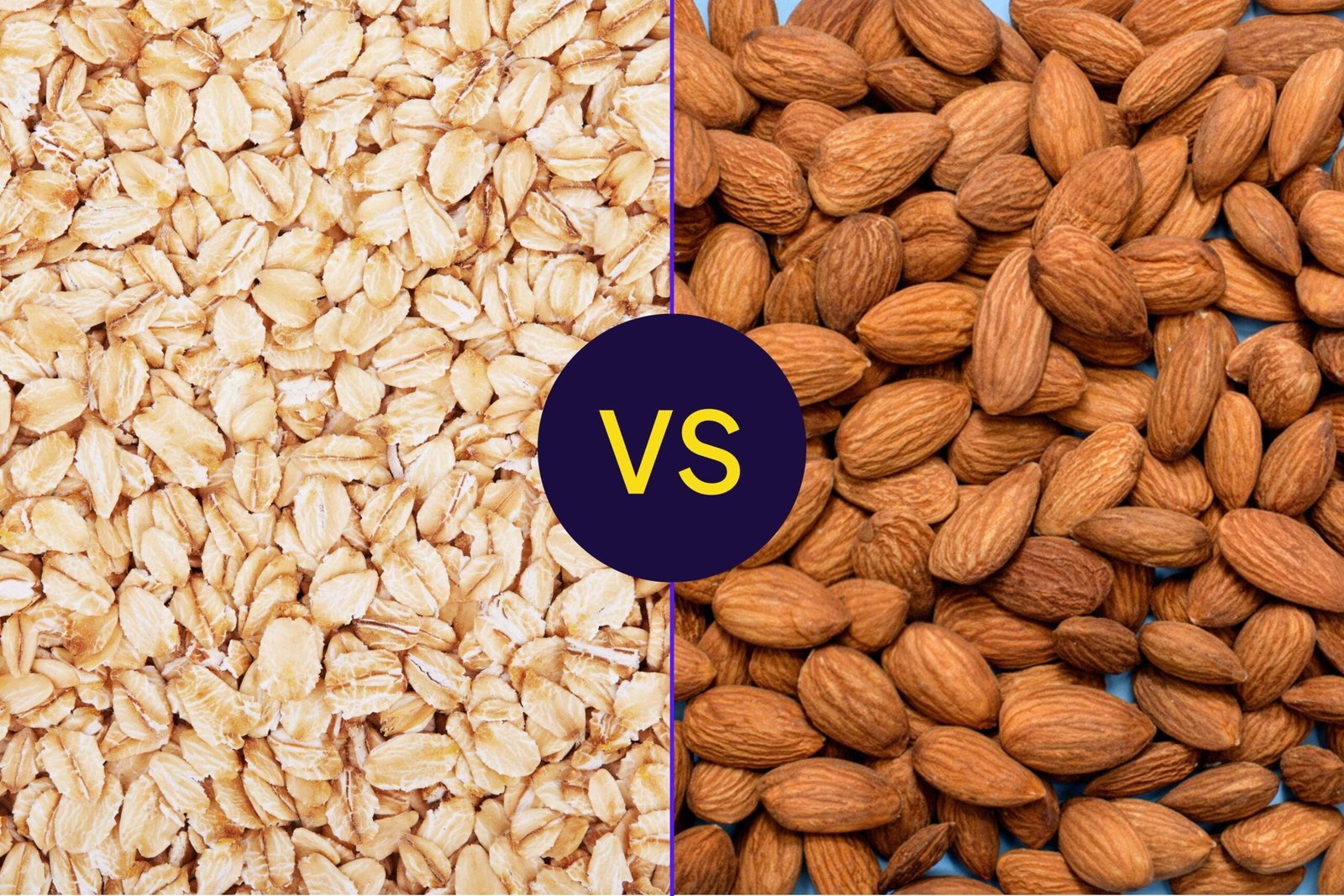
Oats and almonds are two popular and healthy staple foods. Both are nutrient-rich, versatile, and widely available, but they serve different roles when it comes to healthy fats and carbohydrates. Understanding how each food contributes to your health can help you decide which one best supports your goals, or how to combine them for maximum benefit.
Almonds are a rich source of healthy fats. A one-ounce serving (about 23 almonds) contains about 14 grams of fat, most of it monounsaturated. These heart-healthy fats help lower LDL (“bad”) cholesterol while raising HDL (“good”) cholesterol, supporting heart health over time.
Almonds also provide omega-6 fatty acids, which your body needs for brain function and cell growth. To keep these balanced, it helps to eat almonds alongside foods rich in omega-3 fats, like chia seeds, flaxseeds, or fatty fish.
Another benefit of the fats in almonds is that they help you feel full longer. Because fat digests more slowly than carbs, almonds make a smart snack for managing hunger and avoiding energy crashes.
Oats are naturally low in fat and high in carbohydrates. A cup of cooked oats provides about 28 grams of carbs. Oats also contain soluble fiber, which slows digestion and helps keep blood sugar levels steady. This makes oats a reliable fuel source, especially at breakfast or before exercise.
Almonds, however, are low in carbs with just 6 grams per ounce, but high in healthy fats and protein. Rather than being a main energy source, they help you feel full and curb hunger between meals.
Together, oats and almonds complement each other: oats deliver long-lasting energy, while almonds provide satiety and heart-healthy fats. Pairing them, like adding almonds to oatmeal, gives you balanced fuel and a sense of fullness.
Fiber is one area where both oats and almonds shine, but in different ways. Oats are rich in beta-glucan, a type of soluble fiber that helps lower LDL (“bad”) cholesterol, steady blood sugar, and feed good gut bacteria. This makes oats especially beneficial for heart and digestive health.
Almonds provide mostly insoluble fiber, which helps move food through your system, keeps digestion regular, and adds fullness that can curb hunger.
Together, oats and almonds cover both sides of the fiber spectrum: soluble for cholesterol, blood sugar, and gut health, and insoluble for digestion and satiety. Adding almonds to oatmeal is a simple way to combine these benefits for overall wellness.
Protein is another area where almonds stand out. An ounce of almonds provides about 6 grams, making them a snack that supports muscle repair and helps you feel full. Oats, while not protein-dense, still contain over 5 grams per cooked cup, contributing to overall intake.
Almonds can easily boost protein in everyday meals: sprinkle the nuts over salads, blend them into smoothies, or add them to snacks. Oats pair well with protein-rich toppings like Greek yogurt, nut butter, or seeds, turning a simple bowl into a more balanced and filling meal.
Overnight oats made with almond butter and chia seeds, for example, deliver a balanced mix of carbs, protein, and healthy fats. This combination supports energy, satiety, and muscle recovery all at once.
Protein also plays a role in blood sugar management. Meals that combine protein with carbs, like oats topped with almonds, help slow digestion and reduce post-meal spikes. That makes this pairing especially useful for people managing diabetes or trying to maintain steady energy throughout the day.
Beyond fats, carbs, and protein, oats and almonds each bring important vitamins and minerals to the table. Almonds are especially high in vitamin E, an antioxidant that helps protect your cells from damage. They also provide magnesium and potassium, which support muscle function and blood pressure regulation.
Oats provide minerals like manganese and iron, along with B vitamins such as thiamine. These nutrients help your body turn food into energy and support healthy blood cells, making oats particularly valuable for maintaining steady energy levels.
Together, almonds shine in antioxidant and mineral support, while oats contribute nutrients that fuel energy and metabolism. Eating both regularly gives you a broader nutrient profile and a stronger foundation for overall health.
Oats and almonds are both packed with nutrition, but there are some important differences between the two. Here’s how a typical serving of each compares:
Almonds (1 oz/23 almonds, 28 g)
Cooked Oats (1 cup, 234 g)
Calories
164
166
Total Fat
14.2 grams (g)
3.6 g
Saturated Fat
1.1 g
0.6 g
Monounsaturated Fat
9 g
1 g
Polyunsaturated Fat
3.5 g
28.1 g
Carbohydrates
6.1 g
28 g
Fiber
3.6 g
4 g
Protein
6 g
6 g
Vitamin E
7.3 milligrams (mg)
0.3 mg
Magnesium
76 mg
61 mg
Potassium
208 mg
164 mg
Iron
1.1 mg
2.1 mg
Manganese
0.6 mg
2.3 mg
Thiamine (Vitamin B1)
0.06 mg
0.2 mg
Beyond their nutrient profiles, oats and almonds differ in how they’re typically used. Oats are often eaten as a base meal, such as oatmeal or overnight oats, or baked into breads, making them ideal for fueling your day with steady energy.
Almonds are more commonly enjoyed as a snack or topping. They are portable and rich in several nutrients, making them perfect for keeping hunger in check between meals or adding crunch to salads, yogurt, or grain bowls.
Which one fits your diet best depends on your goals. If you’re looking for sustained energy and cholesterol management, oats take the lead with their soluble fiber. If satiety and heart-healthy fats are your priority, almonds are the stronger choice. For balanced nutrition, combining both, like sprinkling almonds on oatmeal, offers the best of both worlds.
Health.com uses only high-quality sources, including peer-reviewed studies, to support the facts within our articles. Read our editorial process to learn more about how we fact-check and keep our content accurate, reliable, and trustworthy.
Kim KH, Kim Y, Seo KW. Efficacy of monounsaturated fatty acids in reducing risk of the cardiovascular diseases, cancer, inflammation, and insulin resistance: a narrative review. Ann Clin Nutr Metab. 2023;15(1):2-7. doi:10.15747/ACNM.2023.15.1.2
Medline Plus. Facts about monounsaturated fats.
U.S. Department of Agriculture: FoodData Central. Nuts, almonds.
Medline Plus. Facts about polyunsaturated fats.
DiNicolantonio JJ, O’Keefe J. The importance of maintaining a low omega-6/omega-3 ratio for reducing the risk of autoimmune diseases, asthma, and allergies. Missouri Medicine. 2021;118(5):453. PMID:34658440
Djuricic I, Calder PC. Beneficial outcomes of omega-6 and omega-3 polyunsaturated fatty acids on human health: an update for 2021. Nutrients. 2021;13(7):2421. doi:10.3390/nu13072421.
Rakha A, Mehak F, Shabbir MA, et al. Insights into the constellating drivers of satiety impacting dietary patterns and lifestyle. Front Nutr. 2022;9:1002619. doi:10.3389/fnut.2022.1002619
Guan ZW, Yu EZ, Feng Q. Soluble dietary fiber, one of the most important nutrients for the gut microbiota. Molecules. 2021;26(22):6802. doi:10.3390/molecules26226802.
Akbar A, Shreenath AP. High Fiber Diet. In: StatPearls. StatPearls Publishing; 2023.
U.S. Department of Agriculture: FoodData Central. Cereals, oats, regular and quick, unenriched, cooked with water (includes boiling and microwaving), without salt.
Yu J, Xia J, Yang C, et al. Effects of oat beta-glucan intake on lipid profiles in hypercholesterolemic adults: a systematic review and meta-analysis of randomized controlled trials. Nutrients. 2022;14(10):2043. doi:10.3390/nu14102043.
Suresh A, Shobna, Salaria M, et al. Dietary fiber: an unmatched food component for sustainable health. Food and Agricultural Immunology. 2024;35(1):2384420. doi:10.1080/09540105.2024.2384420.
MedlinePlus. Potassium.
MedlinePlus. Magnesium in diet.
MedlinePlus. Vitamin E.
MedlinePlus. B Vitamins.
MedlinePlus. Iron.
National Institutes of Health: Office of Dietary Supplements. Manganese.
