

Key Takeaways
- You don’t need a PhD to become a therapist; there are different paths to start this career.
- You can choose to work with different groups like children, families, or people with substance abuse issues.
- Start with a bachelor’s degree in psychology, then pursue further education based on your chosen specialty.
If you’re looking for a rewarding career in which you can genuinely help people and enrich their lives, becoming a psychotherapist may be an excellent choice. But what steps must you take to prepare for this psychology role focused on helping others improve their mental health?
People often assume therapists must earn a Ph.D. in psychology to provide therapy to clients. However, there are a few different training and educational paths you can take toward this fulfilling career. Learn what these paths are so you can decide the best route for you when pursuing a career as a psychotherapist.
Know Your Therapist Career Options
The term “therapist” is often used generically to describe healthcare professionals who provide mental health services to clients. But these professionals can vary greatly in terms of what they do and even where they work. For instance, a clinical psychologist and licensed professional counselor can both work with a variety of mental health concerns in various settings.
Some psychology career paths can also take you into a particular specialty. A substance abuse therapist works with people dealing with drug and alcohol misuse while a marriage and family therapist focuses on relationship issues. Likewise, a licensed school psychologist works with children in a school system.
A licensed social worker often works in the broader community, though this can have specialties as well. If you decide to pursue this psychotherapy role, you might choose to focus on families, schools, public health, substance abuse, corrections, or the community in general.
Yet another career option is to become a therapist specializing in psychosocial rehabilitation. In this role, you would give clients the skills needed to live and work independently—emotionally, cognitively, and socially. This helps people with mental health disorders get the most out of their lives.
These are some of the more common therapy career paths and there are additional types of practice you can pursue. If you have a particular interest, discuss it with an advisor and they can point out all your options.
Assess Your Interests and Who You Want to Help
While becoming a therapist might be your goal, the steps you take to get there depend largely on the type of therapist you want to become. Therapists can work in a wide range of settings and with diverse populations. So, it’s helpful to start your planning process by considering where your interests lie.
Do you want to help people overcome substance abuse? Maybe you have a desire to work with survivors of sexual assault or childhood trauma. If there’s a particular issue you’d like to help people work through and overcome, this can determine the best therapist role for you.
As you might quickly realize, there are nearly as many degree options as there are job descriptions for different types of therapists. Before selecting one, you may also want to consider the type of clients you’d like to work with.
Do you want to work with children? Becoming a clinical psychologist or licensed social worker can help you reach this goal. If on the other hand, you are interested in working with families or couples, becoming a licensed marriage and family therapist or mental health counselor may be right for you.
By getting a general idea of what you would like to achieve as a therapist and who you’d like to work with, you will be in a better position to select a school and choose a degree option.
Learn About Therapy Degree Options
Now that you know the type of therapist you want to become, the next step will be to earn a bachelor’s degree in psychology. This can help prepare you to effectively help others, such as by learning the techniques used in psychotherapy and how to apply them when working with clients.
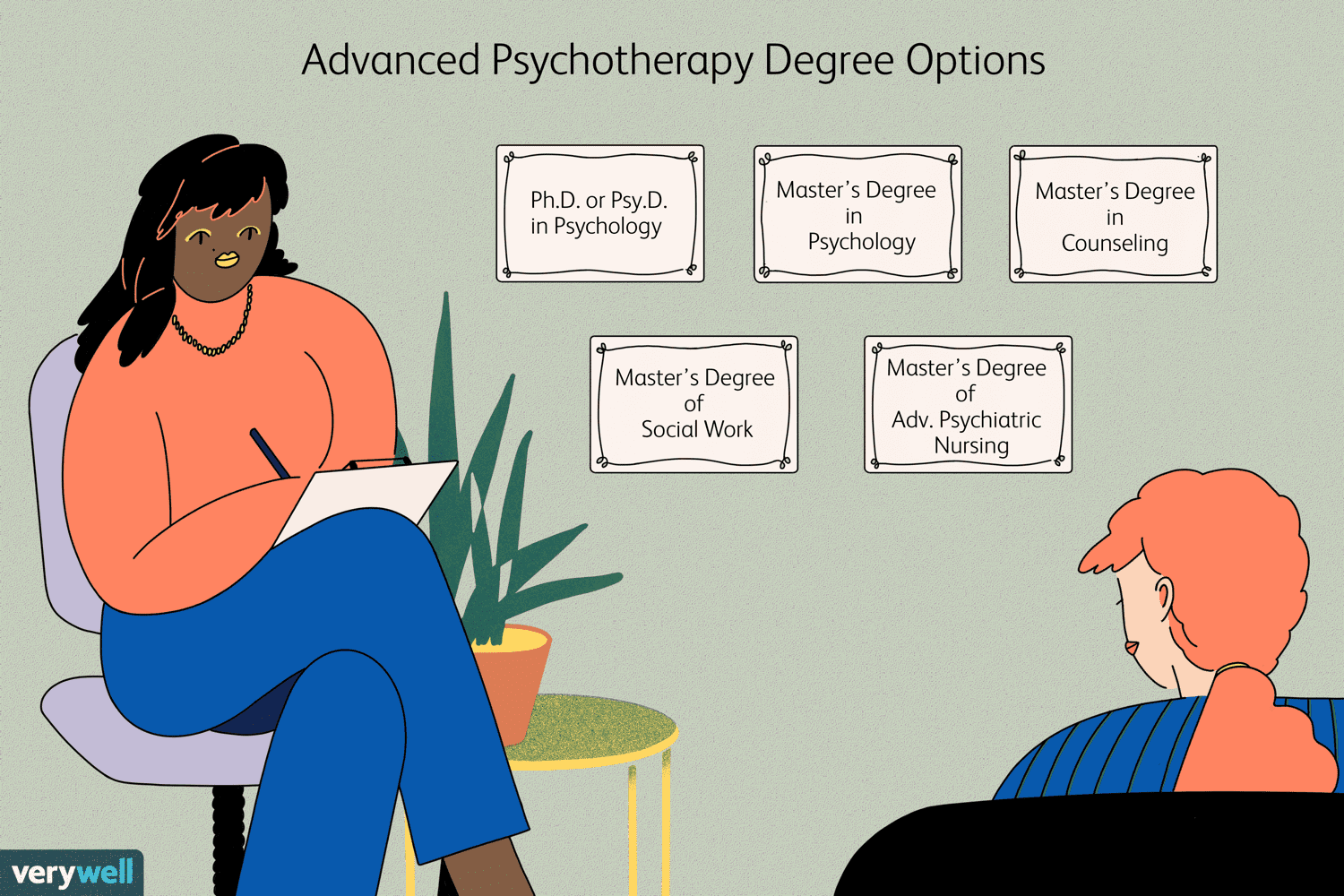
After earning your undergraduate degree, the next step is to earn an advanced degree in psychology. An advanced degree can open up a wide variety of career options, with several program choices to consider. The amount of time and training required to complete each one differs.
People with undergraduate degrees in other fields are often accepted into graduate programs as long as they make up some of the prerequisite coursework. Sociology, education, and health sciences are good bachelor’s degree choices for students interested in becoming therapists.
PhD or PsyD in Psychology
Earning a PhD or PsyD in psychology offers perhaps the widest range of career options. Professionals who have earned a doctorate and become licensed psychologists can work with clients in a wide range of settings, including private practice.
Earning a doctorate often takes between four and eight years of study beyond an undergraduate degree.
Master’s in Psychology
In some states, individuals with a master’s degree in psychology can become licensed psychologists. Master’s degree holders can also work in many different mental health care settings. It is important to check the guidelines in your state to determine what type of services you can provide with this degree.
Master’s Degree in Counseling
If you are interested in working with children, adults, families, or couples, becoming a licensed professional counselor can be a great choice. This requires a master’s degree in counseling.
The 60 credits required to complete the degree can take between two and three years to complete. This is dependent on your schedule and the individual program in which you are enrolled. In many cases, you must complete an additional 12 to 16 credit hours of training to become licensed in your state.
Master’s Degree in Social Work
Licensed clinical social workers (LCSWs) usually complete two years of coursework beyond their undergraduate degree. It also often involves an internship and supervised experience directly in the field.
Individuals with a master’s in social work are often able to provide therapy to clients in a wide variety of settings and situations.
Master’s Degree in Advanced Psychiatric Nursing
This often-overlooked degree option is a great choice for nurses who have an interest in mental health. Advanced psychiatric nurses are required to have a master’s degree or higher in psychiatric-mental health nursing. This can take anywhere from two to three years to complete beyond the bachelor’s degree.
Talk to Your Academic Advisor
After you have chosen the educational path that is right for your unique needs and interests, it is important to discuss your options with an academic advisor at your school of choice. They can provide more information on the therapist role, if needed, and help ensure that you’ve chosen the right path.
Prepare a list of questions about the specific degree requirements and state licensing guidelines for therapists. It’s also wise to learn demographic information about students who have graduated from the program. With the right information and careful thought, you’ll be on your way to a therapy career.
Thanks for your feedback!
What is your feedback?
Helpful
Report an Error
Other
