

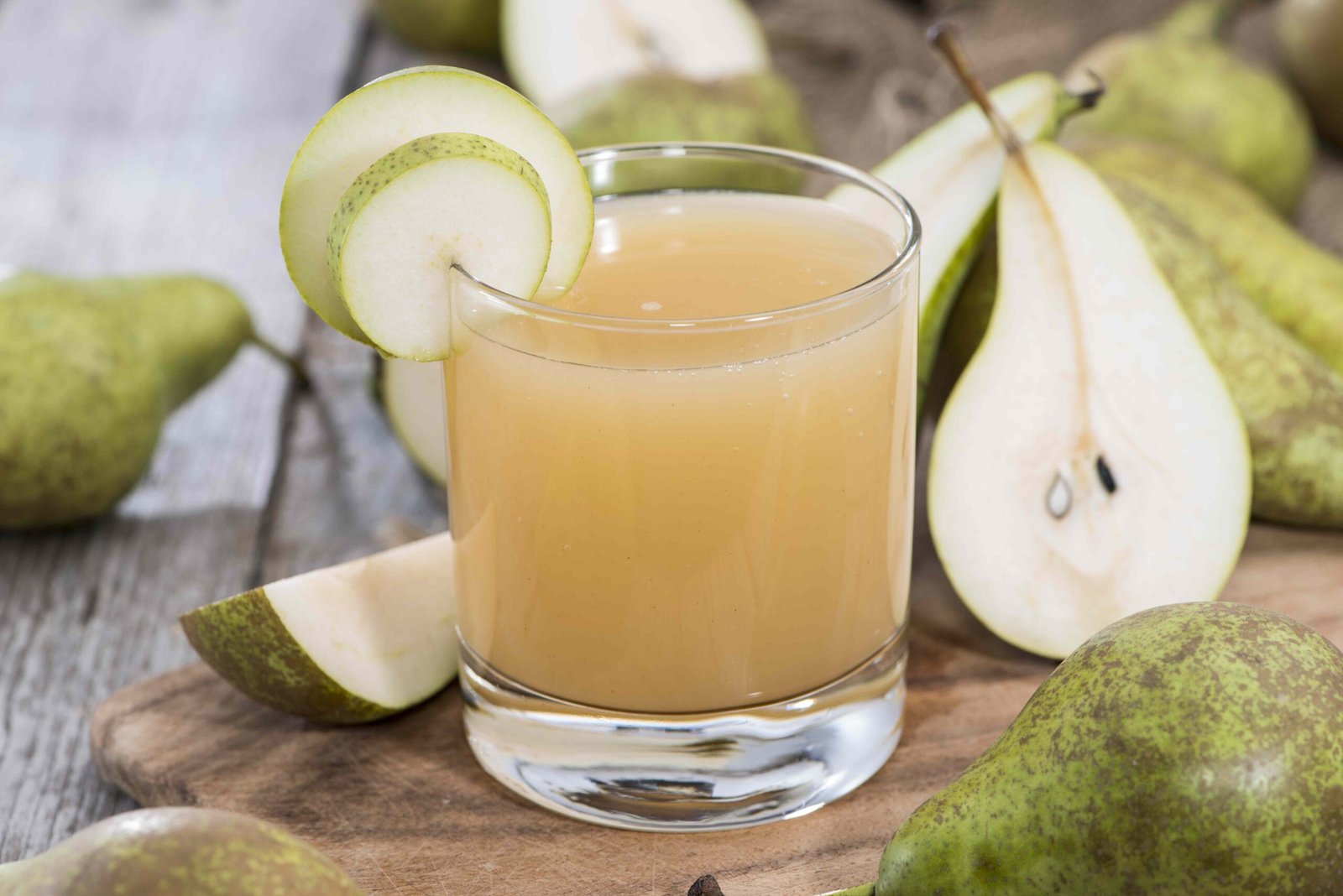
Pear juice is a mildly sweet, soothing drink. People often mix it with other juices or use pear juice concentrate as a sweetener in desserts. It provides carbohydrates, some fiber, and potassium. Here are four ways that drinking pear juice regularly may affect your health.
Pear juice—mainly 100% pear juice—is mostly water and sugar from the fruit. Drinking juice may support hydration, but you’ll get the most hydration benefits by combining different drinks, not relying on pear juice alone.
Pear juice provides quick energy. Juices contain high amounts of carbohydrates, primarily in the form of natural sugars, that your body can quickly absorb. You may feel a small energy boost after drinking any kind of juice, including pear juice.
Pear juice may ease constipation because it contains more sorbitol than other juices like apple, peach, grape, sweet cherry, and strawberry.
One hundred milliliters of pear juice has about 3 grams of sorbitol. Sorbitol is a type of sugar with laxative effects—it pulls water into the intestines, which can help soften stools. However, sorbitol can also make diarrhea worse if it’s already present.
Pear juice may also be gentler on the stomach because it’s less acidic than most other fruit juices.
A glass of pear juice—a 240-milliliter serving—has approximately 16 grams of sugar. Many commercial juice products contain added sugars on top of natural fruit sugars.
Drinking fruit juice—especially those that are not 100% fruit—may increase the risk of high blood sugar in some people. However, some studies also suggest that 100% fruit juice does not affect blood sugar control.
Eating or drinking too much added sugar may increase the risk of weight gain, type 2 diabetes, and heart disease. The Centers for Disease Control and Prevention (CDC) recommends consuming less than 10% of daily calories from added sugar for people aged 2 years and older. This equals about 12 teaspoons, or roughly 50 grams of added sugar, for someone consuming a 2,000-calorie diet.
Consult your doctor about regularly drinking juice, especially if you have diabetes or are taking any medications.
Here is the nutritional value of 100 milliliters of 100% pear juice:
Nutrients
100 mL of 100% Pear Juice
Energy
42 kcal
Protein
0.3 g
Fat
0 g
Carbohydrate
10.6 g
Fiber
2.1 g
Sugars
6.9 g
Potassium
82 mg
Always read the nutrition facts label and ingredient list when buying pear juice, since most products mix pear juice with other fruit juices or add extra sugars to increase sweetness. Many also contain colorings and flavorings.
If you’re buying juice, opt for 100% pear juice with no additional ingredients. You can also choose the juices with the least sugar if a no-added-sugar option is not available.
But if you’re choosing between whole pears or pear juice, whole pears may be a more nutritious option. A large pear provides just over 7 grams of fiber, compared to only about 2 grams in a serving of juice.Getting enough fiber is crucial for healthy blood sugar and lipid levels.
Whole pears also deliver more polyphenols, which have antioxidant benefits. Juicing fruits can significantly decrease their polyphenol content, but blending fruit keeps fiber and skin, resulting in higher polyphenol levels and greater antioxidant capacity.
Health.com uses only high-quality sources, including peer-reviewed studies, to support the facts within our articles. Read our editorial process to learn more about how we fact-check and keep our content accurate, reliable, and trustworthy.
He W, Laaksonen O, Tian Y, Haikonen T, Yang B. Chemical composition of juices made from cultivars and breeding selections of european pear(pyrus communis l.). J Agric Food Chem. 2022;70(16):5137-5150. doi:10.1021/acs.jafc.2c00071
Li J, Zhang C, Liu H, Liu J, Jiao Z. Profiles of sugar and organic acid of fruit juices: a comparative study and implication for authentication. J Food Qual. 2020;2020:1-11. doi:10.1155/2020/7236534
Hong SY, Lansky E, Kang SS, Yang M. A review of pears (Pyrus spp.), ancient functional food for modern times. BMC Complement Med Ther. 2021;21(1):219. doi:10.1186/s12906-021-03392-1
Reiland H, Slavin J. Systematic review of pears and health. Nutrition Today. 2015;50(6):301-305. doi:10.1097/NT.0000000000000112
Lee C woo, Myung SK. Consumption of fruit juice and risk of type 2 diabetes mellitus: a systematic review and meta-analysis of prospective cohort studies. Am J Med. 2025;138(10):1428-1437. doi:10.1016/j.amjmed.2025.05.021
Murphy MM, Barrett EC, Bresnahan KA, Barraj LM. 100 % Fruit juice and measures of glucose control and insulin sensitivity: a systematic review and meta-analysis of randomised controlled trials. J Nutr Sci. 2017;6:e59. doi:10.1017/jns.2017.63
Centers for Disease Control and Prevention. Get the Facts: Added Sugars.
U.S. Department of Agriculture: FoodData Central. 100% Pear Organic Cold-Pressed Juice, Pear.
U.S. Department of Agriculture: FoodData Central. Pears, raw.
Centers for Disease Control and Prevention. Fiber: The Carb That Helps You Manage Diabetes.
Oras A, Akagić A, Spaho N, Gaši F, Žuljević SO, Meland M. Distribution and stability of polyphenols in juices made from traditional apple cultivars grown in bosnia and herzegovina. Molecules. 2022;28(1):230. doi:10.3390/molecules28010230
Pyo YH, Jin YJ, Hwang JY. Comparison of the effects of blending and juicing on the phytochemicals contents and antioxidant capacity of typical korean kernel fruit juices. JFN. 2014;19(2):108-114. doi:10.3746/pnf.2014.19.2.108
