

Why It Works
- Toasting the almond flour enhances its nutty flavor.
- Rubbing the seeds of a vanilla bean into both the dough and the sugar for dusting gives the cookies a sweet, floral flavor.
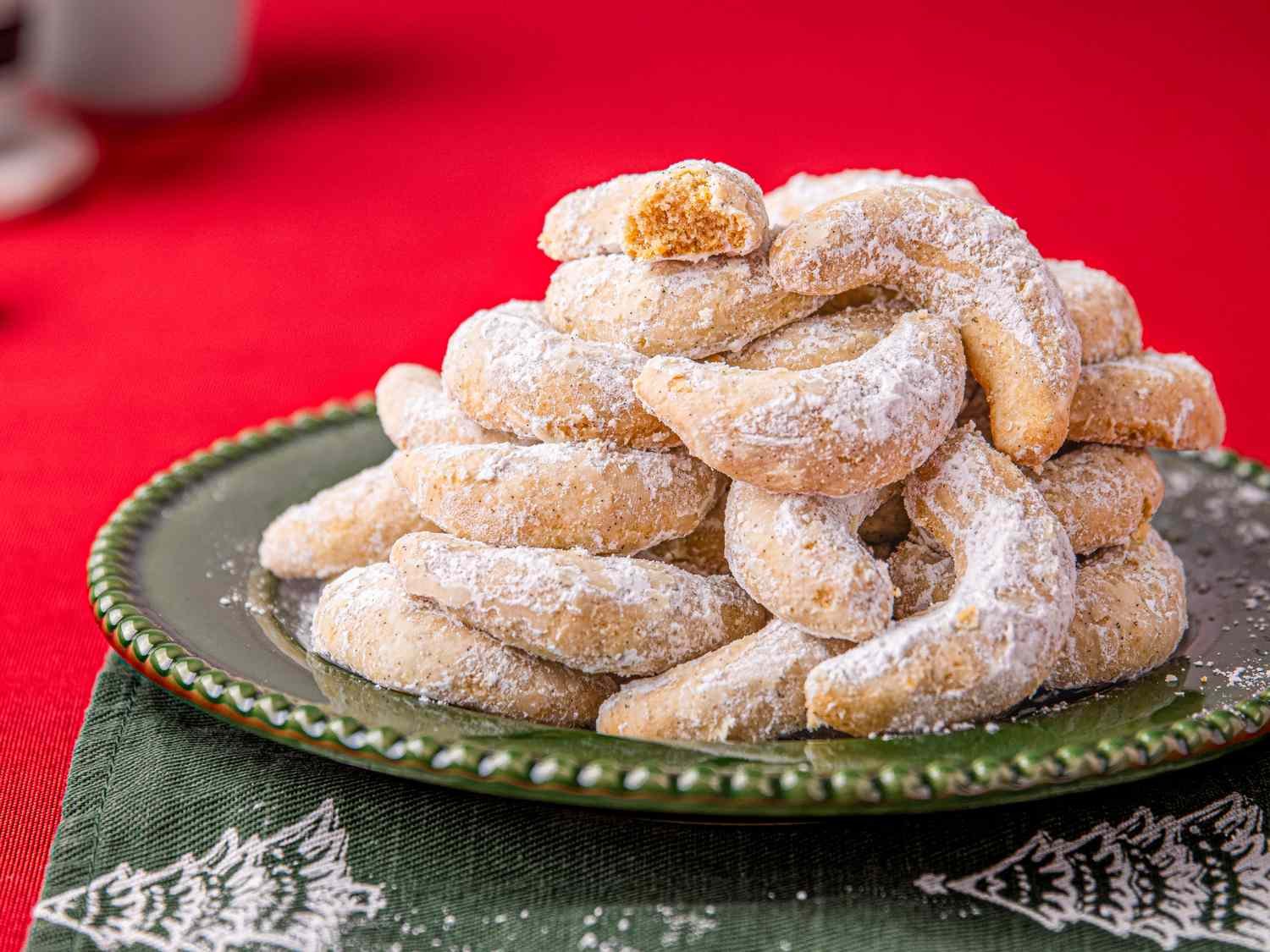
You know it’s Weihnachtszeit—Christmas time—when the cookie-making operation kicks off at my Viennese mother-in-law’s cozy house in Upstate New York. With snow falling outside and German holiday music playing, the entire family huddles together in the kitchen to make batches and batches of vanillekipferl—delightfully rich and buttery Austrian crescent cookies—for their loved ones. The cookies have a distinct nuttiness and a melt-in-your-mouth crumb, and are an essential part of Christmastime in Austria, Germany, and Central Europe. The name combines the words vanille (vanilla) and kipferl (crescents), literally translating to “vanilla crescents.”
Serious Eats / Maureen Celestine
Traditionally, vanillekipferl are made by combining freshly ground almonds, hazelnuts, or walnuts; all-purpose flour; butter; granulated sugar; and egg yolks. The dough is shaped into crescents, baked, then rolled in store-bought vanilla sugar. They’re usually stored and served in a Christmas cookie tin called a Weihnachtskekdose, along with all the other holiday cookies. Most Austrian families, including my husband’s, begin baking in early December and continue through Christmas, storing the cookies in these tins to keep them fresh.
Serious Eats / Maureen Celestine
My version of the recipe is more accessible than the traditional one. Instead of freshly ground nuts, I use store-bought almond flour, which I toast to enhance its nuttiness. I also add vanilla to the dough itself to give it a sweet, floral note. Once the dough has been made, divided into logs, and chilled, the real fun begins—shaping the buttery dough in a warm kitchen while having a laugh with loved ones is as much a part of the tradition as eating the cookies. Keeping the dough cold is crucial, as it helps the cookies stay intact and prevents the butter from melting both during shaping and baking. For tender cookies with a melt-in-your-mouth texture, handle the dough gently to avoid developing excess gluten, which can make the cookies tough and brittle.
To shape the cookies, you’ll divide the logs into 1 1/4-inch pieces, then form each into a crescent in the palm of your hand. Don’t worry about making perfect crescents; you just want them similar in size so they bake evenly.
Though store-bought vanilla sugar from the brand Dr. Oetker is typically used to dust the cookies in Austria and Germany, it can be difficult to find in the US. As a workaround, I provide instructions for making your own vanilla sugar by simply rubbing together powdered sugar and the seeds of a vanilla pod. Once the cookies are baked, you’ll dust them in vanilla sugar twice: first while they’re still hot so the sugar melts into the cookies, and again once they’ve cooled. The result is a deeply fragrant cookie that tastes just as good as it smells.
As the cookies bake, they’ll fill your kitchen with a warm, nutty aroma—my favorite sign that Christmas is just around the corner.
Serious Eats / Maureen Celestine
