

Key Takeaways
Fear of intimacy often stems from childhood experiences like abuse, neglect, or loss of a parent.
Overcoming the fear of intimacy requires facing negative thoughts about yourself and practicing self-compassion.
Fear of intimacy, sometimes referred to as intimacy avoidance or avoidance anxiety, is characterized as the fear of sharing a close emotional or physical relationship. People who experience this fear don’t usually wish to avoid intimacy, and may even long for closeness, but frequently push others away or even sabotage relationships nonetheless.
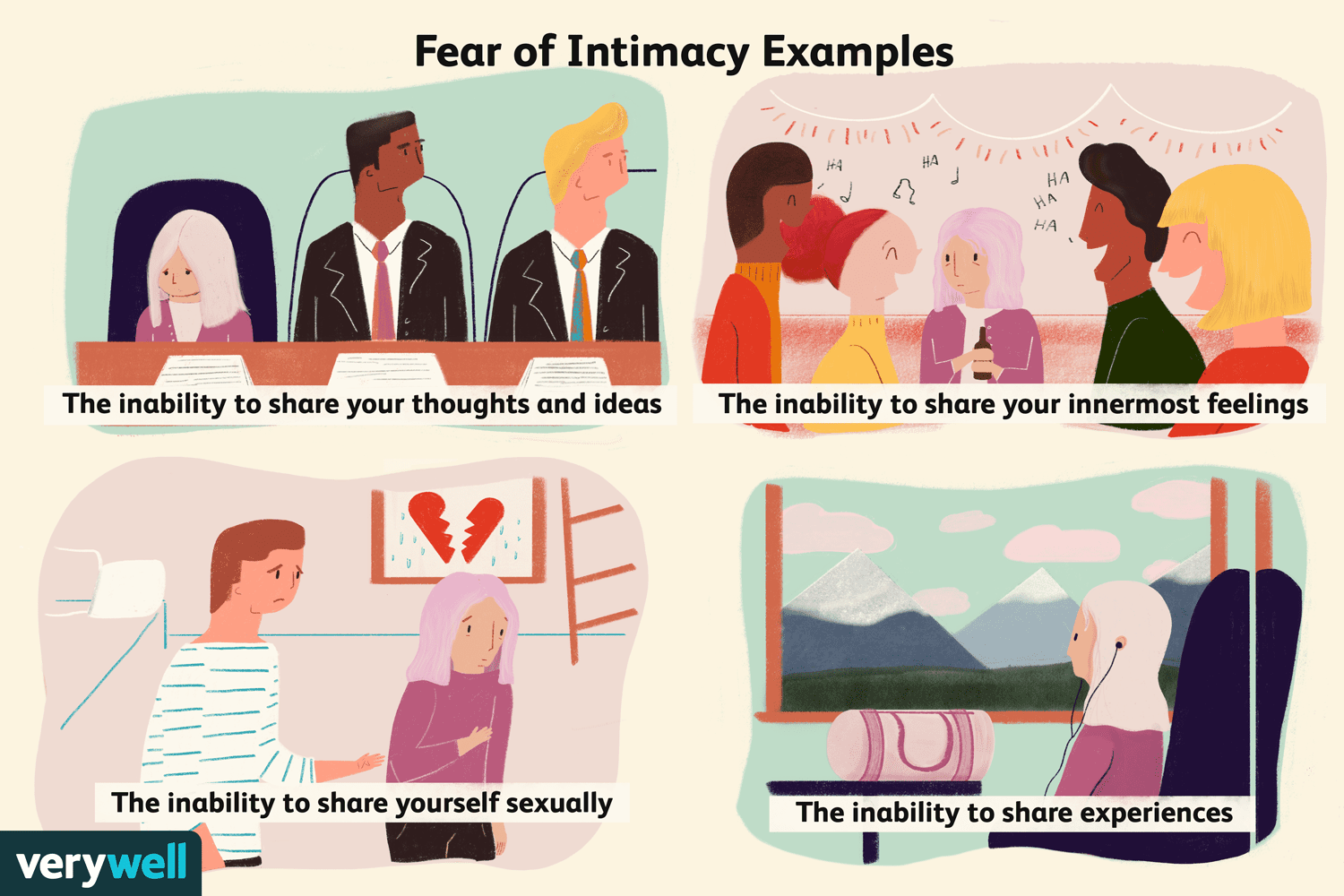
Fear of intimacy can stem from several causes, including certain childhood experiences such as a history of abuse or neglect. The fear may involve one or more of these types of intimacy to different degrees:
- Intellectual: The ability to share your thoughts and ideas with another
- Emotional: The ability to share your innermost feelings with another
- Sexual: The ability to share yourself sexually
- Experiential: The ability to share experiences with another
- Spiritual intimacy: The ability to share your beliefs beyond yourself, in a higher power, or individual connection to others and the world
Overcoming this fear and anxiety can take time, both to explore and understand the contributing issues and to practice allowing greater vulnerability.
Fear of Intimacy vs. Fear of Vulnerability
The fear of intimacy is separate from the fear of vulnerability, though the two can be closely intertwined. A person living with a fear of intimacy may be comfortable becoming vulnerable and showing their true self to the world at first, but there are often limits to how vulnerable they’ll allow themselves to be.
For someone who fears intimacy, the problem often begins when the person finds relationships becoming “too close.”
What Causes Fear of Intimacy?
Fears of abandonment and engulfment and, ultimately, a fear of loss are at the heart of the fear of intimacy for many people, and these fears can coexist. Although the fears are different from one another, both cause behaviors that alternately pull the partner in and then push them away again.
These fears are generally rooted in past childhood experiences and triggered by the here-and-now of adult relationships. This leads to confusion if a person focuses on examining the relationship solely based on present-day circumstances.
Fear of intimacy can also be linked to anxiety disorders.
Fear of Abandonment
Those who are afraid of abandonment worry that their partner will leave them. This fear often results from the experience of a parent or other important adult figure abandoning the person emotionally or physically as a young child.
Fear of Engulfment
Those who have fear engulfment are afraid of being controlled, dominated, or “losing themselves” in a relationship, and this fear sometimes stems from growing up in an enmeshed family.
Anxiety Disorders
The fear of intimacy may also occur as part of a social phobia or social anxiety disorder. Some experts classify the fear of intimacy as a subset of these conditions.
People who are afraid of others’ judgment, evaluation, or rejection are naturally more likely to shy away from making intimate, personal connections. In addition, some specific phobias, such as the fear of touch, may occur as part of the fear of intimacy.
Other people, however, may be comfortable in superficial social situations, numbering their acquaintances and social media “friends” in the hundreds, but have no deeply personal relationships at all.
In fact, the fear of intimacy can be harder to detect as today’s technology allows people to hide behind their phones and social media.
Risk Factors
Risk factors for a fear of intimacy often stem back to childhood and the inability to securely trust parental figures and caregivers, which can lead to attachment issues. Experiences that may increase the risk of fearing intimacy include:
- Enmeshed families: While enmeshed families may, on the surface, appear to be loving and supportive, boundaries and roles might be blurred and lead to issues with attachment, independence, and intimacy.
- Emotional neglect: Parents who are physically but not emotionally available send the message to children that they (and by extension, others) can’t be relied on.
- Loss of a parent: People who have lost a parent through death, divorce, or imprisonment may be left with feelings of abandonment and may have a harder time forming romantic attachments as adults. Research has found that a fear of abandonment is associated with mental health problems and later anxiety in romantic relationships.
- Parental illness: Illness in a parent can result in a feeling of not being able to rely on anyone but oneself, especially when it involves role reversal or the need to “play parent” and care for other siblings at a young age.
- Parental mental illness: Research suggests that parental mental illness, such as narcissistic personality disorder, can affect attachment formation in children, which may result in insecure attachment and poor coping strategies in adulthood.
- Parental substance use: Substance use issues can make it difficult for parents to provide consistent care, which can interfere with the formation of attachments.
- Physical or sexual abuse: Abuse in childhood can make it difficult to form both emotional and sexual intimacy as an adult.
- Neglect: People who experienced neglect as children may find it difficult to trust and rely on others, including intimate partners, as adults.
- Verbal abuse: Children who are emotionally abused may grow into adults who fear being ridiculed or verbally abused if they share anything with others, which can lead to an inability to share and be vulnerable in relationships with other people.
A fear of intimacy is also more common in people who are taught not to trust strangers, in those who have a history of depression, and in those who have experienced rape.
Traumatic interactions in relationships outside the nuclear family, such as with a teacher, another relative, or a peer who is a bully, may also contribute to a fear of intimacy.
While the focus is primarily on childhood, the experiences of relationships during adolescence and adulthood can continue to influence a person’s openness to intimacy.
Signs and Manifestations
The fear of intimacy can play out in a number of different ways in any type of relationship, whether romantic, platonic, or familial.
It’s important to note that the manifestations of an underlying fear of intimacy can often be interpreted as the opposite of what the person is trying to achieve in terms of connection. For instance, a person may strongly desire close relationships, but their fear prompts them to do things that cause problems forming and sustaining them.
Ironically, relationship-sabotaging actions are usually most pronounced when the relationship in question is one that the person particularly values.
For those who have been involved with a person living with a fear of intimacy, this paradox is particularly important to understand. The fear does not usually cause major difficulties unless a person truly longs for closeness. Here are some specific behaviors that are commonly seen.
Serial Dating and Fear of Commitment
A person who has a fear of intimacy is often able to interact with others, at least initially. It’s when the relationship grows closer and the value of the relationship grows that things begin to fall apart.
Instead of connecting on an intimate level, the relationship is ended in some way, and replaced by yet another, more superficial relationship. The pattern that emerges is many short-term relationships. There are a number of reasons why a person may appear to have a “commitment phobia” or be accused of being a serial dater; fear of intimacy may be one.
Perfectionism
The underlying fear of intimacy often lies a feeling that a person does not deserve to be loved and supported. This leads to the need to be “perfect” to prove oneself lovable.
Whether it takes the form of being a “workaholic” or other manifestations of perfectionism, the fear often works to push others away rather than draw them near.
Difficulty Expressing Needs
A person with a fear of intimacy may have great difficulty expressing needs and wishes. Again, this may stem from feeling undeserving of another’s support.
Because partners are unable to “mind read,” those needs go unfulfilled, essentially confirming the person’s feelings that they are unworthy. This pattern can translate into a vicious circle, one in which the lack of a partner understanding unexpressed needs leads to a further lack of trust in the relationship.
Sabotaging Relationships
People who have a fear of intimacy may sabotage their relationship in many ways. Act of sabotage may take the form of nitpicking and being very critical of a partner. It may also take the form of making themselves unlovable in some way, acting suspicious, and accusing a partner of something that hasn’t actually occurred.
Difficulties With Physical Contact
A fear of intimacy can also lead to extremes when it comes to physical contact. On one side, a person may avoid physical contact completely. On the other, they may seem to have a constant need for physical contact.
Diagnosis
There is a spectrum when it comes to fear of intimacy, with some people having only mild traits and others being unable to form any close relationships at all. Psychometric testing can help a psychologist or therapist better define where a person lies on the spectrum and also evaluate for other mental health conditions.
The Fear of Intimacy Scale is one measurement that can help objectively assess the condition.
How to Know If You Have Intimacy Issues
Watch out for the following signs in yourself that may indicate a fear of intimacy:
- An inability to express what you need and want from those in your life
- Poor communication or avoidance of serious topics in your relationships
- Trouble trusting your partner with important matters or decisions
- An unwillingness to share your dreams and/or goals
- Purposely sabotaging relationships once you begin to get close to the other person
- Avoiding physical contact with your partner
- Refraining from being spontaneous or adventurous in the bedroom
Treatment for Fear of Intimacy
Professional guidance is often required to navigate a fear of intimacy, especially if the fear is rooted in complicated past events. Choose your therapist carefully, as therapeutic rapport, mutual respect, and trust are essential to the work of healing. You may find that you need to try several therapists before you find a match.
Your therapist can help you come to terms with any past or present events that are clouding the situation and help you design a series of small steps to gradually work through your fear.
Many people who have a fear of intimacy also experience problems with depression, substance use, and anxiety disorders that also need to be addressed. A therapist can assist with these individual concerns as well.
Get Help Now
We’ve tried, tested, and written unbiased reviews of the best online therapy programs including Talkspace, BetterHelp, and ReGain. Find out which option is the best for you.
Coping With a Fear of Intimacy
Whether you consult with a therapist or not, there is some work that must be done in order to conquer a fear of intimacy that only you can do. This largely comes down to facing and challenging negative attitudes about yourself, which is critical if lasting change is to take place.
This process can take time, a willingness to accept uncertainty, and the effort to review your life to discover how and why you developed this fear.
Accept Uncertainty
Those who fear intimacy ultimately fear the consequences of a relationship that turns sour. It’s important to accept the fact that there are no guarantees in life or in human relationships. Every connection with another person is ultimately a gamble. Despite that, social relationships are a basic driving goal of human existence.
Practicing courage can make a difference, and it’s been found that developing positive relationship experiences can decrease fear. A caveat is that it’s important to do this with someone who you believe you can trust. Try to focus more on living day to day, rather than focusing on (or needing) a particular outcome.
Express Self-Compassion
In order to successfully battle the fear of intimacy, you must first be comfortable with yourself. If you truly know and accept your own value and worth as a person, then you know that rejection is not as crushing as it may seem.
You will be able to set appropriate boundaries to avoid engulfment and cope with abandonment if it comes along.
Practicing self-compassion may sound easy to some, but for others, it’s not always intuitive. There are several excellent books and workbooks available that may be helpful if you’re not certain where to begin.
Press Play for Advice On Cultivating Self-Love
Hosted by therapist Amy Morin, LCSW, this episode of The Verywell Mind Podcast, featuring actress KJ Smith, shares how to cultivate self-love. Click below to listen now.
Follow Now: Apple Podcasts / Spotify / Google Podcasts
Look at Your Past
Most of us don’t want to think negatively about a parent or parental figure but try to honestly evaluate your childhood relationships in an effort to zero in on possible contributions to your fear of intimacy. Think about the messages you received in your family and compare these with the messages you should have received.
If you had a neglectful, abusive, or engulfing parent, recognizing that your relationship with your parent is not the only model for intimate relationships may help you realize what might be possible in terms of intimacy.
Tune Into Your Inner Dialogue
The inner dialogue that leads to the manifestations of a fear of intimacy is often deep-seated, and after living a lifetime as your own inner critic, it may seem normal to you.
Rather than accepting that critic, try to catch yourself casting negative self-judgments. Look to see where they are coming from and challenge and correct them when you can.
Look at Your Goals
What do you really want in life? Do you want a long-term intimate relationship? If so, how have you pushed people away in the past? Take time to review what your wishes and goals were and are and how your actions either help or hinder them.
Give Yourself Time
Overcoming a fear of intimacy doesn’t happen overnight. Even when you feel like you have gained ground, you will inevitably have setbacks. Grant yourself forgiveness when this happens and speak kindly to your inner self.
Try not to view your fear as a character flaw. Instead, try to look at it as simply something that likely stems from your distant past that you can work through in order to have a better future.
Research has also shown that positive relationship experiences can be beneficial for those who have issues with intimacy. Having such positive experiences may improve your ability to form intimacy over time.
Advice for Loved Ones
If it is your loved one who is coping with a fear of intimacy, you will need to practice patience. Setbacks are perfectly normal and to be expected. Establishing safety and trust is of utmost importance so that your loved one can begin to open up.
Try to not react personally or with anger if your loved one tries to push you away. Recognize that they are not rejecting you, but rather that they fear you will reject them.
Keep your partner’s fear of abandonment, rejection, or engulfment in mind as you think about their words and behaviors. Their upbringing may cause them to interpret an action in a completely different way than you would.
For example, if your partner is coping with a fear of engulfment due to growing up in an enmeshed family, surprising them by saying, “we are going on a trip” may not be a loving and pleasant surprise at all, and may reinforce their fear of being controlled. Instead, providing clear choices and making sure your partner is involved in all decisions might be interpreted as more loving.
Regular reminders of your love, through both words and actions, are important. Don’t assume your partner “feels” loved. Rather, create an environment that supports the fact that they are deserving of it.
Most importantly, let your partner know that overcoming the fear is a team effort. While you are likely curious, it’s not important for you to understand how this all started. Instead, what your loved one needs is support and a willingness to listen when they are ready to share.
Finally, keep in mind that fear of intimacy usually rears its head in relationships that a person cherishes—not those that are superficial. It’s also usually triggered by positive emotions instead of negative ones.
Questions and Tips For Building Intimacy In Your Relationship
Keep in Mind
Actions rooted in a fear of intimacy only perpetuate the concern. With effort, and especially with a good therapist, however, many people have overcome the fear and developed the understanding and tools needed to create long-term intimate relationships.
