

Key Takeaways
- Use different strategies like making doodles, using mnemonics, and listening to voice memos to help with studying.
- Create a “launch pad” by your door to keep your backpack and keys organized for the next day.
- Set reminders to take your ADHD medication as prescribed to help manage symptoms effectively.
Every autumn, thousands of students move away from the structure and safety of home to the freedoms of college life. While it’s an exciting time filled with many possibilities for learning and growth, it can also be challenging academically and socially—especially for college students with attention-deficit/hyperactivity disorder (ADHD).
Learn some of the challenges that college students with ADHD face, as well as strategies that can be used to overcome these obstacles. This includes learning how to study with ADHD and taking certain actions to foster friendships with other students.
Qualities for Student Success
Sarah D. Wright, ADHD coach and author of “Fidget to Focus: Outwit Your Boredom—Sensory Strategies for Living with ADD,” explains that successful students usually have four qualities that help them achieve their goals:
- Sticking with things even when the going gets tough (perseverance)
- Ability to delay gratification and focus on the big picture
- Time management and organizational skills
- Striking the right balance between fun and work
These particular skills, however, don’t come easily to people with ADHD. One of the hallmarks of this mental health condition is impaired executive functioning. This means that students with ADHD may struggle with staying organized, sticking to a plan, and managing time effectively.
How ADHD Affects College Students
College students often face more responsibilities, less structured time, increased distractions, and new social situations—all while lacking access to many of the support systems they had in high school. Impaired executive functioning can make handling these changes a bit harder for students with ADHD, resulting in:
- Poor academic performance and achievement: Students with ADHD frequently report feeling dissatisfied with their grades. They may struggle in their classes due to difficulties starting and completing tasks, disorganization, problems remembering assignments, difficulty memorizing facts, and trouble working on lengthy papers or complex math problems.
- Troubles with time management: Students with ADHD often have irregular lifestyles that result from poor time management. This can create problems with being on time, preparing and planning for the future, and prioritizing tasks.
- Difficulty regulating and managing emotions: Students with ADHD also often struggle with social issues, negative thoughts, and poor self-esteem. Some ADHD symptoms can make friendships and other relationships more challenging while worrying about these issues contributes to poor self-image.
The good news is that these areas of executive function can be improved. For most college students with ADHD, the problem isn’t in knowing what to do, it’s getting it done. Developing strategies that focus on this goal can lead to positive academic and social effects.
Tips for Succeeding in College With ADHD
There are several strategies you can use to help stay on track if you are a college student with ADHD. Here are seven that Wright suggests.
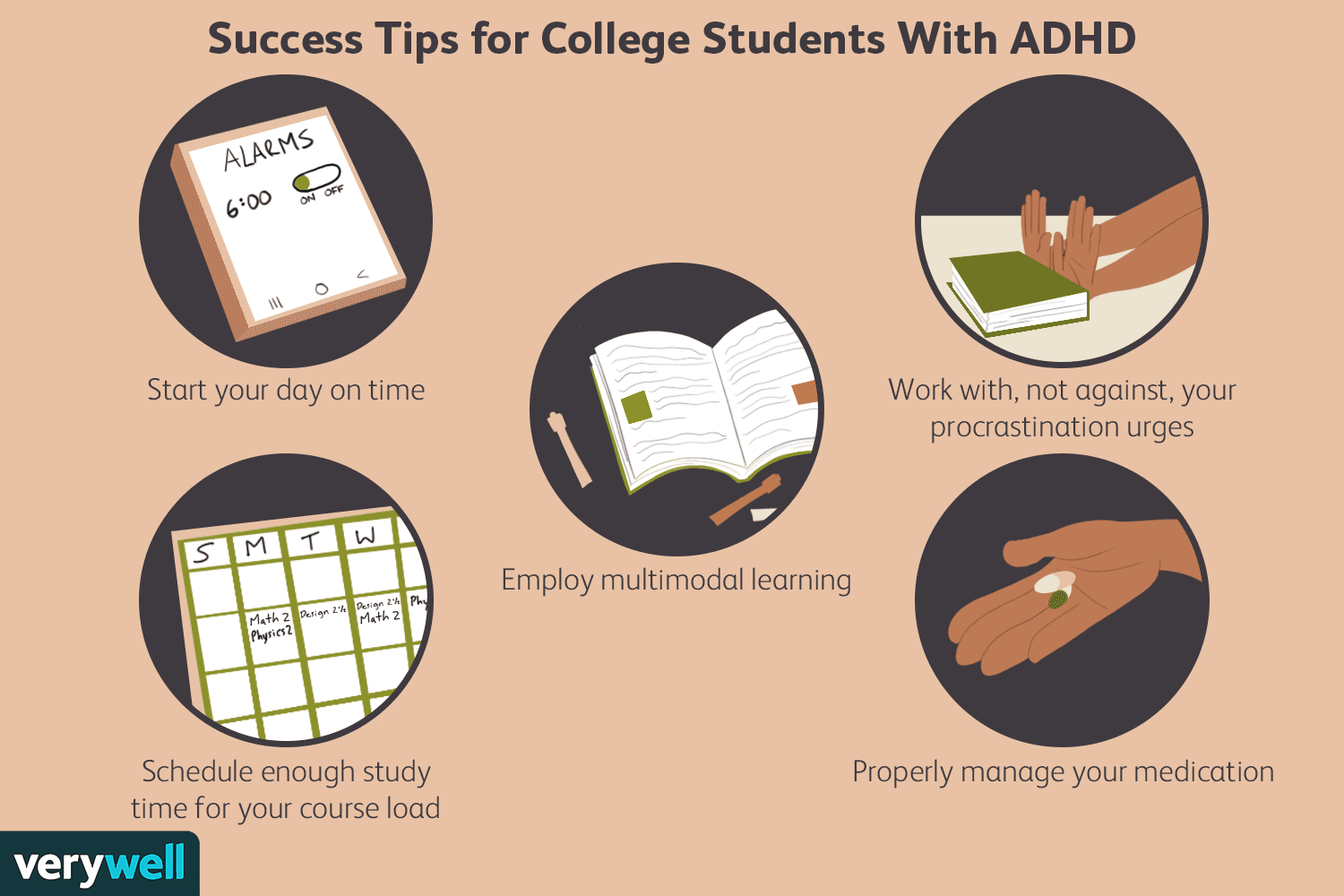
1. Take Steps to Start the Day on Time
There are three main factors that contribute to being late in the morning: Getting up late, getting sidetracked, and being disorganized.
If Getting Up Late Is an Issue
Set two alarms to go off in sequence. Put the first alarm across the room so you have to get out of bed to turn it off. Put the second where you know it will bother your roommates, increasing the consequences if you don’t get out of bed and turn it off. Set both alarms to go off early so you can take your time getting ready.
If Getting Sidetracked Is an Issue
If certain actions tend to derail you, like checking your email or reading the news, make it a rule that those activities must wait until later in the day so you can stay on task. Also, figure out how much time you need to dress, eat, and get organized, then set alarms or other reminders to cue these tasks.
Three options are:
- Use a music mix as a timer. If you have 30 minutes to get ready, the schedule might look like this: wash and dress to songs 1 to 3, eat breakfast to songs 4 to 6, get your stuff together during song 7, and walk out the door by song 8. This option works best if you use the same mix every morning.
- Use your phone or buy a programmable reminder watch so your alarms are always nearby.
- Put a big wall clock in your room where you can easily see it. If your room is part of a suite with a common room and bathroom, put wall clocks in those spaces as well.
If Being Disorganized Is the Issue
Create a “launch pad” by your door. Collect all of the things you’ll need the next day the night before (like your backpack and keys), and put them on the pad so you can grab them and go. Include a note to help you remember important events for the day, such as an appointment or quiz.
2. Work With Your Urge to Procrastinate
Though it may sound counterproductive, if you feel the urge to procrastinate, go with it. When you have ADHD, sometimes things only get done right before they’re due. At that point, nothing has higher priority, increasing the urgency and consequences if you don’t do them now. These qualities are what can finally make a task doable, so work with them.
If you plan to procrastinate, it’s important to stack the deck so you can pull it off. For example, if you have to write a paper, make sure you’ve done the reading or research in advance and have some idea of what you want to write. Next, figure out how many hours you’ll need, block those hours out in your schedule, and then, with the deadline in sight, sit down and do it.
3. Study Smarter, Not Harder
Boredom and working memory issues can make studying a bit more challenging for students with ADHD. Rather than trying harder to force the information into your head, get creative with the learning process.
If you’re wondering how to study with ADHD, research shows that multi-modal learning or learning via a variety of different methods can be helpful. Ideas include:
- Highlight text with different-colored pens.
- Make doodles when taking notes.
- Record notes as voice memos and listen to them as you walk across campus.
- Use mnemonics to create funny ways to remember facts.
- Stand up while you study.
- Read assignments aloud using an expressive (not boring) voice.
- If you can, get the audio version of a book you need to read and listen to it while you take notes and/or exercise.
- Work with a study buddy.
These won’t all work for every person, but try mixing up your strategies and see what happens. Taking study breaks every couple of hours and getting enough sleep are also part of studying smarter, not harder.
Sleep impacts learning in two main ways. First, sleep deprivation has a negative impact on short-term memory, which is what you use to learn the materials when you study. Second, sleep is needed to move short-term memories into long-term memory, which is what you rely on when it’s time to take the test.
Sleep is important for both short- and long-term memory, making it critical for both learning new material and recalling what you’ve learned.
4. Schedule Your Study Time
Many students with ADHD are highly intelligent. They can pull off a passing grade, or even a good one, in high school by cramming their studies in the night before a test.
This strategy doesn’t work as well in college since cramming reduces your ability to retain what you’ve learned long-term. This can make it harder to remember what you need to know once you enter your field of choice.
One good rule of thumb for college students is to study two to two-and-a-half hours per week for every course credit hour. Put this time into your schedule to make sure you have it.
5. Plan and Prioritize Your Time
It may sound strange, but it’s important to plan time to plan. If you don’t develop this habit, you may find yourself always being reactive with your day rather than proactive—the latter of which can help you take more control over your schedule.
Set aside time on Monday mornings to develop a high-level plan for the week, using Friday mornings to plan for the weekend. In addition, do a daily review of your plan over breakfast—possibly adding pertinent details—to make sure you know what’s coming your way that day.
When making your plans, differentiate between what you need to do and everything that can or should be done. Prioritize what needs to be done first, taking care of these items before moving on to lower-priority tasks on your list.
6. Implement Strategies to Stick to Your Plan
With ADHD, sticking to a plan is often difficult. If you like rewards, use them to assist with this. For instance, you might tell yourself, “I’ll read for two hours, then go to the coffee house.” Having something to look forward to can make it easier to muster through your studies.
If you’re competitive, use this personality trait instead. Pick another student in your class whom you want to do better than and go for it. If you know that you respond to social pressure, make plans to study with classmates so you won’t let them down. Or hire a tutor so you have structured study time.
Research suggests that focusing on skills related to time management, target planning, goal setting, organization, and problem-solving can all be helpful for students with ADHD.
Hiring a coach can also be beneficial. There is growing evidence, both research-based and anecdotal, that supports ADHD coaching as a vital strategy in helping students learn to plan, prioritize, and persist in following their plans.
This type of coaching is sometimes described as a form of life coaching influenced by cognitive behavioral-type therapy, which helps people develop behaviors, skills, and strategies to better deal with ADHD symptoms. It can lead to greater self-determination and direction, reduced feelings of overwhelm and anxiety, and increased self-confidence and self-sufficiency.
7. Manage Your Medication
One study found that only around 53% of college students with ADHD adhere to their medication plan. Poor medication adherence can have serious consequences, contributing to poor academic performance and decreased graduation rates.
Steps you can take to stay on top of your ADHD medications include:
- Find a local healthcare provider: Regularly monitoring your medications helps ensure that you are at the best dosage for you. If you’re going to school a long way from home, find a local healthcare provider to meet with regularly. You can also schedule regular visits with your university’s health services.
- Find a local pharmacy: Determine where you’ll order and pick up your medication. Set reminders on your phone so you know when to refill your prescription. You may also be able to sign up for text reminders.
- Store medications safely: Abuse of ADHD medications is on the rise on college campuses, even though this can result in high blood pressure, increased feelings of anger and distrust, trouble sleeping, and even strokes. Keep your ADHD medications in a safe location and never share them with others.
- Set reminders to take your medication: If you are struggling to take your medication as prescribed, consider using a reminder app or setting reminders on your phone.
Research points to medication as the most effective and available ADHD treatment option. However, it’s important to talk to your care provider to decide the best treatment approach for your individual situation and needs.
Social Strategies for Students With ADHD
Interpersonal challenges are also common for college students with ADHD. While being out on your own for the first time can be exciting, this mental health condition can lead to difficulties in building and maintaining friendships.
CHADD—which stands for Children and Adults with Attention-Deficit/Hyperactivity Disorder, an organization funded by the U.S. Centers for Disease Control and Prevention—offers these tips:
- Remember that you aren’t the only one who feels the way you do. Other students may be feeling just as excited (and overwhelmed) as you. During orientation, help them feel more comfortable by being friendly and listening when they share their concerns.
- Look for opportunities to meet and interact with others. You might make new friends in class, in your dorm, at the school cafeteria, or at other places on campus. View each of these locations as an opportunity to expand your social network.
- Find activities or clubs to join. Colleges and universities are great places to explore hobbies and meet people who share your interests. Check out bulletin boards on campus or look at your school’s website to learn more about the options that are available.
- Stay in contact with your current friends. Don’t let your high school friendships fade into the background just because you’re at college. While you’re busy with new things and might not see each other every day, stay in touch by phone, text, social media, or email. Your current friends can be great sources of social support.
Get Help Now
We’ve tried, tested, and written unbiased reviews of the best online therapy programs including Talkspace, BetterHelp, and ReGain. Find out which option is the best for you.
