

Why It Works
- Frying the noodles and other ingredients with lard gives the dish its signature rich flavor and mouthfeel.
- Letting the ingredients rest in intervals in a screaming-hot wok helps them take on the dish’s characteristic smokiness without too much extra work.
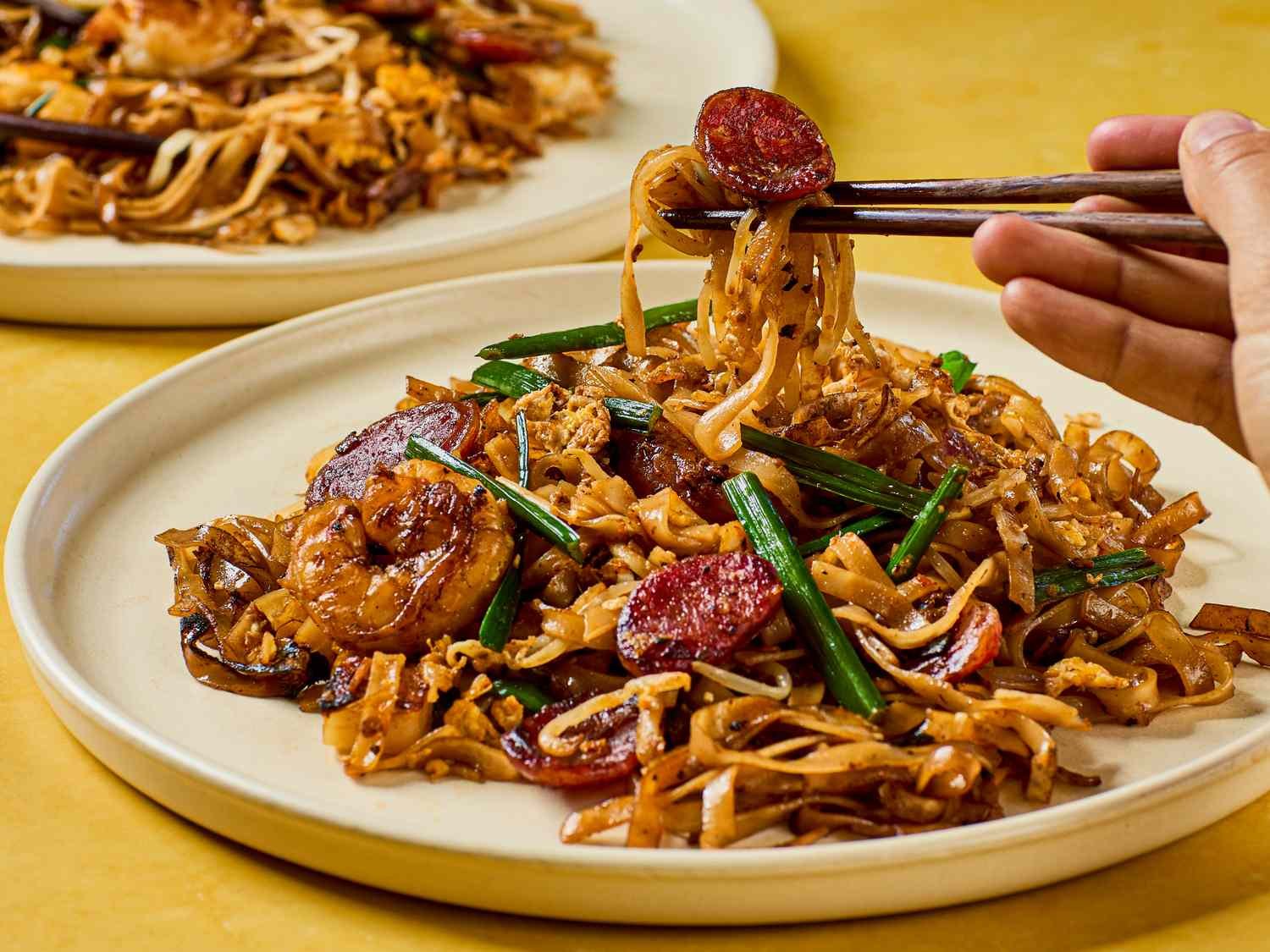
Char kway teow is one of the most popular stir-fried noodle dishes in Malaysia. Originating from the northern island state of Penang, it consists of broad, flat rice noodles stir-fried with seafood. The noodles are liberally seasoned with soy sauce and, most importantly, cooked over incredibly high heat, which imparts a characteristic smoky flavor. There are myriad ways to spell the dish in the Roman alphabet, and it isn’t uncommon to see it referred to as char kueh tiao or char kuay tiaw. Its name comes from the Hokkien pronunciation of 炒粿條.
Many cuisines around the world have a version of fried noodles. In Southeast Asia, you’ll find various wheat noodle dishes, such as mee goreng (which has several regional variations), as well as rice noodles like pad Thai and pancit bihon. Pad Thai is arguably the region’s most visibly exported noodle dish, as it’s served in many Southeast Asian restaurants worldwide. Char kway teow is pad Thai’s southern cousin: The dish is softer in texture and heftier, with richness from lard. It’s essential to use fresh rice noodles whenever possible, as they offer the soft suppleness you want.
Unlike pad Thai, which journalist Isabella Kliger notes in Smithsonian Magazine was ostensibly created in the 1960s as a national dish for cultural export, char kway teow has humbler beginnings. Chinese fishers and cockle-gatherers reportedly invented the dish in pre-independence Malaysia, sometime before 1957, to sell their surplus catch. To this day, shrimp remains the quintessential protein used in char kway teow. However, with inflation and overfishing, the shellfish have become increasingly expensive, turning shrimp-laden char kway teow into a luxury.
It’s extremely uncommon to make char kway teow at home, largely because hawkers prepare it over blazing-hot gas ranges that can churn out a plate of the noodles in minutes. Malaysians dine out almost as if it’s a sport, and char kway teow is firmly among the dishes traditionally eaten outside the home. That said, for many of us around the world (perhaps you!), your favorite char kway teow “uncle”—an endearing term for vendors—may be a little too far out of reach, so knowing how to make it at home is incredibly useful when the homesickness pangs hit. And thankfully, despite what many would say, it is absolutely possible to make it at home, as long as you have a gas range and the tenacity to make it work for you. Let’s get into the components of char kway teow.
Serious Eats / Melati Citrawireja
The Key Ingredients for Char Kway Teow
The Best Noodles to Use for Char Kway Teow
Fresh wide, flat rice noodles are best; when cooked, they become soft and supple—a texture that’s one of the signature attributes of char kway teow. In Malaysia, fresh rice noodles are widely available in supermarkets, and you’ll likely be able to find them in Asian grocery stores in the US, too. Check the refrigerated aisles—chances are they’ll be there. If you come across rolled rice noodles (cheong fun) instead, those work too, though they’re more delicate. Simply cut them into strips no wider than half an inch and unroll them gently.
If all you can find are dried flat rice noodles—even pad Thai noodles—they’ll work in a pinch. The noodles will still taste great, but their texture will be slightly chewier than is traditional for this dish. Before using them in the dish, you’ll need to either cook them or soak them in boiling water to soften them, then drain and rinse them under cold water. The texture you’re looking for is one where you can easily squish the noodle between two fingers.
Don’t Skimp on the Seasoning
This is by far the trickiest part for any char kway teow vendor or home cook to nail. Some folks like it saltier, some sweeter, some want it absolutely doused in sauce, while others prefer a lighter touch. The ratio of the ingredients for the sauce in my recipe below is modeled after my favorite char kway teow stall in Kuala Lumpur, which a chatty older uncle runs: It delivers enough umami to stand up to the wok hei without overpowering the dish, isn’t overly saturated with dark soy sauce (I personally prefer lighter-colored noodles), and pleasantly spicy from just a touch of white pepper and chile. If you have some sambal belacan on hand, it has the perfect heat level for char kway teow. Alternatively, you can use other ready-made chili pastes or sauces, such as sambal oelek, sambal tumis (from making nasi lemak), or, in a pinch, even plain chili crisp.
The Best Proteins to Use in Char Kway Teow
The protein in char kway teow is often seafood, thanks to its origins. As I mentioned earlier, shrimp is an essential ingredient. Blood cockles were once common in char kway teow, but that’s becoming increasingly rare these days, primarily due to the elevated risk of hepatitis transmission via the shellfish. This recipe doesn’t call for blood cockles, but many might appreciate a half-dozen freshly shelled cockles or clams stirred through in the last minute of cooking. Fish cakes are also a common and economical addition, and vegetarian versions typically call for slices of firm tofu. For many people these days, char kway teow isn’t char kway teow without lap cheong, a cured Chinese sausage that adds chew and a deeply savory note. You can find links of lap cheong relatively easily at Asian supermarkets, where it’s often sold bunched together.
Lard Is Your Friend
Char kway teow is often made with lard, which imparts a savory flavor and a lip-smacking mouthfeel. I tested several batches of char kway teow using neutral cooking oil, but it simply didn’t have the richness that lard brings to the dish. In Malaysia, it’s much more common to purchase pre-cubed raw pork fat from the butcher to render the lard yourself, rather than buying a tub of ready-made lard. The delicious by-product of this rendering is chu yau char (crispy pork cracklings). Most stalls that use lard stir in a spoonful of chu yau char, resulting in delightfully crunchy bursts of fat. If you would like to reduce the amount of saturated fat in the recipe, you can use your preferred cooking fat, such as vegetable or canola oil, along with a teaspoon of lard for added flavor. Vegetarian versions use shallot oil and/or garlic oil, which provide similar—although not identical—savory notes and full mouthfeel.
Vegetable Add-Ins
Vegetables are admittedly an afterthought in char kway teow. Chinese chives are a standard ingredient, while mung bean sprouts bulk up the dish, adding freshness and crunch. For vegetarian versions, hardy mustard greens and bok choy can be added, though simply increasing the chives and bean sprouts will also suffice. I’ve also included minced preserved radish for its sweet-sharp flavor; it’s not a common addition, but one that’s a delight whenever I encounter it.
Serious Eats / Melati Citrawireja
The Key Techniques to Making the Best Char Kway Teow
Many people have waxed on about what wok hei (which means “breath of a wok” in Cantonese) is and how it affects the flavor of a dish. For char kway teow, wok hei is essential—without it, people often say, “This is just regular fried kway teow, not char kway teow.” This is what prevents most people from making char kway teow at home, and it’s the main reason why I did not include it in the original Malaysian cuisine guide I developed for Serious Eats. As discussed extensively in the 2022 Serious Eats digital issue, The Wok, the only real way to achieve wok hei at home is to get an outdoor wok burner. Indoors, wok hei is still achievable with a gas range, combined with fellow Serious Eats contributor Tim Chin’s torch hei technique.
However, during testing in my Malaysian kitchen on a gas stove and in cross-testing on a gas stove in the US, the torch hei route wasn’t necessary for this particular dish—simply letting the ingredients rest in between stirring helped them develop sufficiently dark colors and smoky flavors. Be sure to open all the windows and turn on the exhaust fan; my poorly ventilated kitchen meant my home smelled like lard for weeks. (A novelty for guests, but not so fun for my perpetually hungry cats searching in vain for the source of said smell.) That said, I am based in Malaysia, and gas ranges available in Asia are generally more powerful than those in the West, so you might find torch hei necessary, depending on the power of your stove. If you do incorporate this blowtorch step, do so towards the end of step four below, during what I call the stir-and-rest portion.
What’s the “stir-and-rest,” you ask? It’s a technique in which I let the ingredients sit in a screaming-hot wok between bursts of stirring, helping them absorb smoky flavor and develop color without burning. For every 10 seconds of vigorous stirring, I spread the ingredients evenly across the wok and let them rest for about five seconds before repeating the process. This encourages more even browning, and the resulting smokiness is genuinely impressive. If all you have is an indoor electric or induction range, the noodles will still turn out delicious—but for the sake of preventing intense debate on Southeast Asian social media, please refrain from calling it char kway teow.
This Fast and Flavorful Noodle Stir-Fry Is a Malaysian Street Food Icon
Cook Mode
(Keep screen awake)
For the Sauce:
1/4 cup (60 ml) light soy sauce
1 1/4 teaspoons dark soy sauce
1/2 tablespoon oyster sauce
1/2 tablespoon fish sauce
1/2 teaspoon Diamond Crystal kosher salt; for table salt, use half as much by volume
1/4 teaspoon granulated sugar
1/4 teaspoon white pepper
For the Noodles:
1/4 cup (60 ml) lard, homemade or store-bought, divided, see notes
1 link Chinese sausage (1 3/4 ounces; 50 g), such as lap cheong, thinly sliced at a diagonal, divided
2 ounces (57 g) Chinese-style fish cakes, sliced into 1/2-inch pieces, divided (see notes)
8 medium (36/40 to 41/50) shrimp (about 1 pound; 454 g), shelled and deveined, divided
3 medium cloves garlic (1/2 ounce; 15 g), finely chopped, divided
4 teaspoons Chinese-style minced preserved radish, such as chai poh (菜脯), divided (optional)
1 pound (454 g) fresh flat-rice noodles, such as kway teow (粿條), divided, see notes
1 cup mung bean sprouts (about 3 1/4 ounces; 90 g), divided
4 teaspoons sambal belacan, sambal oelek, or preferred chile paste (about 1 1/2 ounces; 40 g), divided
4 teaspoons (20 ml) neutral oil, such as canola or vegetable, divided
4 duck eggs (preferable) or chicken eggs, divided, see notes
1/4 cup Chinese chives (about 1 1/2 ounces; 40 g), stems removed and cut into 2-inch pieces, divided
4 teaspoons crispy pork cracklings, such as chu yau char (猪油渣), divided (optional)
In a small bowl, whisk light soy sauce, dark soy sauce, oyster sauce, fish sauce, salt, sugar, and white pepper to combine, stirring well until salt and sugar are dissolved. Set aside.
Serious Eats / Melati Citrawireja
Set a wok over high heat. When wok begins to smoke, add 1 tablespoon of lard, along with 1/4 of the Chinese sausage, a 1/4 of the fish cakes, 1/4 of the shrimp, a 1/4 of the minced garlic, and 1/4 of the preserved radish, if using. Cook, stirring regularly with a metal wok spatula, to stir-fry ingredients, about 10 seconds. Let the ingredients rest until slightly charred, 5 to 10 seconds. Stir-fry to mix, another 10 seconds, then let the ingredients sit for another 5 seconds. (This stir-fry and resting cycle will continue throughout most of the cooking process.)
Serious Eats / Melati Citrawireja
Add 1/4 of the rice noodles and 1/4 of the bean sprouts, along with 2 tablespoons of the sauce mixture and 1 teaspoon sambal belacan. Cook, stir-frying and tossing ingredients, 10 seconds, then let rest until slightly charred, 5 seconds. Repeat stir-frying and resting 1 to 2 more times, until noodles and ingredients are evenly coated in the sauce and sambal belacan.
Serious Eats / Melati Citrawireja
Move cooked noodles to one side of the wok. On the empty side, add 1 teaspoon neutral oil and heat until it just shimmers. Crack 1 egg into the oil and, using the tip of the spatula, scramble the egg until cooked, about 10 seconds. Let egg rest for about 5 seconds, then fold eggs into cooked noodles, along with 1/4 of the Chinese chives and 1/4 of the crispy pork cracklings. Cook, stirring constantly, for 10 seconds, then let rest 5 seconds. Repeat stir-frying and resting until noodles are nicely browned and charred but not burned, 4 to 5 more times. (If using a blowtorch for additional wok hei, hold flame 2 to 3 inches above skillet while stirring constantly, until oil combusts and imparts a smoky aroma, about 30 seconds.)
Serious Eats / Melati Citrawireja
Transfer to a plate. Repeat steps 2 to 4 with remaining ingredients.
Serious Eats / Melati Citrawireja
Special Equipment
Gas range, wok
Notes
Fresh rice noodles are preferable for their soft chew, which is a key highlight of char kway teow. Rehydrated dried rice noodles are acceptable in a pinch, but will be firmer when rehydrated. If using dried rice noodles, cook according to package directions before proceeding with the recipe; drain and set aside.
A combination of neutral oil, such as canola or vegetable, and 1 teaspoon lard can be used in place of of lard.
You can still make a decent char kway teow without lap cheong. Simply increase the quantities of the fish cakes and shrimp.
To facilitate cooking, you can (and should!) pre-portion your ingredients and arrange your mise en place. Group together lap cheong, fishcakes, shrimp, minced garlic, and preserved radish and divide into 4 equal portions. Group fresh/cooked rice noodles and mung bean sprouts together and divide into 4 equal portions. Group Chinese chives and crispy pork together and divide into 4 equal portions.
Duck eggs have a richer, fattier flavor than chicken eggs, and are what most local hawkers use in Malaysia.
Make-Ahead and Storage
Char kway teow is best eaten immediately. Leftovers taste serviceable and last for up to 3 days in the fridge in an airtight container. To reheat: heat a wok over maximum flame until it smokes, and add no more than 1 teaspoon of neutral oil to lubricate the wok. Add the leftover noodles and vigorously stir for at least 30 seconds, then plate and serve.
