

Uterine or endometrial cancer is cancer that occurs in the uterus or the endometrial lining of the uterus. The risk of uterine cancer increases with age, with most cases occurring after menopause. People with diabetes, obesity, and high blood pressure are also at higher risk.
The Global Cancer Statistics Report has found that uterine cancer is the sixth most prevalent cancer among people assigned female at birth. Uterine cancer has also increased in incidence by 132% over the past 30 years. This is likely due to an increase in obesity rates and an aging population.
If you have been diagnosed with uterine cancer, it is helpful to know the stages for this cancer and what each stage means.
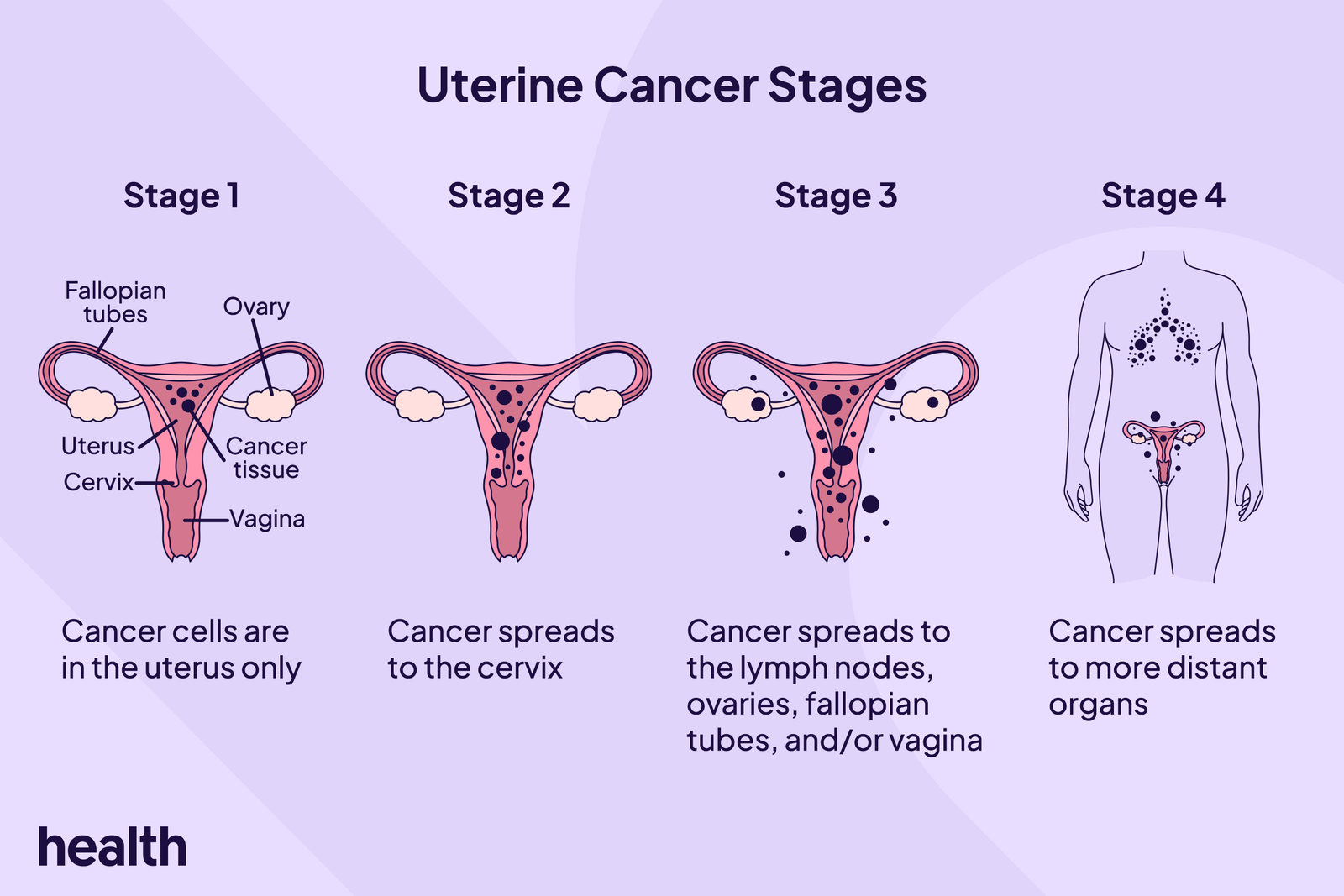
Illustration by Joules Garcia for Health
Staging cancer is a way to communicate how large your tumor or tumors are, where they are located, and if they have spread. Knowing your cancer’s stage can give you insight into the seriousness of your cancer diagnosis and your prognosis. It also allows your healthcare provider to formulate a treatment plan.
When staging cancer, healthcare providers use two systems for staging uterine cancer. These include the FIGO system (International Federation of Gynecology and Obstetrics) and the American Joint Committee on Cancer TNM staging system. They stage or classify cancer after considering three factors. These include:
- Tumor (T): They consider the size of the tumor and how far it has grown into the uterus and whether it has spread to nearby organs or structures.
- Lymph nodes (N): They also consider whether the cancer has spread to nearby lymph nodes, including those in the pelvis and those around the aorta (the primary artery that runs from your heart and down the back of your pelvis and abdomen).
- Metastasis (M): They look to see if the cancer has spread to distant sites in the body, like lymph nodes or organs in other parts of the body.
Once your T, N, and M categories are determined, this information is used to stage your cancer. If your staging is based on examining the tumors after your surgery, this is called surgical staging. If surgery is not possible, your staging is referred to as clinical staging.
If you have stage 1 uterine cancer, your symptoms likely include abnormal vaginal bleeding, such as heavier-than-normal periods, breakthrough bleeding between periods, or bleeding after menopause.
Treatment for this stage of cancer sometimes includes surgery like a hysterectomy, radiation therapy, or clinical trials. If you plan to have children later, your healthcare provider may recommend hormone therapy like progestin therapy. The additional letters after the one in stage 1 cancer provide more information about the type of cancer growth you are experiencing.
1A1
With this stage of cancer, your tumor is limited to the endometrium (the inner lining of your uterus).
1A2
If your healthcare provider communicates this stage, the tumor is a non-aggressive histologic type. Its growth is less than halfway through the myometrium (the underlying muscle layer of the uterus).
1A3
With this stage of cancer, your tumor is a non-aggressive histologic type limited to the uterus and ovary. It has not spread to any nearby lymph nodes or to distant parts of the body.
1B
If you have this stage of cancer, you have non-aggressive histologic types with growth more than halfway through the myometrium. It has not moved beyond the uterus. The cancer also has not spread to nearby lymph nodes or to distant parts of the body.
With this stage of cancer, the disease has spread to the cervix but is not outside of your uterus. There is also no cancer in nearby lymph nodes or distant parts of the body. Like stage 1, you may experience abnormal bleeding, spotting, or bleeding during menopause.
Treatment options are also similar to stage 1 and can include hysterectomy, radiation therapy, or clinical trials.
At this stage, your cancer has spread to the ovaries, fallopian tubes, vagina, or lymph nodes. Your bladder or the inner lining of the rectum are not yet impacted.
Like stages 1 and 2, you may experience abnormal bleeding. However, you may also experience pain and pressure in the abdomen. Bloating, discomfort during sex, feeling full after eating, or changes in bathroom habits are also possible.
Typical treatment options in this stage include hysterectomy, pelvic washing, chemotherapy, or radiation. The additional letters after the three in stage 3 provide more information about the type of cancer growth you are experiencing.
3A
With this cancer stage, the disease has spread to the outer surface of your uterus. It may also be in the nearby fallopian tubes or ovaries. Your cancer is not in nearby lymph nodes and has not spread to distant parts of your body.
3B1
If your healthcare provider says you’re at this stage, it means your cancer has spread to the vagina or the parametrium (the tissues around the uterus). The cancer is not in the nearby lymph nodes or distant parts of the body.
3B2
With this cancer stage, the disease has spread to the peritoneum, which is a sheet of smooth tissue that lines the abdomen and pelvis. It has not spread to the distant parts of the body, and it is not in the nearby lymph nodes.
3C1
If you’re at this stage, the cancer has spread to pelvic lymph nodes. But it’s not in the lymph nodes around the aorta or the distant parts of your body.
3C2
With this cancer stage, the disease has spread to lymph nodes around the aorta (para-aortic lymph nodes). It’s not in the distant parts of your body.
If you have stage 4 uterine cancer, the disease has spread to distant sites of your body beyond the pelvis like your bones, liver, or lungs. It also may or may not be in your lymph nodes. Symptoms of this stage are similar to the other stages. However, you may also experience symptoms related to the location of the cancer, such as difficulty breathing if the cancer is in your lungs.
As for treatment, the cancer may be too advanced for surgery. But you may still qualify for chemotherapy, radiation therapy, hormone therapy, immunotherapy, and targeted therapy.
4A
If your cancer is at this stage, it has likely spread to the bladder or rectum. It may or may not have spread to the nearby lymph nodes but has not spread to distant sites.
4B
When a healthcare provider has communicated this stage of cancer, it has spread to your abdominal peritoneum. At this stage, your cancer can be any size and it may or may not have spread to your lymph nodes.
4C
If you have this stage of cancer, it likely has spread to distant parts of your body, such as your lungs, bones, liver, or brain. You also may be assigned this stage of cancer if it has spread to lymph nodes outside of the abdomen or lymph nodes above the kidneys.
The prognosis of uterine cancer—or the likely outcome or survival rate of the disease—is not an exact science, but it can allow people to prepare for the potential outcome of their treatment. Prognosis or survival rates indicate what percentage of people live for a certain length of time after finding out they have cancer.
Usually, these numbers refer to the five-year survival rate. In other words, they let you know how many people are living five years after they were diagnosed. Keep in mind, these numbers are not exact and can be influenced by your age, health, and how your cancer responds to treatment.
Your underlying health conditions can also influence your prognosis. Conditions like diabetes, obesity, and high blood pressure could potentially worsen your prognosis.
Here are the five-year survival rates for uterine cancer:
- Localized cancer or stages 1 and 2: With this stage, the cancer has not spread beyond the uterus, and the five-year survival rate is 95%.
- Regional cancer or stage 3: With this stage, the cancer has spread to nearby lymph nodes or tissues like the pelvis, and the five-year survival rate is 70%.
- Distant cancer or stage 4: With this stage, the cancer has spread to distant areas like the lungs or liver, and the five-year survival rate is 19%.
Uterine cancer occurs in your uterus or the endometrial lining and is most likely to happen after menopause. Healthcare providers use staging to communicate the seriousness of your cancer and how much it has spread within your body.
Earlier uterine cancer stages indicate the cancer has stayed local to the uterus, while later cancer stages indicate the cancer has spread outside of the uterus. Earlier cancer stages tend to have a better prognosis.
Knowing the stage of your cancer gives you insight while helping your healthcare provider formulate a treatment plan. If you do not understand what your staging means, ask your healthcare provider to explain further.
