

Metabolism, or the body’s processes for converting food into energy, is complicated and largely determined by factors beyond your control, such as age, race, and biological sex. However, incorporating more exercise into your daily routine may help you increase your metabolism and burn more calories throughout the day.
Research shows that all kinds of walking—from long, slow strolls to shorter, quicker “micro walks”—can help boost metabolism and lead to weight loss for some people.
There are lots of ways to add more walking to your daily routine, but if you’re looking for a structured walking workout, try using pace intervals.
Here’s how to do it:
- Start – 3:00 minutes: Warm up by walking at a slow, easy pace.
- 3:00 – 5:00 minutes: Walk at a moderate pace that’s slightly faster than your warm-up pace, but still relatively easy.
- 5:00 – 6:00 minutes: Walk at a brisk pace. You should still be able to carry on a conversation.
- 6:00 – 7:00 minutes: Speed up to a fast walking pace. Your breathing will be quicker, but you should still be able to speak in full sentences.
- Repeat steps 2-4 as many times as you’d like.
- To cool down, walk for 2-5 minutes at a slow, easy pace.
Your body’s metabolism increases during exercise and stays elevated afterwards—this is called post-exercise oxygen consumption (EPOC).
This elevated metabolism doesn’t last all day. However, research has shown that EPOC is greater when people do high-intensity interval training (HIIT) exercises such as burpees. In other words, burpees will likely lead to a greater “afterburn” effect, where the body will continue to burn calories at a higher-than-normal rate even after you’ve completed your workout.
Here’s how to do it:
- Stand with your feet shoulder-width apart.
- Bend your knees, push your glutes back, and lower into a deep squat. Place the palms of your hands on the ground in front of your feet.
- Jump or step your feet back so that you’re in a high plank position.
- Lower your chest all the way to the ground. Then, keeping your back flat and core tight, push through your palms to return to a high plank position.
- Jump or step your feet forward to meet your hands.
- Jump up to standing and clap your hands overhead. Repeat.
- Do as many burpees as you can for 20 seconds, then rest for 10 seconds. Repeat these intervals for a total of eight rounds.
HIIT workouts that include whole-body movements may elicit higher levels of EPOC—or a longer-lasting elevated metabolism.
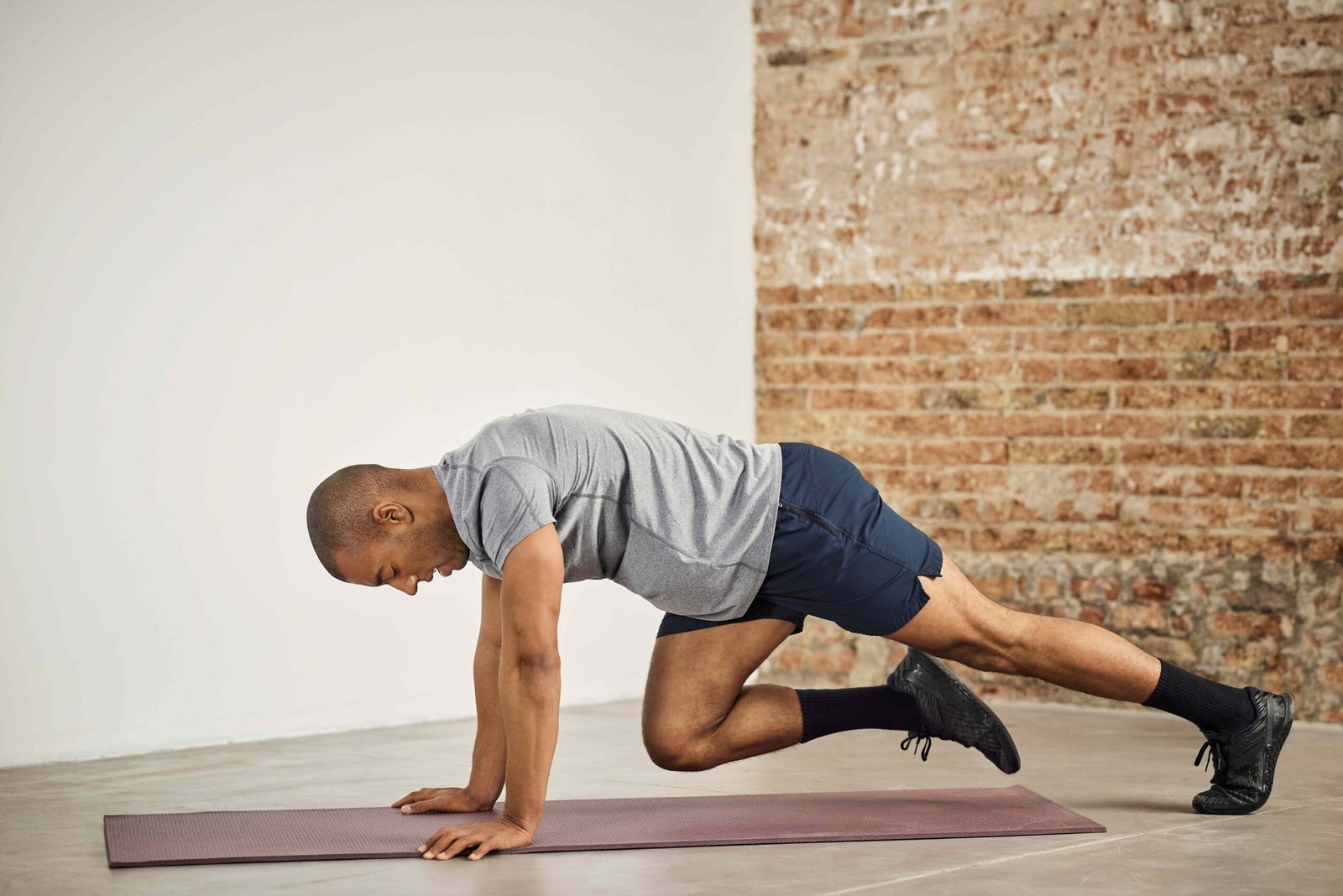
For this reason, the mountain climber is an excellent metabolism-revving option. After just a few reps, you’ll feel nearly every muscle in your body activate, from your forearms down to your calves.
Here’s how to do it:
- Start in a high plank position with your elbows and shoulders stacked over your wrists. Keep your neck neutral, back flat, and core engaged.
- Bend your right knee and draw it up toward your chest. Then, immediately straighten your knee and return to a plank position.
- Just as your right foot comes back to meet the left, quickly draw your left knee up toward your chest.
- Continue alternating your knees in a climbing motion while keeping your back flat and your hips extended. (Don’t pike at the waist.)
- Do as many mountain climbers as you can for 30 seconds, then rest for 30 seconds. Repeat for 8-10 minutes.
Because it’s dynamic, the kettlebell swing quickly elevates your heart rate and offers many of the same longer-lasting metabolism benefits you’d get from other go-to HIIT exercises.
But kettlebell swings also act as resistance training, which may have a positive effect on the body’s glucose, or blood sugar, metabolism in particular.
How to do it:
- Place a kettlebell on the ground and stand just behind it with your feet about hip-width apart.
- Keeping your back flat, hinge at your hips, push your glutes back, and grab the handle of the kettlebell with both hands.
- With straight arms, hike the kettlebell back between your legs.
- As the kettlebell swings forward, quickly thrust your hips and stand up. Allow the momentum of the movement to carry the kettlebell forward and up. (It may take a few swings for it to get up to shoulder height.)
- As the kettlebell drops, hinge at your hips, push your glutes back, and allow the kettlebell to swing back through your legs again. Repeat.
- Set a timer for 10 minutes. At the top of every minute, do 10-15 kettlebell swings and use the rest of the minute to rest.
The dumbbell thruster is a compound movement, meaning that it engages multiple joints and muscle groups.
Research shows that compound movements demand more oxygen consumption than single-joint movements, making them a smart choice for those looking to kickstart their metabolism—higher oxygen intake is linked with higher metabolism.
How to do it:
- Stand with your feet about hip-width apart and hold a pair of dumbbells in front of your shoulders, palms facing each other.
- Push your hips back, bend your knees, and lower into a squat.
- Push through the soles of your feet and extend your knees. As you return to a standing position, push the dumbbells directly overhead. Keep your core tight and avoid arching your back.
- To begin the next rep, lower the weights to your shoulders as you squat. Repeat.
- Do 2-3 sets of 10-12 reps.
Increasing muscle mass can improve your body’s metabolic functioning and help avoid obesity.
To make the most of your strength-training sessions, use heavy weights and perform lifts like the deadlift, which target larger muscle groups.
How to do it:
- Stand just behind a set of dumbbells (or other heavy weights) with your feet hip-width apart.
- Maintaining a flat back and an engaged core, hinge at the hips, push your hips back, and lower your torso. Bend your knees slightly.
- With straight arms and your palms facing in toward you, grab the dumbbells.
- Push your hips forward and squeeze your glutes as you stand up. The weights should be hanging down at your sides.
- Again, hinge at the hips, push your glutes back, and bend your knees slightly to lower the weights in front of your legs. Once you feel a deep stretch in the back of your thighs, stop.
- Push your hips forward and squeeze your glutes as you stand up.
- Repeat for a total of 8-12 reps. Do 2-3 sets.
Choosing the right exercise is important, but other factors can also impact your metabolism. It’s also important to:
- Prioritize sleep. Sleep won’t be able to boost metabolism, however, inadequate sleep can lead to weight gain and may make it harder for your body to process sugar. Aim for at least 7 hours of shut-eye each night.
- Increase your NEAT. When it comes to your metabolism, scheduled workouts are just part of the equation. Non-exercise activity thermogenesis (NEAT), or all the energy you burn doing everyday activities, also counts. Small efforts, or “exercise snacks” such as taking the stairs, add up throughout the day.
- Move after you eat. Studies indicate that a post-meal walk can support metabolism by helping to control blood sugar levels. Make a habit of going for a brief stroll after you clear the table.
