

Skip the machines, try these 5 seated moves to rebuild strong, stable shoulders.
Strong shoulders play a quiet but essential role in how your body moves each day. They support posture, guide arm motion, and protect your upper body during activities ranging from lifting objects to catching yourself after a stumble. After 50, shoulder strength becomes less about pushing heavier weights and more about preserving control, comfort, and confidence through every range of motion you use.
That’s where seated shoulder training earns its place. Working from a seated position reduces momentum and forces your shoulders to do the work. Free weights and resistance bands allow your arms to move naturally, encouraging stabilizers to engage and joints to track cleanly. This approach improves real-world strength while staying accessible, joint-friendly, and easy to perform at home or in a busy gym.
There’s also a practical reason seated work shines for this muscle group. The shoulders consist of several smaller muscles that work together to create smooth, powerful movement. Because of that structure, they respond best to consistent, controlled training rather than occasional high-effort sessions. Seated exercises make it easier to manage volume, maintain form, and train more frequently without beating up your joints.
Put it all together, and you get a smart, sustainable way to rebuild shoulder strength after 50. The five seated exercises below target every part of the shoulder complex, improve stability, and reinforce healthy movement patterns. Each one helps you stay strong overhead, confident with daily tasks, and capable for years to come.
Single-arm Seated Shoulder Press
This press builds pressing strength while keeping your core and shoulder stabilizers engaged. Training one arm at a time improves bilateral balance and exposes weaknesses that machines often mask. The seated position reduces momentum, keeping the focus on clean shoulder mechanics. Over time, this helps improve overhead control and confidence in daily lifting.
Muscles Trained: Anterior deltoids, medial deltoids, triceps, upper chest, and core stabilizers.
How to Do It:
- Sit tall on a bench or chair with your feet flat on the floor.
- Hold a dumbbell at shoulder height with your palm facing forward.
- Brace your core and keep your ribs down.
- Press the weight straight up until your arm reaches full extension.
- Lower under control back to shoulder height.
Recommended Sets and Reps: Perform 3 to 4 sets of 8 to 10 reps per arm. Rest for 45 to 60 seconds between sets.
Best Variations: Neutral grip press, tempo-controlled press, alternating reps
Form Tip: Press slightly back, not straight forward, to keep your shoulder joint stacked and strong.
Seated Lateral Raise
Lateral raises strengthen the medial deltoids, which give the shoulders width and support overhead movement. Performing them seated removes leg drive and keeps tension exactly where it belongs. This helps protect aging joints while still building shape and endurance. Consistent lateral raises improve shoulder symmetry and posture.
Muscles Trained: Medial deltoids, upper trapezius, and rotator cuff stabilizers.
How to Do It:
- Sit tall, holding dumbbells at your sides with palms facing inward.
- Slightly bend your elbows and brace your core.
- Raise the weights out to your sides until your arms reach shoulder height.
- Pause briefly at the top.
- Lower slowly back to your sides.
Recommended Sets and Reps: Perform 3 sets of 12 to 15 reps. Rest for 30 to 45 seconds between sets.
Best Variations: Partial reps, single-arm raises, extended tempo lowers
Form Tip: Lead with your elbows and keep the weights lighter than you think you need.
Seated Band Pull-aparts
Band pull-aparts strengthen the muscles that keep your shoulders aligned and pain-free. They target the often-neglected upper back and rear shoulder muscles that support posture and joint stability. Seated execution reinforces proper torso position and removes compensation. This move pairs well with pressing to keep shoulders balanced.
Muscles Trained: Rear deltoids, rhomboids, mid trapezius, and rotator cuff.
How to Do It:
- Sit upright, holding a resistance band at chest height.
- Keep your arms straight with a slight elbow bend.
- Pull the band apart by squeezing your shoulder blades together.
- Stop when your arms line up with your shoulders.
- Return slowly to the start position.
Recommended Sets and Reps: Perform 3 to 4 sets of 15 to 20 reps. Rest for 30 seconds between sets.
Best Variations: Overhead pull-aparts, pause reps, alternating grips
Form Tip: Pull your shoulder blades down and back instead of yanking the band.
Seated Cuban Press
The Cuban press develops shoulder strength through rotation, supporting long-term joint health. It improves coordination between the pressing muscles and the rotator cuff stabilizers. This exercise reinforces safe overhead mechanics while improving shoulder resilience. It works best with lighter weights and focused control.
Muscles Trained: Rotator cuff, anterior deltoids, medial deltoids, and upper back.
How to Do It:
- Sit tall, holding light dumbbells with elbows bent at your sides.
- Raise your elbows until your upper arms reach shoulder height.
- Rotate your forearms upward until the weights point toward the ceiling.
- Press the dumbbells overhead.
- Reverse the motion back to the start position.
Recommended Sets and Reps: Perform 2 to 3 sets of 6 to 8 reps. Rest for 60 seconds between sets.
Best Variations: Pause rotations, band Cuban press, segmented reps
Form Tip: Use light weight and move with control through every phase of the lift.
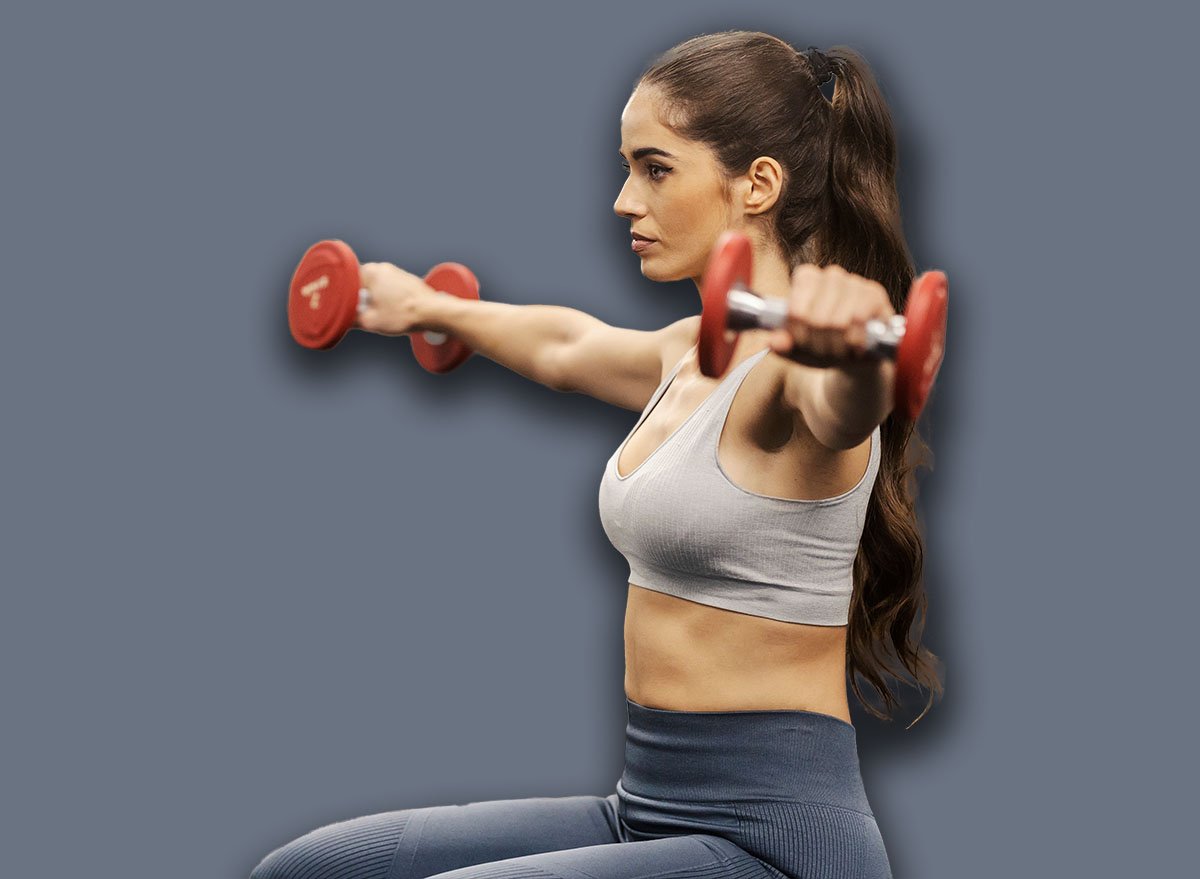
Seated Front Raise
Front raises strengthen the anterior deltoids, which assist with lifting and reaching tasks. The seated position limits momentum and improves muscle activation. This exercise also supports pressing strength and shoulder endurance. When done with control, it reinforces healthy shoulder mechanics.
Muscles Trained: Anterior deltoids, upper chest, and core stabilizers.
How to Do It:
- Sit tall, holding dumbbells in front of your thighs.
- Brace your core and keep your arms slightly bent.
- Raise the weights straight forward to shoulder height.
- Pause briefly at the top.
- Lower slowly back to the start.
Recommended Sets and Reps: Perform 3 sets of 10 to 12 reps. Rest for 45 seconds between sets.
Best Variations: Alternating raises, plate front raises, tempo reps
Form Tip: Lift with control and avoid swinging the weights upward.
The Best Tips for Building Shoulder Strength After 50
Shutterstock
Strong shoulders come from consistent training, not just harder training. Consistency, exercise selection, and recovery matter more as joints age. These strategies help you build strength while keeping your shoulders feeling good.
- Train shoulders two to three times per week: Frequent, moderate sessions support strength gains without excessive soreness.
- Pair presses with pulling work: Balancing pushing and pulling keeps shoulders aligned and reduces irritation.
- Control your tempo: Slower lowering phases increase muscle tension and improve joint awareness.
- Prioritize range of motion: Move through comfortable, pain-free ranges to maintain shoulder mobility and strength.
- Warm up intentionally: Light band work before lifting improves blood flow and joint readiness.
References
- Choi, Seok-Hwa, and Byoung-Hee Lee. “Clinical Usefulness of Shoulder Stability Exercises for Middle-aged Women.” Journal of physical therapy science vol. 25,10 (2013): 1243-6. doi:10.1589/jpts.25.1243
