

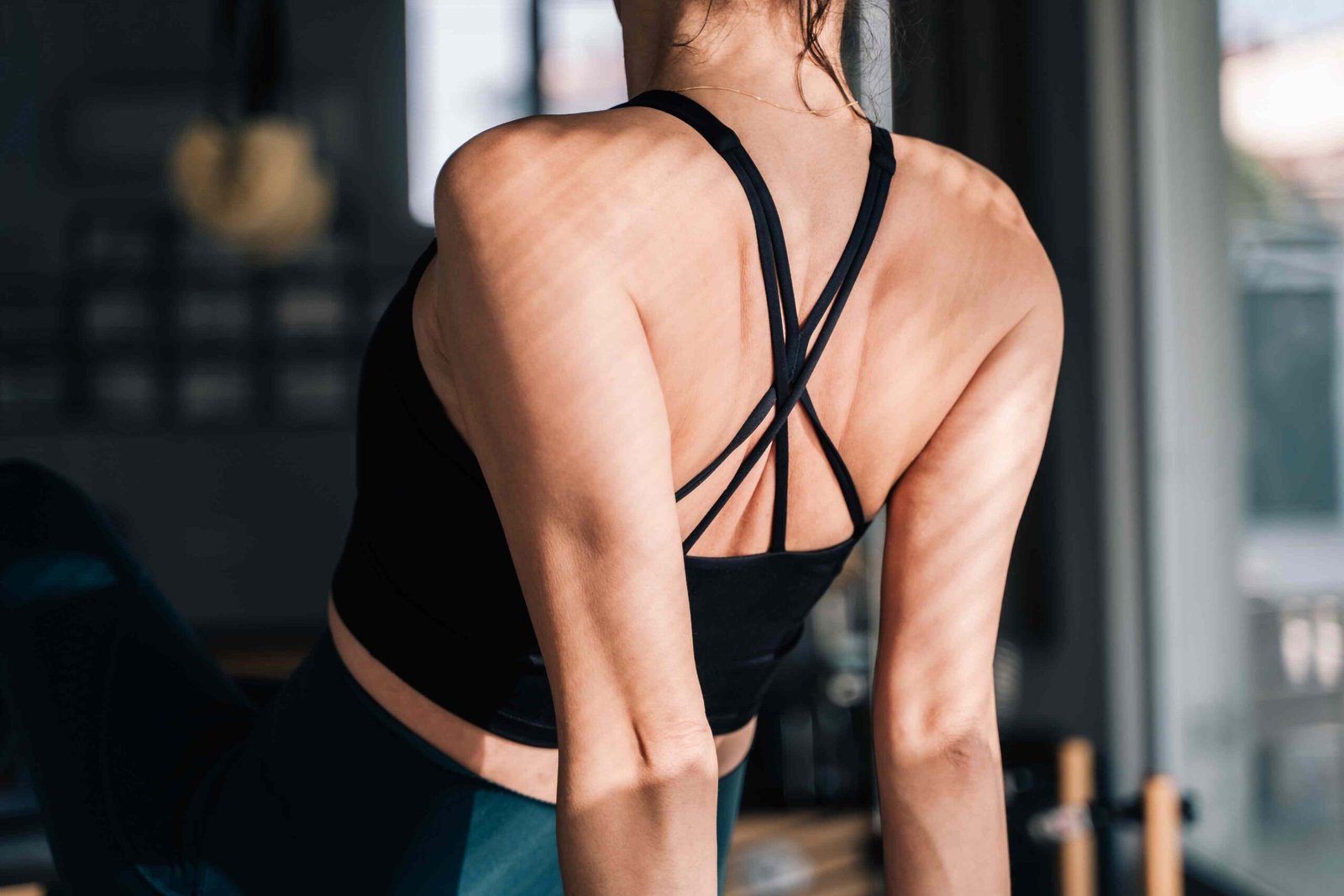
There are a wide variety of exercises you can implement to target the back.
A staple posterior chain (backside of the body) exercise, deadlifts target your erectors, lats, rhomboids, and traps, along with your glutes and hamstrings as well. While you can do them with a barbell, using a kettlebell is a bit more intuitive for getting the hinging pattern down.
- Stand with your feet hip-width apart, with the kettlebell between your feet.
- Brace your core and bend at the hips and knees simultaneously to grab the kettlebell with both hands.
- Keeping your core tight and back neutral, push through your midfoot as you lift the weight by extending your hips and knees.
- Lock your hips out at the top without overextending and stand tall with your shoulders in line with your pelvis.
- Slowly reverse the direction, completing subsequent reps.
The lat pulldown is a vertical pulling movement that develops the latissimus dorsi muscles, which are important for posture and shoulder stability. Well-developed lats help prevent rounding of the shoulders and also help to prevent injuries by supporting the humerus (upper arm bone) during movement.
- Sit at the lat pulldown cable machine and adjust the knee pad to secure your legs.
- Now, grip the bar with your hands slightly wider than shoulder-width.
- Lean back slightly, point your collarbone up toward the ceiling, engage your core, and pull the bar down toward your chest, squeezing your shoulder blades together at the bottom.
- Return the weight back to the top with control, feeling your lat muscles engage through the eccentric portion of the exercise.
This horizontal pulling exercise effectively targets your mid-back, rhomboids, and traps, all of which contribute to improved posture and a balanced back. Make sure to avoid rounding your shoulders forward when you row to keep the tension on your back muscles.
- Attach a handle to the rowing machine, any will do, and grab it, keeping your arms extended and back straight.
- Engage your core and pull the handles towards your torso, squeezing your shoulder blades together, and then slowly return to the starting position with control.
- Complete several reps and sets through, using a weight setting that’s appropriately heavy.
Another horizontal pulling variation, the dumbbell row, challenges your single arm strength and stability and helps to correct any strength discrepancies between each side. By working each side individually, you can ensure you develop more balanced strength.
- Grab a bench and place your left hand and your left knee on it as well.
- Now, move your right leg out to the side and hold a dumbbell with your right hand, letting it hang toward the floor.
- Brace your core and pull the dumbbell towards your torso, making sure to keep your elbow close to your body.
- Squeeze behind your shoulder blades at the top of the movement and lower the weight with control back to the starting position.
- Complete all your reps on one side before switching to the other.
Though more advanced than other vertical pulling exercises, the pull-up is a staple exercise that targets your whole back. This movement can be particularly challenging to learn at first and requires quite a bit of upper body strength, so you might want to add some assistance while you build strength to do a full pull-up.
You can use an assisted pull-up machine if you’re at the gym, or hang a strong resistance band around the pull-up bar with your knees through it, which acts as a ‘sling shot’ to help boost you while you pull yourself up.
- If you’re using any assist, put your knees on the pad or through the resistance band first. Now, grab the pull-up bar with your hands slightly wider than shoulder-width, palms facing away from you.
- Hang from the bar with your arms fully extended and engage your core.
- Then, in one fluid motion, pull your chin over the bar by retracting your shoulder blades and using your arms while you point your collarbone toward the ceiling and look up slightly.
- Slowly lower your body back down to the starting position with control and complete more reps until you fatigue, but make sure your form stays consistent.
- Improved posture: Strengthening your back helps align the spine and pull the shoulders back, reducing slouching and promoting a more confident, upright stance.
- Enhanced overall strength: Training your back muscles supports your body during various movements, improving performance in physical activities.
- Better ability to perform daily activities: A strong back aids in tasks like picking items off the floor, carrying groceries, and completing household chores.
- Reduced risk of spinal injury: Strengthening the back—especially the vulnerable lower back—helps protect against injury and pathology.
- Focus on form: Ensures you’re targeting the correct muscles and minimizes the risk of injury.
- Prioritize technique over weight: Emphasize proper movement mechanics before increasing load, and progress gradually as sets and reps become easier.
- Set personal goals: Helps keep you accountable and motivates you to strive for continuous improvement.
