

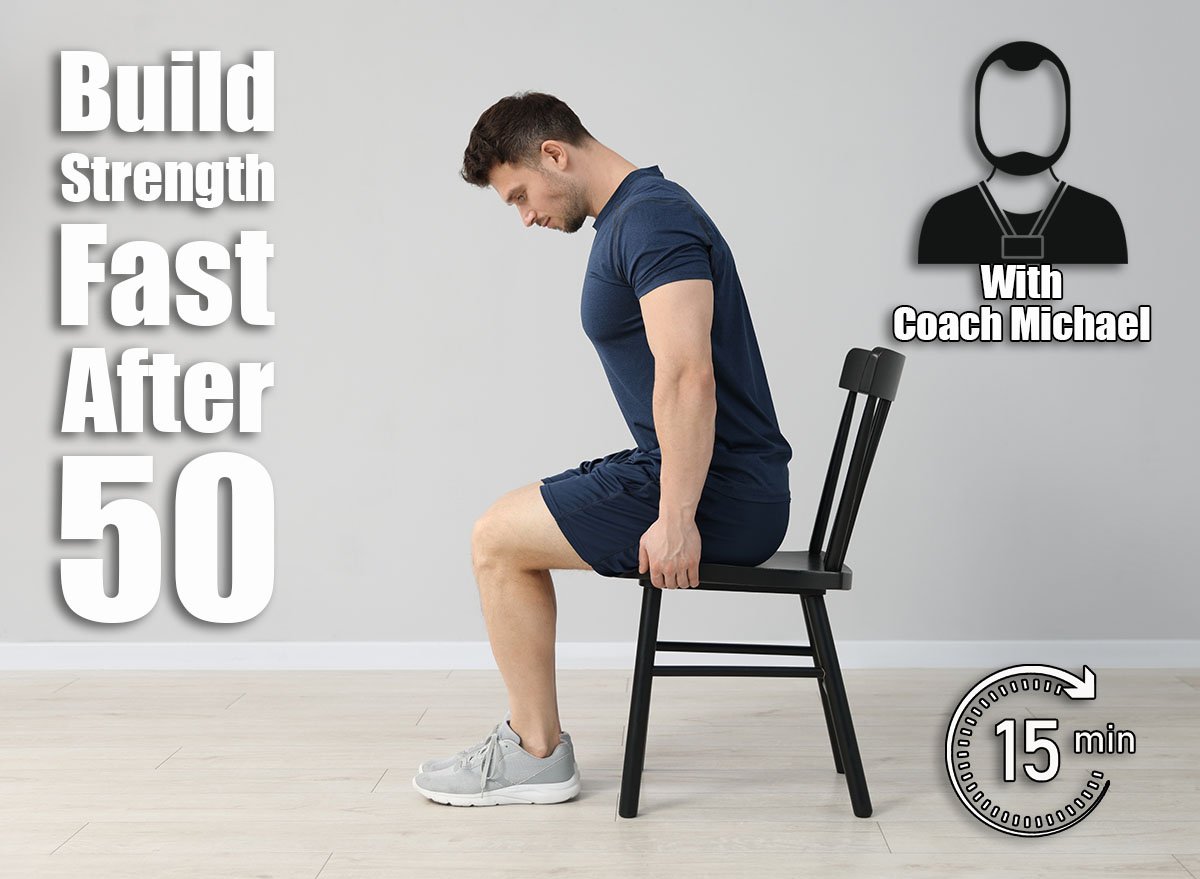
Getting up from a restaurant chair without using your hands shouldn’t feel like a challenge, yet it’s one of the most common struggles people face after 50. While you might be able to walk for miles, simple movements like standing from low seats or reaching overhead can become surprisingly difficult as functional strength quietly disappears.
I’ve been in the fitness industry for almost 4 decades and I completed my personal training certification over 35 years ago. I’ve worked with thousands of people over 50 and I see the same strength issues come up time and again. Chair exercises are often overlooked and some people look down on them but they are by far, one of the most effective ways to start rebuilding functional strength that carries over into daily life. Here’s how five simple chair exercises can rebuild the strength you need for daily independence and confidence.
The Strength Challenges You’re Probably Facing
Shutterstock
By far the most common issue I see is the ability to easily get out of chairs, especially low ones or soft sofas. People who have lost strength in their legs start to use their arms to push themselves up. Clients who are otherwise active can still struggle with this – they might have the ability to walk for miles but have problems standing up from a restaurant chair without using their hands.
Core strength disappears faster than people realise. Not the six-pack abs kind, but the deep stabilising muscles that keep your spine supported when you bend, lift, or even just stand for extended periods. This shows up as back pain during simple tasks like loading the dishwasher or reaching into high cupboards.
Upper body strength drops dramatically, especially in the pulling muscles. Opening jars becomes impossible, carrying shopping bags hurts, and lifting anything overhead feels risky. Women lose this strength faster than men because they typically start with less muscle mass.
The real problem is that people don’t notice these changes happening gradually. They adapt by avoiding certain movements, asking for help more often, or just accepting that this is what getting older means. But it doesn’t have to be.
Why Chair Exercises Actually Work Better Than You Think
Shutterstock
Chair exercises work because they meet people exactly where they are. If you can’t get down on the floor safely or your balance isn’t great, the chair provides stability while still allowing you to work your muscles hard enough to get stronger.
The chair acts as a training tool, not a crutch. For leg strength, sitting down and standing up repeatedly is one of the best functional exercises you can do – it directly trains the exact movement pattern that most people struggle with. You can make it harder by going slower, adding pauses, or eventually using just one leg.
For upper body work, the chair gives you a stable base to push or pull against. This is actually better than some gym machines because your core has to work to keep you stable. A seated row using resistance bands trains your pulling muscles while your core works to keep you upright.
What makes chair exercises particularly effective for this age group is that you can progress them gradually. Start with assistance, then work towards independence, then add difficulty. The movement patterns transfer directly to daily activities.
5 Chair Exercises That Build Strength After 50
Chair Stands (Sit to Stand)
This builds serious strength because it targets your quadriceps, glutes, and core using your full body weight as resistance. These are the exact muscles you need for getting up from any seat, climbing stairs, and maintaining independence.
How to do it:
- Sit in a sturdy chair with feet flat on the floor, hip-width apart.
- Cross arms over chest.
- Lean forward slightly, then push through your heels to stand up completely.
- Lower back down with control – don’t just drop into the chair.
- Do this 3-4 times per week, starting with 8-10 repetitions for 2-3 sets.
For beginners: Place a cushion on the chair to make it higher, or use your hands on the armrests for assistance. As you get stronger, remove the cushion or reduce hand assistance.
Mistakes to avoid: Don’t let your knees cave inward, don’t use momentum to rock yourself up, and don’t lean too far back when sitting down. Keep the movement controlled and deliberate.
Seated Rows with Resistance Band
This builds the pulling strength that most people lose first – your mid-traps, rhomboids, and rear deltoids. These muscles are needed for good posture, pulling doors open, and lifting objects toward your body.
How to do it:
- Sit tall with a resistance band looped around your feet (or tied to something sturdy in front of you).
- Hold the handles with arms extended.
- Pull your elbows back, squeezing your shoulder blades together.
- Slowly return to start.
- Do this 2-3 times per week, 10-15 repetitions for 2-3 sets.
For beginners: Use a lighter resistance band or pull with less range of motion. Focus on feeling the muscles between your shoulder blades working.
Mistakes to avoid: Don’t round your shoulders forward, don’t use your arms only (the power should come from your back muscles), and don’t let the band snap back – control the return phase.
Seated Chest Press with Resistance Band
This strengthens your chest, shoulders, and triceps – the pushing muscles you need for opening heavy doors, pushing yourself up from bed, and general upper body power.
How to do it:
- Loop the band behind the chair back at chest height.
- Hold handles with arms at 90 degrees, elbows level with shoulders.
- Press forward until arms are straight, then return with control.
- Do this 2-3 times per week, 10-12 repetitions for 2-3 sets.
For beginners: Use a lighter band or don’t press out as far. Focus on keeping your back against the chair for support.
Mistakes to avoid: Don’t let your shoulders roll forward, don’t press too high (keep elbows at shoulder level), and don’t hold your breath during the movement.
Seated Leg Extensions
This strengthens your chest, shoulders, and triceps – the pushing muscles you need for opening heavy doors, pushing yourself up from bed, and general upper body power.
How to do it:
- Sit tall with your back against the chair.
- Slowly straighten one leg until it’s parallel to the floor, hold for 2 seconds, then lower with control.
- Alternate legs or do one leg at a time. Do this 3 times per week, 8-12 per leg for 2-3 sets.
- This targets your quadriceps individually, helping to correct imbalances between legs.
- Strong quads are essential for stair climbing, standing from chairs, and knee stability.
For beginners: Don’t lift as high – even straightening your leg halfway will work the muscle. Hold the sides of the chair for stability.
Mistakes to avoid: Don’t swing your leg up using momentum, don’t lock your knee aggressively at the top, and don’t let your back arch away from the chair.
Seated Overhead Press
This builds shoulder and arm strength needed for reaching high shelves, putting items in overhead bins, and general upper body power. The seated position allows you to focus on the arms without worrying about balance.
How to do it:
- Sit with a resistance band under your feet, holding handles at shoulder height.
- Press straight up overhead until arms are fully extended, then lower with control.
- Do this 2-3 times per week, 8-10 repetitions for 2-3 sets.
For beginners: Use a lighter band or press only halfway up. The key is controlled movement, not how high you go.
Mistakes to avoid: Don’t arch your back excessively, don’t press the handles forward (they should go straight up), and don’t let your shoulders hunch up toward your ears.
How to Schedule Your Weekly Workouts
Shutterstock
Start with 3 days per week, with at least one day of rest between sessions. Your muscles need time to recover and adapt – this is when they actually get stronger. Monday, Wednesday, Friday works well for most people.
Do all 5 exercises in each session, but start with just one set of each for the first week. Add a second set in week two, and a third set by week four (if you feel ready). The whole session should take 15-20 minutes.
Listen to your body. Some muscle soreness 24-48 hours after exercise is normal, but sharp pain or soreness that lasts more than 3 days means you need more recovery time. It’s better to do less consistently than to overdo it and have to stop.
After 4-6 weeks, you can increase to 4 days per week if you want faster progress, but 3 days consistently will give you significant strength gains.
The Foods That Speed Up Your Strength Gains
Shutterstock
Protein becomes more important as we age because our bodies become less efficient at using it to build and maintain muscle. Aim for 20-30 grams of protein at each meal – that’s about the size of your palm worth of meat, fish, or chicken.
Eggs are perfect for this age group because they contain all the amino acids your muscles need to repair and grow. Greek yogurt, cottage cheese, and protein powders are easy ways to boost intake if you struggle to eat enough meat.
Don’t forget carbohydrates – your muscles need fuel for your workouts and recovery. Sweet potatoes, oats, and brown rice provide steady energy without blood sugar spikes.
Vitamin D is often deficient in people over 50 and it’s needed for muscle function. Most people need a supplement, especially in winter. Omega-3 fatty acids from fish or supplements help reduce exercise-related inflammation.
Timing matters too. Try to eat some protein within 2 hours of your workout – this is when your muscles are most ready to use it for repair and growth.
What Results You Can Expect in Just 6-8 Weeks
Shutterstock
The improvements in the first 6-8 weeks are often dramatic because much of your initial weakness isn’t actually lost muscle – it’s your nervous system forgetting how to coordinate movement efficiently.
Most of my clients can do 2-3 more chair stands by week 3, and by week 6 they’re doing them without using their hands at all. This represents a huge gain in functional strength and independence.
Upper body strength typically improves 20-30% in the first 8 weeks. Someone who struggled to lift a 5-pound bag over their head might be able to handle 8-10 pounds comfortably.
The real changes you’ll notice: getting up from chairs becomes automatic again, you’ll stop avoiding low seats, stairs won’t leave you breathless, and you’ll feel more confident moving around. These quality of life improvements often happen within the first 3-4 weeks.
After 8 weeks, you’ll have built a solid foundation. The rate of improvement slows down but doesn’t stop – people who stick with it for 6 months often surprise themselves with how much stronger they become than they ever thought possible.
Looking for more easy ways to lose fat? Here’s How Long Your Walking Workout Should Be To Shrink Belly Fat.
