

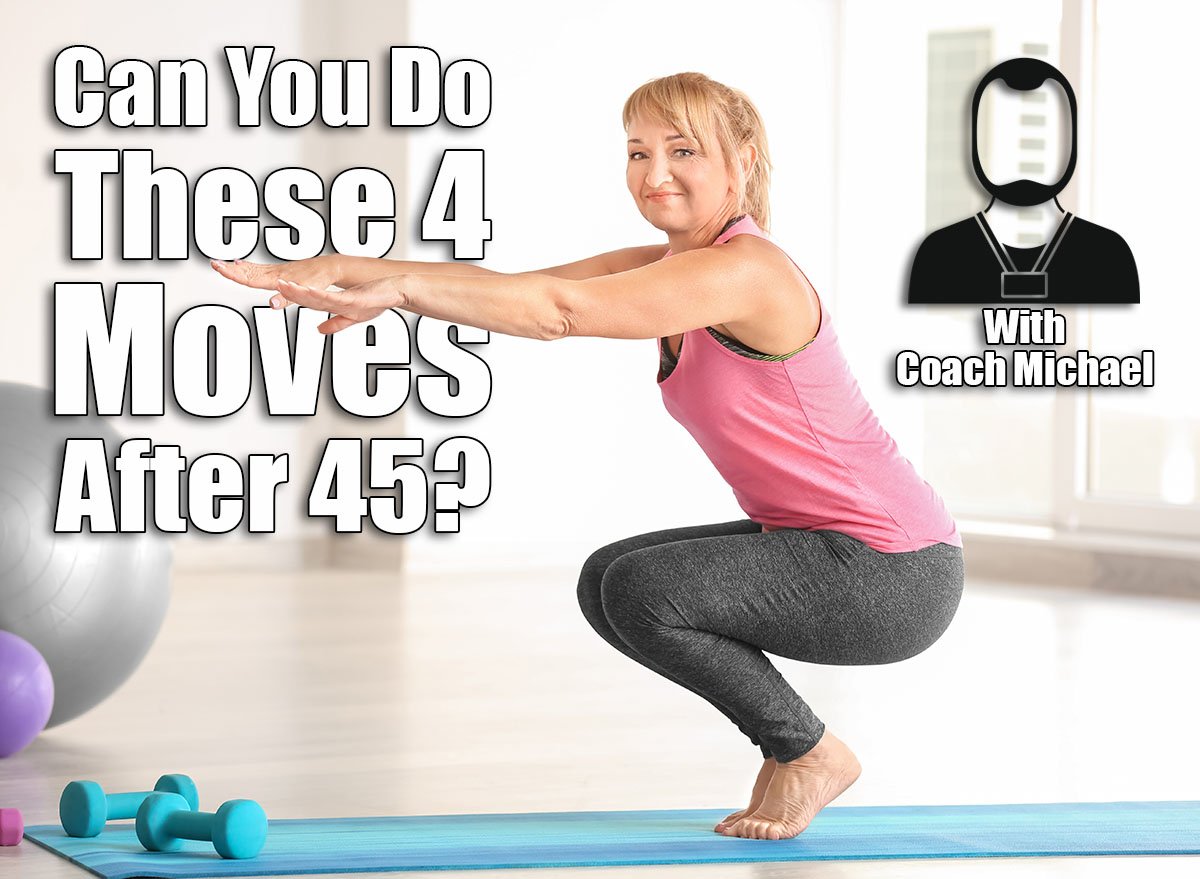
Getting older is painful; you pull your shoulder twisting to get something from the back seat of your car, you hurt your back with a violent sneeze and where you used to wake up ready to go, now you feel like your joints don’t wake up until 30 minutes after you do. Unfortunately, it’s not uncommon and after over 3 decades as a personal trainer and fitness educator, I see issues in around 80% of clients as they approach 50. The good news? These aren’t inevitable consequences of aging—they’re warning signs that can be reversed with the right approach. Here are four simple movement tests that reveal whether your joints are aging faster than they should, plus the exact steps to turn back the clock.
The Most Common Joint Problems Hit in This Specific Order
Shutterstock
I’ve been a personal trainer for over thirty years, and for older adults, the pattern is clear: People over 45 tend to struggle with their hips first, then their shoulders, then their knees, and finally their lower back. There’s a good reason for all of these. Our hips lose mobility from sitting too much, our shoulders get tight from years of desk work or poor posture (or a combination of the two), our knees suffer from imbalances that have compounded issues over the years, and the lower back compensates for everything else that’s going wrong.
This changed everything about how I assess a client’s movement. Rather than looking at isolated joints, I started looking at how the whole body works together. If someone can’t touch their toes, I’m not just looking at their hamstring flexibility; I’m looking at their hip-hinge, whether their spine is neutral, and how their knees track. The human body is fantastic at hiding problems by compensating somewhere else, so single-joint tests often miss the true story.
One thing that’s incredibly revealing is that the people who regularly exercise often have worse movement than those who are sedentary, but have maintained basic mobility. Years upon years of incorrect training patterns, pushing through injuries and pain, and never addressing fundamental movement problems create bodies that are strong, but don’t work properly. This is why when I complete an assessment, I focus on movement quality over performance metrics.
4 Movements That Reveal If Your Joints Are Aging Too Fast
The Deep Squat Reveals Everything About Your Lower Body
The deep squat tells you everything about your hips, ankles and spine working together.
- Stand with feet slightly wider than shoulder width
- Turn your toes out about 30 degrees
- Lower yourself down slowly while keeping your chest up
- Distribute your weight evenly across your feet
- Go as low as you can while keeping your heels flat on the ground
- Aim to get your hips below your knees with heels down
- Hold the position for 30 seconds if possible
- Keep your knees tracking over your toes throughout the movement
- The movement should feel comfortable with no pain
- You should be able to sit comfortably in a full squat position
- If you can’t get your hips below parallel, this indicates joint problems
- If you need to lift your heels or feel pinching in hips or knees, this shows accelerated joint wear
- This test reveals ankle mobility, hip flexibility, knee tracking, and spinal control issues
- Most 45-year-olds should manage this easily
- If you can’t perform this movement properly, your joints are aging faster than they should
- Poor performance suggests you’re aging like someone 10-15 years older
The Overhead Reach Exposes Hidden Shoulder Problems
The overhead reach reveals shoulder and thoracic spine health.
- Stand with your back against a wall, feet about six inches away from it
- Press your lower back flat against the wall
- Raise both arms overhead with straight arms
- Try to touch the wall behind you while keeping your lower back pressed flat
- Your shoulders should move freely without your back arching
- The overhead reach should feel effortless and smooth, not forced or painful
- Both arms should touch the wall behind you while your lower back stays flat
- If there’s a gap between your arms and the wall bigger than your fist, this indicates problems
- If you have to arch your back to reach the wall, this also indicates problems
- Poor performance exposes shoulder impingement and frozen shoulder precursors
- Limited mobility reveals thoracic spine stiffness from poor posture
- Difficulty with this movement suggests your shoulders and upper spine have aged prematurely
- This movement should feel smooth, not forced or painful.
The Single-Leg Stand Predicts Your Fall Risk
The single-leg stand tests your hip stability and proprioception – your body’s awareness in space.
- Stand on one foot with the other knee bent at 90 degrees
- Keep your arms relaxed at your sides
- Hold the position for 30 seconds without wobbling
- Avoid putting your raised foot down during the test
- Don’t use your arms for balance
- Switch legs and repeat the test
- The test should feel boring, not challenging if your balance is good
- Aim for minimal sway, no foot adjustments, and no arm movements
- If you can’t hold the position for 20 seconds or need multiple attempts, your neuromuscular system may be declining faster than normal
- Inability to hold for 10 seconds doubles mortality risk over the next decade according to research
- Poor performance reveals hip weakness, ankle instability, and nervous system decline
- These issues accelerate fall risk as you age
Your Spinal Rotation Shows How Well You Move in Daily Life
The seated rotation shows spinal mobility and core control.
- Sit on the floor with legs straight out in front of you
- Cross your arms over your chest
- Rotate your entire torso to look behind you, going as far as you can without using momentum
- Keep your hips from shifting during the rotation
- Return to center and rotate the other direction
- Aim for at least 45 degrees of rotation in each direction without hip movement
- Optimal range is 60-80 degrees of pure spinal rotation in each direction
- Most people over 45 only achieve 30-40 degrees and compensate by moving their hips
- Limited rotation indicates spinal stiffness and core weakness that can lead to back pain and injury
- If you can’t look directly behind you without your whole body shifting, your spine has lost critical mobility needed for daily activities.
What Failing These Tests Really Means for Your Future
Shutterstock
Failing these movements means your body has already started the compensation patterns that accelerate aging. When you can’t deep squat, your body stops using your glutes properly, overloading your knees and lower back with every step. Poor overhead reach means your shoulders are heading toward impingement, frozen shoulder, or rotator cuff tears – not if, but when.
The single-leg stand failure is particularly concerning. Poor balance predicts falls, and falls after 50 often mark the beginning of a serious decline. One bad fall can trigger a cascade – fear of falling leads to less movement, less movement causes muscle loss, and muscle loss increases fall risk. It’s a vicious cycle that turns active adults into frail elderly seemingly overnight.
Limited rotation affects everything you do. Getting out of the car, checking blind spots while driving, and reaching for things behind you – these become increasingly difficult and dangerous. Your body compensates by moving your whole body instead of just rotating, which strains your back and hips. This is why so many people throw their back out doing simple tasks.
The real concern isn’t today’s limitations – it’s the trajectory. Joint problems compound exponentially. What’s mildly uncomfortable at 45 becomes limiting at 55 and disabling by 65. But here’s the thing, most people don’t realise – these aren’t inevitable consequences of aging. They’re consequences of neglecting basic movement patterns.
The Exact Exercises That Reverse Joint Aging
Shutterstock
Start with wall sits for the deep squat. Stand with your back against a wall, slide down until your thighs are parallel to the floor, and hold for 20-30 seconds. Do this three times daily. Once you can hold for a minute, progress to goblet squats with a light weight. Hold the weight at chest height, squat down slowly, pause at the bottom, and stand up. This rebuilds the squat pattern while strengthening the exact muscles you need.
For shoulder mobility, doorway stretches work brilliantly. Stand in a doorway, place your forearm against the frame with your elbow at 90 degrees, step forward until you feel a stretch across your chest. Hold 30 seconds, three times each side, twice daily. Combine this with band pull-aparts – hold a resistance band at shoulder height, pull it apart by squeezing your shoulder blades together. Three sets of 15 reps daily.
Balance training starts simple. Stand on one foot while brushing your teeth. Progress to standing on one foot with eyes closed for 10 seconds. Then try single-leg Romanian deadlifts – stand on one leg, hinge at the hip while extending the other leg behind you, return to standing. Start with no weight, add light dumbbells as you improve. Three sets of 8 per leg.
Restore rotation with seated twists using a resistance band. Anchor a band at chest height, sit sideways to it, hold the band with both hands and rotate away from the anchor point. Control the movement in both directions. Three sets of 12 each side. Also practice cat-cow stretches – on hands and knees, arch and round your spine slowly. Twenty reps, twice daily.
The secret is doing these exercises daily, not intensely. Joint mobility responds to frequency, not intensity. Five minutes every day beats an hour once a week.
Your Timeline for Seeing Real Improvements
Shutterstock
Test these four movements weekly, but practice the corrective exercises daily. Your joints need consistent input to change their movement patterns. Think of it like learning a language – daily practice creates fluency, weekly practice maintains what you have.
Most people see noticeable improvements within two weeks. The single-leg stand improves fastest – your nervous system adapts quickly when challenged properly. Balance improvements often double in the first month. Shoulder mobility takes 3-4 weeks of consistent work before you feel real change. The shoulders have been stuck in poor positions for years, they need gentle, persistent coaxing.
Deep squat improvements vary wildly. If ankle mobility is your limiting factor, you might gain full range in 4-6 weeks. Hip restrictions take longer – expect 8-12 weeks of daily work. Some people need six months to achieve a comfortable deep squat, especially if they’ve avoided the position for decades.
Spinal rotation improves steadily but slowly. Each week you might gain 2-3 degrees of rotation. After eight weeks, most people have gained 15-20 degrees each direction. The key is not forcing it – forced rotation damages discs. Gentle, consistent practice lets your spine remember how to move safely.
The timeline that matters most is this: every week you don’t address these issues, recovery takes longer. A 45-year-old might restore full movement in three months. A 55-year-old with the same restrictions might need six months. By 65, some movement patterns become nearly impossible to fully restore. Start now, be patient, stay consistent. Your future self will thank you.
Looking for more easy ways to lose fat? Here’s How Long Your Walking Workout Should Be To Shrink Belly Fat.
